Europe’s 2026 review of its Emissions Trading System will decide whether carbon pricing can expand without weakening the emissions cuts it was created to deliver.
For African airlines, ports, exporters, waste authorities and carbon-project developers, the lesson is immediate: market access will increasingly depend on measurable climate performance, credible safeguards and investment signals that reward real abatement.
Europe’s Carbon Market Faces Its Endgame
The European Union is entering a decisive review of its Emissions Trading System, with the mid-2026 process expected to shape how the bloc prices pollution on the road to its 2040 climate target and net zero by 2050.
- The central question is no longer whether carbon markets can cut emissions.
- It is whether they can absorb new technologies and sectors without creating cheaper routes around direct decarbonisation.
Clean Air Task Force argues that permanent removals, aviation, shipping, municipal waste and non-permanent carbon utilisation must be taken as connected design choices.
A weak rule in one part of the market can shift emissions, costs or investment elsewhere, leaving the headline cap intact while real-world climate performance deteriorates.
That matters beyond Europe. African economies are linked to the EU through aviation, maritime trade, industrial exports, waste technologies and an emerging carbon-removal market.
The review therefore offers a governance test for any country hoping to use carbon pricing without sacrificing environmental integrity, development priorities or public trust.
Removals Could Reset Carbon Market Integrity
The most consequential proposal is the gradual integration of permanent carbon removals into a system built around reducing emissions.
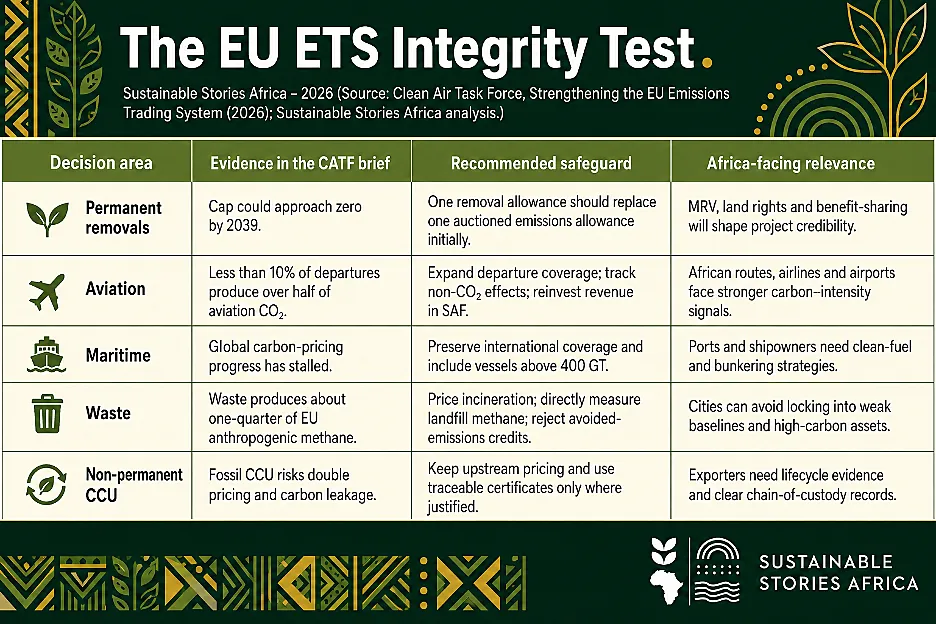
Under the current linear reduction factor, the EU ETS cap could approach zero as early as 2039.
That creates an endgame problem: a thinner supply of allowances could increase price volatility, reduce market liquidity and make residual emissions in hard-to-abate sectors progressively more expensive.
Permanent removals such as direct air carbon capture and storage and biogenic carbon capture and storage could sustain traded volumes and help neutralise residual emissions.
However, CATF warns that poorly designed access could allow companies to buy their way out, rather than cutting gross emissions.
Its proposed guardrail is deliberately strict: for every removal allowance entering the market during initial integration, one fewer traditional emissions allowance should be auctioned.
The report also calls for supply controls, differentiated allowances, robust permanence and monitoring rules, and a formal review within two years of a revised directive taking effect.
Temporary removals and biochar should not be admitted before their permanence, biomass demand and market effects are fully tested.
The principle is clear: removals should complement abatement, not become an accounting substitute for it.
Aviation Exposes The System’s Hardest Gaps
Aviation illustrates why system boundaries matter. Long-haul flights account for less than 10% of departures but over half of aviation emissions, a share CATF projects could reach 56% by 2050.
However, extra-EEA flights remain outside the EU ETS. Pricing all departing-flight emissions from 2012 to 2023 could have raised about €41 billion for cleaner fuels and transition measures.
CO2 is only part of aviation's footprint.
Contrails can generate warming comparable to flight CO2 over shorter timeframes, with 80% of that warming linked to just 2% of flights.
Google and American Airlines tests found rerouting 3% – 5% of flights, using roughly 2% more fuel, cut contrail warming by 54%.
CATF backs full non-CO2 monitoring, contrail-avoidance incentives and a data-driven polluter-pays mechanism.
Sustainable aviation fuel support tests policy consistency further. Up to 20 million allowances reserved through 2030 cover up to 95% of the price gap for renewable fuels and 70% for advanced biofuels.
CATF wants this extended beyond 2030 to ensure removals don't divert investment from synthetic and advanced biofuels.
Stronger Prices Could Accelerate Real Investment
A more coherent ETS could turn compliance revenue into industrial investment.
- CATF recommends preserving maritime coverage while extending the system to vessels above 400 gross tonnage, including offshore ships.
Shorter and more predictable routes may be particularly suitable for electrification, hybrid systems, hydrogen, ammonia and other scalable low-carbon options.
- For African ports and shipping companies serving Europe, this is a signal to align fleet, fuel and bunkering plans with the carbon intensity of trade corridors.
Waste pricing could also change technology choices.
The EU waste sector produces approximately one-quarter of the bloc’s anthropogenic methane emissions.
CATF proposes full-auction coverage for municipal waste incineration, no credits for supposedly avoided landfill emissions, and measurement-based monitoring and third-party verification for landfill methane.
The aim is to make prevention, diversion, recycling, composting and verified methane capture more attractive than unpriced disposal.
For African cities considering waste-to-energy projects, the opportunity is not to copy Europe’s infrastructure sequence.
It is to adopt the integrity lesson early: measure actual landfill methane, protect waste pickers and communities, test lifecycle emissions, and avoid financial structures that reward burning recyclable or organic material simply because a hypothetical landfill baseline looks worse.
Safeguards Must Travel Across Connected Markets
Governments and regulators should treat the EU review as a template for connected-market due diligence.
- Carbon-removal rules need separate reduction and removal targets, transparent allowance types, lifecycle accounting, long-duration storage standards and liability arrangements for reversal.
- Public procurement, reverse auctions and carbon contracts for difference can bridge early cost gaps without weakening the carbon price faced by emitters.
Airlines and airports;
- Should build non-CO₂ monitoring into flight planning, develop sustainable-fuel procurement strategies and assess how an expanded departure-based EU charge would affect African routes.
Ports, shipowners and fuel suppliers;
- Should map vessel exposure, clean-fuel availability and infrastructure needs. Municipal authorities should establish facility-level methane baselines before selecting incineration, landfill-gas or organics-management investments.
African carbon-market authorities should also recognise the report’s implicit warning.
Demand from a larger compliance system can attract capital; however, it can also intensify pressure on land, biomass and communities.
High-integrity African projects will need credible monitoring, clear land rights, benefit-sharing, safeguards against double counting and proof that removals do not delay domestic emissions reductions.
Those conditions are not administrative burdens; they are the foundation of durable market value.
Path Forward – Integrity Must Lead the Next Phase
The EU should expand its carbon market only where measurement, enforcement and investment incentives can preserve real emissions cuts.
Permanent removals, international aviation, shipping and waste all require differentiated rules rather than a single carbon price.
African institutions should prepare now by strengthening MRV, lifecycle analysis and community safeguards across connected value chains.
The strongest market signal will be one that rewards verifiable transition, protects development priorities and makes low-carbon investment more bankable than pollution.