Nigeria named 31 winning bidders for 37 upstream blocks in July 2026; however, selection does not equal the receipt of a Petroleum Prospecting Licence (PPL).
The real story is the obligation stack behind each award: work commitments, guarantees, fiscal exposure, environmental duties, host-community obligations, infrastructure access, regulatory consents and a long path from exploration title to producing asset.
Winning Blocks Do Not Mean Ownership
Nigeria’s 2025 Licensing Round attracted 200 bids from 143 companies for 37 of the 50 blocks offered, while 13 blocks received no bids.
On 21 July 2026, the Nigerian Upstream Petroleum Regulatory Commission announced 31 winning bidders.
The result signals appetite for selected acreage across onshore, shallow-water, deep-offshore and frontier basins, but it does not complete the award process.
Udo Udoma & Belo-Osagie’s review makes the legal distinction explicit.
- A winning bidder must still satisfy post-offer conditions, pay the applicable signature bonus and fees, obtain ministerial approval and complete the licence package.
- Until those steps are verified for a block, the bidder should not be described as already holding a Petroleum Prospecting Licence.
That distinction changes how investors, lenders, communities and the public should read the round.
The headline is not simply who won. It is when the selected bidders can fund and manage the full set of obligations required to convert exploration opportunity into a commercial, producing and responsibly governed asset.
The Market Priced More Than Geology
The bid distribution is best read as a market signal rather than a ranking of geological popularity.
- The technical criteria extended beyond subsurface quality to appraisal, drilling, facilities, tie-backs, gas handling, health and safety, community matters, decommissioning and economic robustness.
- Commercial submissions covered the signature bonus, work-programme commitment and performance security.
Signature bonuses were capped between $3 million and $7 million.
The bid guarantee was set at 5% of the proposed bonus.
Work-performance security could not be below 1% of the financial commitment.
Winners were determined by the highest weighted technical and commercial score, rather than the largest cheque.
That architecture sought to favour deliverability over a single upfront payment.
The 13 blocks without bids should not automatically be labelled commercially empty or geologically poor.
- Without block-level evidence, the result only shows that no acceptable proposition emerged under the available risk-return profile.
- Terrain, data confidence, security, infrastructure, fiscal terms, gas commercialisation, capital intensity and exit options can be as influential as the prospect itself.
The market effectively priced the obligation stack before the first well.
Titles, Terms And Timelines Shape Value
A PPL grants exploration and appraisal rights, not production. A Petroleum Mining Lease (PML) may be next after a commercial-discovery area, contingent on an approved Field Development Plan and statutory grant.
The remaining PPL acreage doesn't automatically convert, so financing models must separate existing exploration value from contingent future-production value.
Timing reinforces this discipline.
- Onshore and shallow-water PPLs run for an initial three years, extendable by three more if work conditions are met.
- Deep-offshore and frontier PPLs run for five years, extendable by five, capping windows at six and ten years respectively.
This signals that acreage must be worked, rather than warehoused.
The post-offer timetable is equally strict.
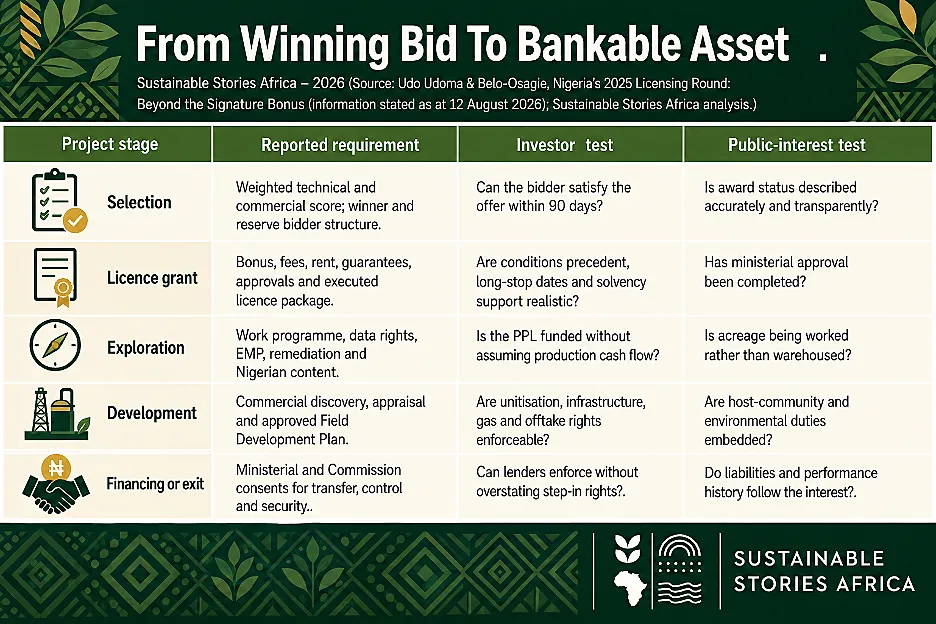
- Within 90 days, winners must provide parent-company and work-commitment guarantees, pay fees, first-year rent and signature bonus, and submit regulatory and solvency confirmations, with the model contract signed at or before bonus payment.
- Failure risks forfeiture to a reserve bidder.
PPL 2010 illustrates information limits: the 641.60-square-kilometre deep-offshore block has 3D seismic coverage, no drilled wells, and named winning and reserve bidders; however, public records don't confirm final licence status, participating interests, infrastructure access, reservoir continuity or financing.
Adjacency to producing fields remains a diligence question, rather than a proof of value.
Disciplined Awards Can Unlock Productive Acreage
If the award process is completed transparently and work programmes are properly financed, the round can deepen Nigeria’s upstream pipeline while testing the performance-based acreage regime of the Petroleum Industry Act.
Competitive allocation can bring new technical capabilities, local participation and capital into assets that might otherwise remain idle, including frontier basins where the regulator reported notable interest.
The development opportunity extends beyond the wellhead.
- Commercial discoveries can support Nigerian engineering, procurement, environmental services, gas processing, transport, storage and other midstream investments.
- Host-community trusts and Nigerian-content requirements can convert project expenditure into more durable local value when they are planned from the beginning rather than treated as post-discovery compliance annexes.
The benefit, however, depends on disciplined sequencing.
- A discovery without an approved development plan, evacuation capacity, processing arrangements, offtake or compatible midstream authorisations can remain stranded.
The NUPRC governs upstream title and operations, while the Nigerian Midstream and Downstream Petroleum Regulatory Authority becomes material where monetisation depends on infrastructure.
Bankability, therefore, lies at the interface between licence, contract, facilities and market.
Bankability Begins With The Obligation Stack
Funding plans should extend well beyond the signature bonus.
At the grant and exploration stage;
- cash requirements cover fees, rent, guarantees, work commitments, environmental arrangements, remediation contributions, Nigerian-content execution and early decommissioning planning.
- General Licence Conditions require an Environmental Management Plan within six months of licence commencement, with abandonment funding timed per 2026 regulations.
During discovery and development;
- Appraisal and the Field Development Plan must address technical, economic, environmental, gas, community, Nigerian content and decommissioning requirements.
- Where Chapter 3 of the Petroleum Industry Act applies, operators must fund a Host Communities Development Trust based on attributable prior-year operating expenditure, a continuing obligation separate from the bonus.
Lenders and acquirers;
- Should verify the offer letter, ministerial approval, licence instrument, coordinates, model contract, data rights and fiscal model.
- Assignment or change of control needs prior ministerial consent; security over a participating interest needs Commission consent; disclosing technical data to banks requires prior written approval.
- A charge is not self-executing.
Fiscal modelling;
- Should apply the Nigeria Tax Act 2025 (effective January 2026), testing royalty variations, domestic delivery obligations, remediation costs and infrastructure constraints.
- The signature bonus is an entry price, rather than the project budget.
Path Forward – Execution Will Decide The Round’s Legacy
The regulator should publish clear award-status milestones and enforce work commitments consistently.
Bidders must complete the legal grant process, finance exploration and disclose progress without presenting selection as ownership or commercial discovery.
Investors should underwrite the full obligation stack from licence to market, while communities and regulators track environmental, local-content and host-community delivery.
The round will succeed only when winning bids become responsible work programmes, approved developments and productive assets.