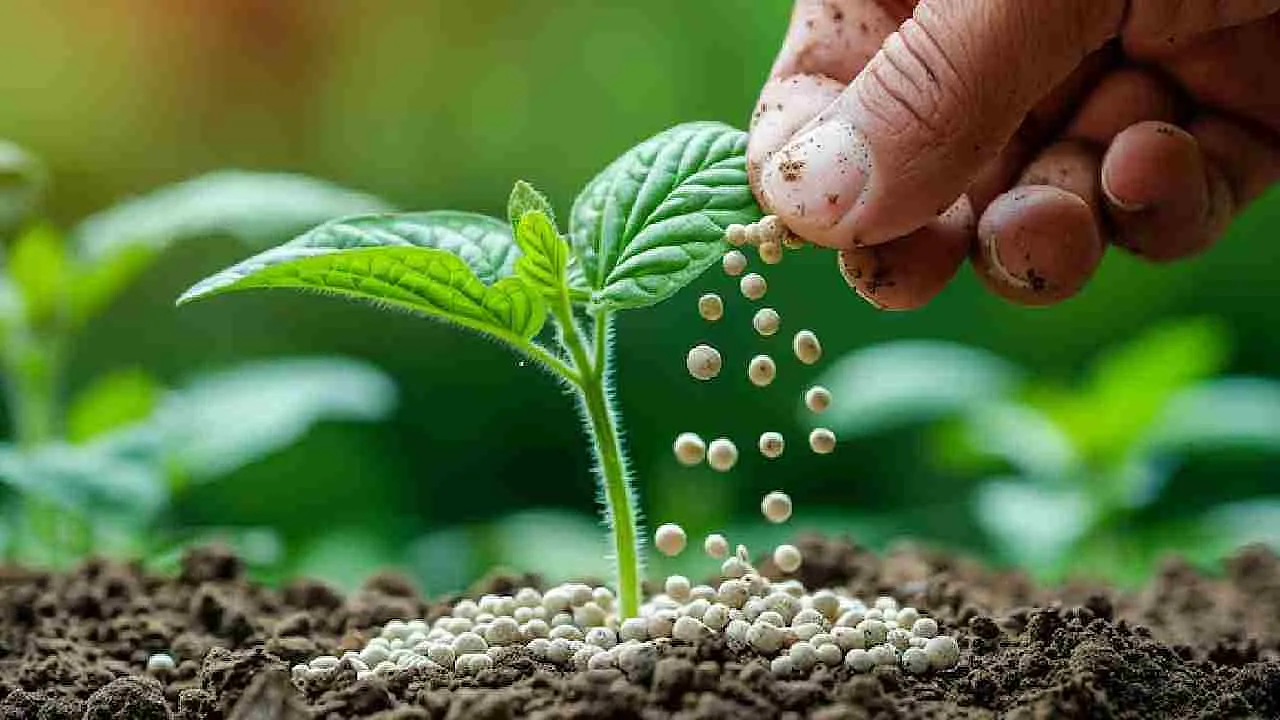
A Down To Earth interview on fertiliser fallout in India carries a wider warning for Africa: food security can be shaken far from the farm.
As wars, shipping risks and import dependence reshape global agriculture, African governments must treat fertiliser, soil health and local production as strategic development priorities.
Food Security Now Faces Global Shocks
A war thousands of kilometres away can still decide what a farmer plants, how much land is cultivated and how expensive food becomes for families.
That was the core warning from Down To Earth’s Beyond The Plate interview, where public policy expert Narasimha Reddy Donthi discussed how conflict, fertiliser supply and global trade risks can shape India’s food systems.
For Africa, the lesson is immediate. The continent faces many of the same vulnerabilities as India: dependence on imported inputs, exposure to foreign-exchange pressure, high logistics costs, climate-stressed farms and millions of smallholders who make planting decisions under uncertainty.
The interview’s central message is that fertiliser is not just an agricultural product. It is food infrastructure.
When it becomes scarce or expensive, the pressure moves from ports to warehouses, from agro-dealers to farmers, and finally to household food baskets.
Distant Wars Now Reach Farms
The striking point from the interview was simple: global conflict can determine whether a bag of fertiliser reaches a farmer. The issue is framed around how the US-Israel conflict involving Iran could affect what farmers in Punjab or Madhya Pradesh decide to plant, because fertiliser availability shapes crop choice, cultivated area and food prices.
That question matters deeply for Africa. The continent is already trying to feed a fast-growing population under climate volatility, high debt costs and weak rural infrastructure.
Any fertiliser shock can quickly become a food-price shock, especially where farmers depend on rain-fed agriculture and have limited access to credit.
The risk is not theoretical. The African Union’s Fertiliser and Soil Health Action Plan recognises that Africa must improve soil health, fertiliser use, financing, local production and regional trade over the 2024 – 2034 period.
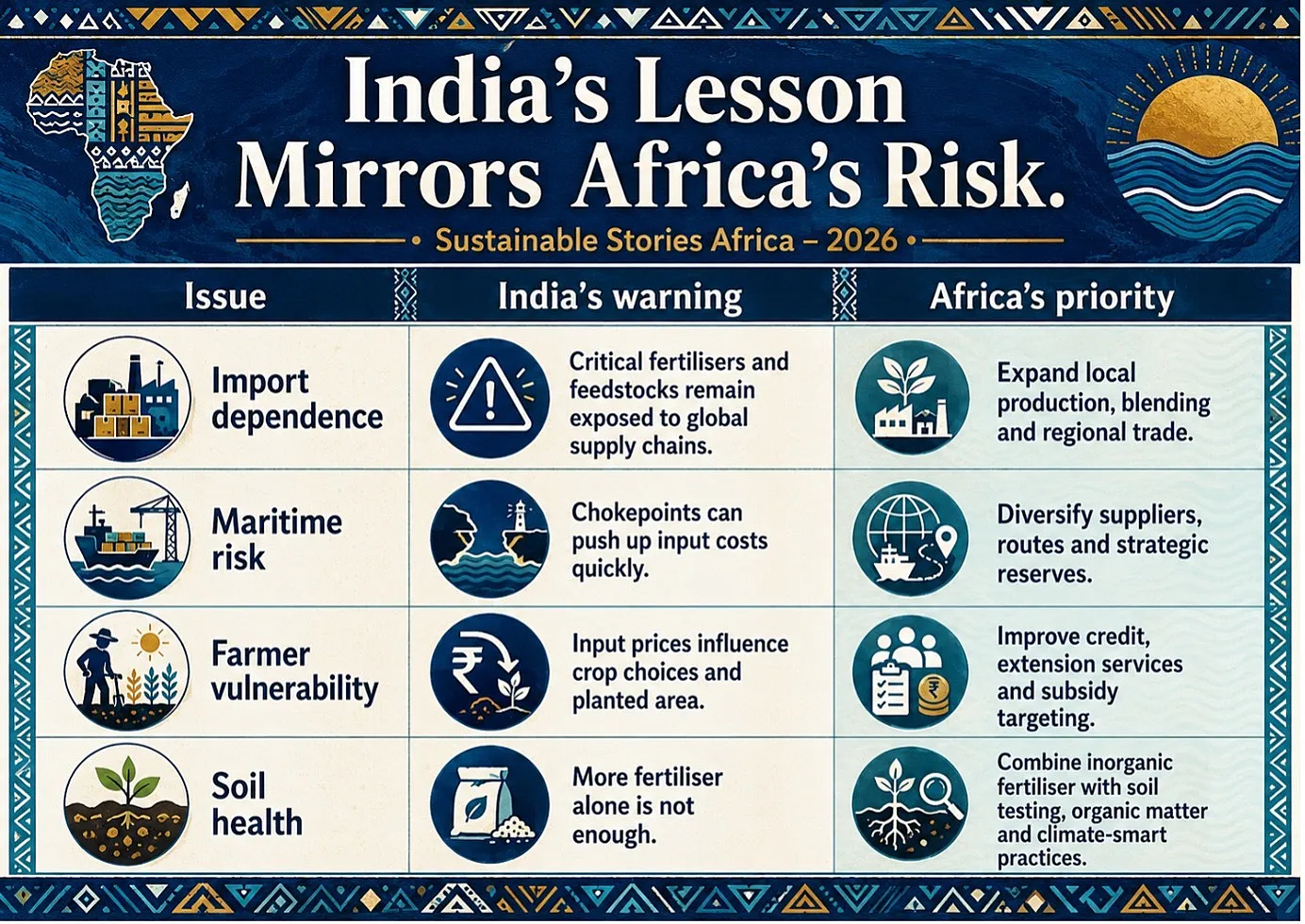
India’s Lesson Mirrors Africa’s Risk
India’s case is powerful because it shows how even a major agricultural economy can remain vulnerable to imported nutrients, energy markets and maritime chokepoints.
A March 2026 ICRIER paper noted that India’s import dependence remains significant, including around 20% for urea, nearly 50% for diammonium phosphate and almost 100% for muriate of potash, while domestic urea production also depends heavily on imported natural gas.
For Africa, the picture is more fragmented but equally urgent. Fertiliser consumption has improved since the 2006 Abuja Declaration, but progress remains below its ambition.
A 2024 summary of the Africa Fertiliser and Soil Health Summit noted that fertiliser consumption rose from about 8kg per hectare in 2006 to around 18kg per hectare, still less than half the 50kg target.
The soil challenge is even deeper. AUDA-NEPAD reports that about 75% – 80% of Africa’s cultivated area is degraded, with nutrient losses of 30kg – 60kg per hectare annually, affecting more than 485 million people.
Resilience Can Raise Rural Prosperity
The opportunity for Africa is not simply to use more fertiliser. It is using the right fertiliser, in the right places, at the right price, supported by better soil data and stronger markets.
If Africa gets this right, the gains could be transformational.
- Higher yields would reduce food import bills.
- Improved soil management would improve climate resilience.
- Stronger input markets would make farming more bankable.
- Local fertiliser production and blending could create jobs across mining, gas, logistics, research, manufacturing and distribution.
This is where Africa can avoid repeating older mistakes. The next food-security strategy should not push blanket fertiliser use without soil intelligence.
It should combine mineral fertilisers with organic inputs, liming where soils are acidic, water management, quality seeds, extension support and digital advisory systems.
The African Union’s 2024 – 2034 action plan already points in this direction, calling for improved policy, financing, markets, soil health monitoring and context-specific fertiliser recommendations.
Governments Must Secure Input Systems
The first action is to treat fertiliser as strategic infrastructure.
- Ministries of agriculture, finance, trade, industry and transport need a joined-up plan that links procurement, foreign exchange, port clearance, rail and road logistics, farmer finance and soil-health advisory.
Second, Africa needs stronger regional fertiliser value chains.
- Countries with phosphate, natural gas, limestone and organic fertiliser potential should be connected to countries with high food-production needs. This requires bankable industrial projects, predictable trade rules and investment incentives that do not collapse after one budget cycle.
Third, subsidies must become smarter.
- Too often, input support programmes are late, politicised or poorly targeted. Africa needs digital farmer registries, transparent voucher systems, private agro-dealer participation and monitoring. This is to ensure that fertiliser reaches farmers before planting windows close.
Fourth, regulators must clamp down on fake and poor-quality fertilisers.
- A farmer who buys weak or adulterated inputs loses money twice: first at purchase, then at harvest. Standards agencies, customs authorities and agricultural regulators must ensure quality control to protect food security.
Fifth, banks and development financiers should de-risk the input chain.
- Credit guarantees, warehouse receipt systems and working-capital facilities can help agro-dealers stock fertiliser earlier and closer to farmers.
Africa Must Learn Before Crisis Deepens
The India interview matters because it connects a distant geopolitical shock to an ordinary farm decision.
That same chain is familiar across Africa: a global disruption raises import costs; currency pressure increases local prices; dealers reduce stock; farmers cut application rates; yields fall; food prices rise.
Africa cannot control every global conflict, shipping route or commodity market. But it can reduce exposure.
The continent’s policy challenge is to move from emergency fertiliser responses to long-term food-system resilience.
That means investing in soil maps, fertiliser plants, organic nutrient systems, regional logistics, farmer finance and climate-smart extension.
It also means recognising that fertiliser policy is no longer only about agriculture. It is about inflation, jobs, climate adaptation, trade, nutrition and national stability.
Path Forward – Build Soil-Secure Food Systems
Africa’s priority is clear: reduce fertiliser vulnerability while rebuilding soil health. Governments must align local production, regional trade, farmer finance and soil intelligence around a single food-security agenda.
The lesson from India is not dependence, but preparedness. Africa needs input systems that can withstand global shocks and still deliver affordable food, resilient farms and stronger rural economies.