
Across African and emerging markets, finance leadership is being pulled beyond reporting into the systems that create, protect and sustain enterprise value.
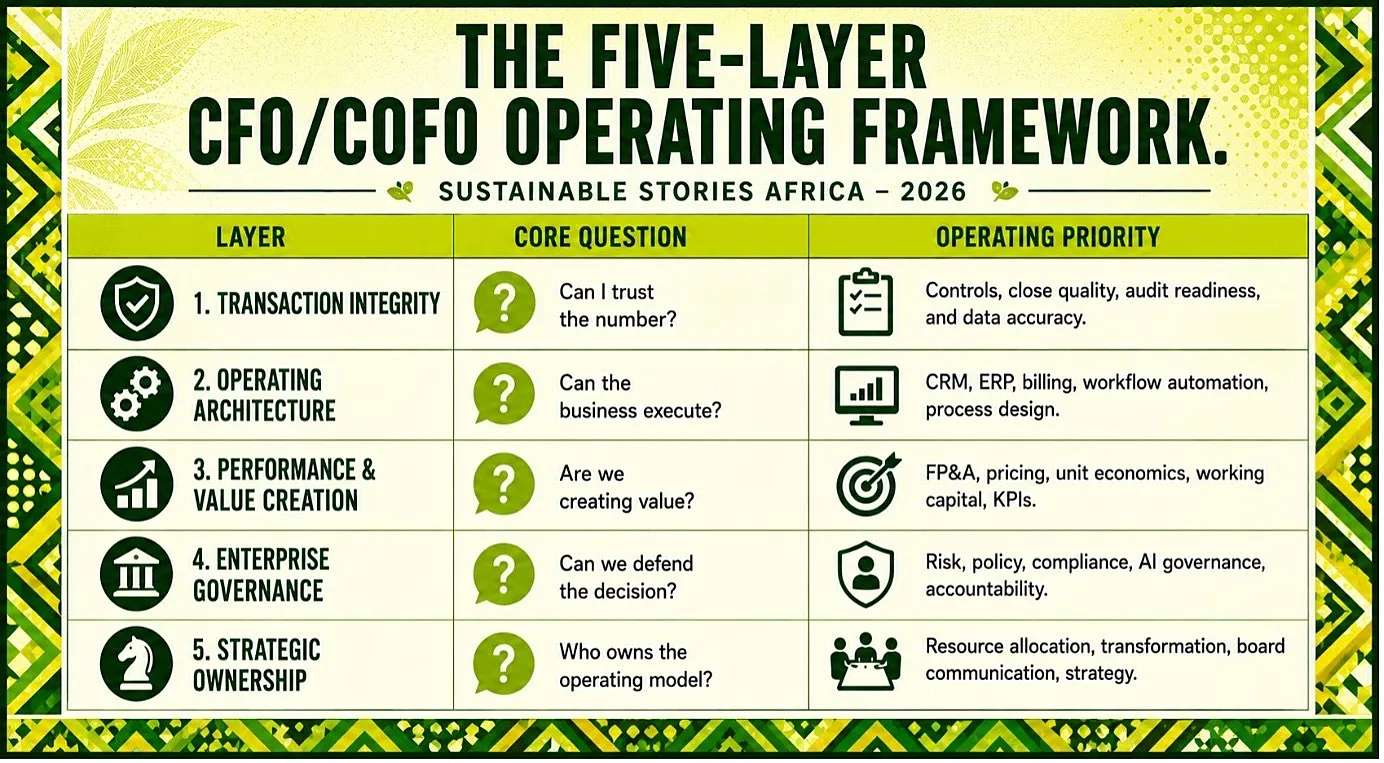
The FinPolNomics CFO/COFO five-layer framework reframes the finance chief as an architect of transaction integrity, operating systems, governance, performance and strategy, rather than merely a custodian of past numbers.
The message is direct and urgent: companies do not only need cleaner books. They need an operating architecture that makes those numbers trustworthy, actionable and resilient enough to survive real-world volatility.
Finance Leadership Moves Beyond The Numbers
For years, the finance function in African companies was measured by a narrow standard: did the accounts close on time, did the audit clear, and did the board receive the numbers? That discipline remains non-negotiable.
However, the operating environment has fundamentally changed. Inflation, currency volatility, fragmented data systems, climate exposure, accelerating AI adoption, and tighter governance expectations are forcing finance leaders to own far more than historical accuracy.
The FinPolNomics five-layer model names that shift. The CFO, and increasingly the Chief Operating and Finance Officer, is not only a steward of reports. They are the architects of how value is created, measured, defended, and scaled across the entire enterprise.
This is a structural redefinition of the finance mandate, and it is happening now.
For African businesses, this is not abstract management theory. It speaks directly to the everyday reality of fragmented systems, delayed reconciliations, manual revenue processes, weak internal controls, and boards that need faster, clearer decisions to compete and grow responsibly.
The Architecture Is The Competitive Edge
In a continent where an estimated 65% of businesses report that financial data quality constrains strategic decisions, the CFO who only reports what happened is already behind.
The CFO who owns the systems that produce and protect those numbers is where leadership value truly resides.
The FinPolNomics framework does not ask finance leaders to become technologists or operations managers.
It asks them to take responsibility for the operating environment that determines whether the numbers are trustworthy, whether execution delivers, and whether the enterprise can defend every major decision it makes.
That is the architecture question.
From Clean Books to Execution Architecture
The first layer is transaction integrity: order-to-cash, procure-to-pay, record-to-report, treasury management, internal controls, audit readiness, and data quality governance. In many
African firms, this is where value leakage begins, not because leaders lack ambition, but because systems and controls are not connected, and manual workarounds create gaps that compound over time.
The second layer moves finance into operating architecture. CRM integration, deal desk governance, billing systems, ERP management, data warehouse oversight, workflow automation, systems integration, master data governance, and AI deployment standards all sit here.
This is where finance transitions from commentator on results to builder of execution capacity, a shift with profound implications for how African companies compete.
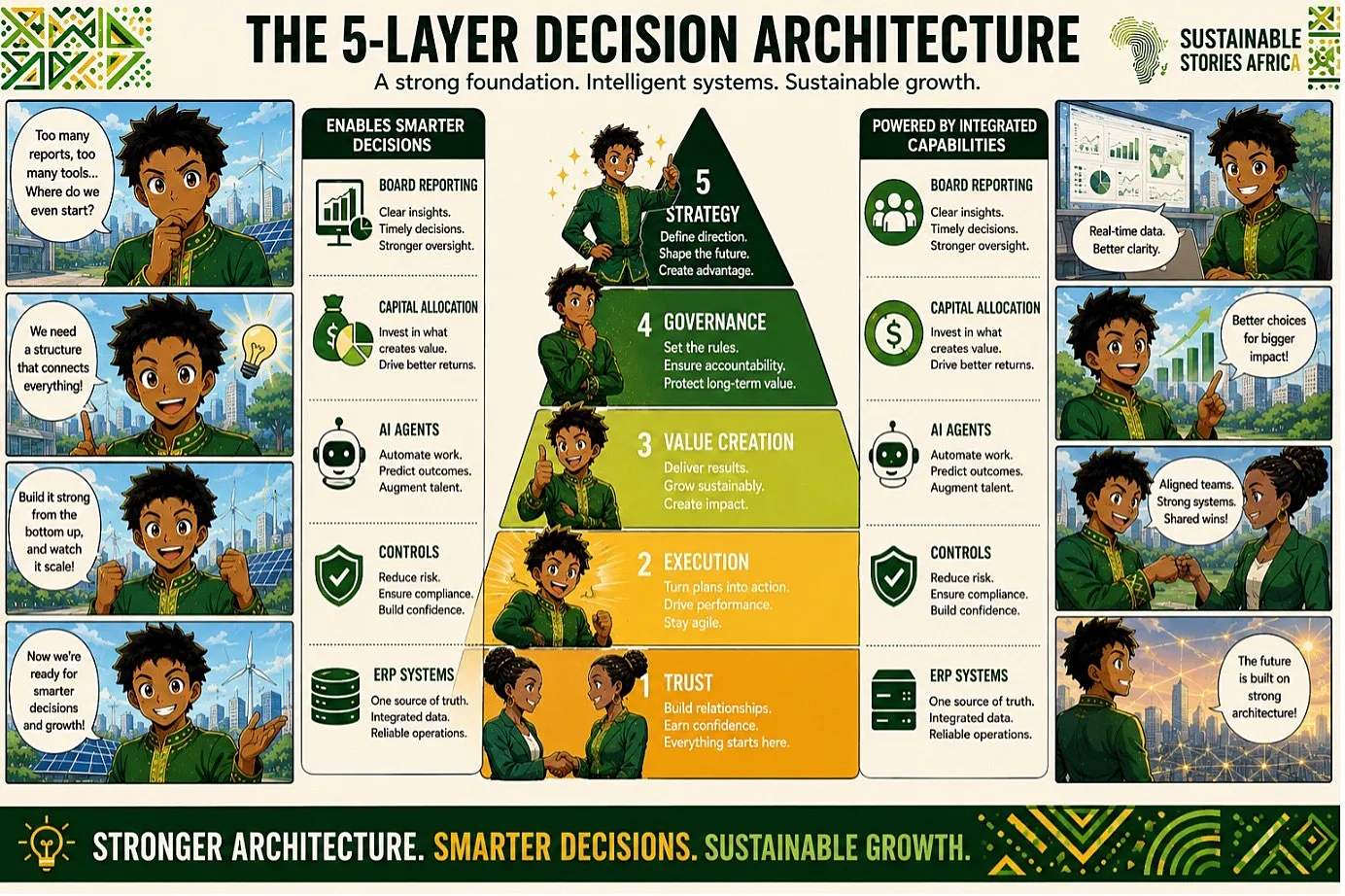
The third and fourth layers push finance into enterprise value creation and governance. FP&A, pricing architecture, unit economics, working capital optimisation, KPI design, capital allocation, and M&A integration must connect seamlessly with risk management, AI governance, segregation of duties, agent accountability, and regulatory oversight.
The result is a finance function that can explain not only what happened, but why it happened, what it means strategically, and how leadership will respond. This is especially critical where investors, lenders, and regulators are demanding stronger, more credible evidence of institutional resilience.
What Stronger Finance Architecture Unlocks
When finance owns only the numbers, problems surface late, often after losses are already embedded in the business.
When finance owns the architecture behind the numbers, leadership can detect risk earlier, allocate capital with greater precision, and defend decisions with evidence rather than assertion.
A modern CFO scorecard built on this framework would include quality scores, reliable forecast reliability, control maturity assessments, working capital velocity, decision cycle speed, AI governance readiness indicators, and the percentage of strategic decisions backed by reliable, independently verified data.
These are not abstract targets. They are the operational indicators that distinguish institutions that grow sustainably from those that struggle to scale.
What Must Change Immediately
Boards should elevate operating architecture to a board-level governance issue, rather than a back-office concern.
Finance leaders must be granted authority to standardise data definitions, remove process bottlenecks, design automation guardrails, and align technology priorities with enterprise value creation.
This is not an IT project; it is a governance mandate.
Management teams should also commission a five-layer readiness audit to assess where transaction integrity is weakest, which systems constrain execution, how performance metrics connect to strategy, whether governance can defend key decisions, and who currently owns the operating model.
The answers will define the priority investment map.
Path Forward – Build Finance Into Execution
African companies should make the move from finance-as-reporting to finance-as-operating-architecture.
The priority is not bigger dashboards or more complex models; it is trustworthy data foundations, integrated execution systems, clear role ownership, and board-level accountability for the operating environment that produces financial results.
Sustainable growth will depend on finance teams that not just report value, but also create it, protect it, defend every major decision, and sustain enterprise performance through whatever conditions the market delivers.
The five-layer model provides the map; the urgency to act is now.