
Across African markets, ESG integration is rapidly shifting from voluntary corporate social responsibility initiatives to structured systems tied directly to financial performance and governance oversight.
Investors, regulators and development financiers are increasingly demanding measurable sustainability performance.
Companies that treat ESG as a strategic operating framework, rather than a communications exercise, are beginning to unlock access to capital, operational efficiencies and long-term resilience.
From CSR Narratives to ESG Systems
Across global capital markets, environmental, social and governance (ESG) considerations are reshaping how businesses measure risk, value and long-term resilience.
For African corporations navigating rising regulatory expectations and investor scrutiny, the shift from corporate social responsibility (CSR) storytelling to structured ESG integration is becoming unavoidable.
At its core, ESG represents a framework for measuring how environmental and social factors influence corporate financial performance.
Unlike CSR, which was traditionally driven by corporate values and stakeholder goodwill, ESG increasingly reflects the expectations of financial stakeholders assessing risk exposure and long-term enterprise value.
For African firms seeking access to international capital, integrating ESG into governance structures, risk management systems and operational strategies is no longer optional. It is becoming a central component of corporate competitiveness.
CSR Versus ESG – Understanding Materiality Differences
One of the most persistent misconceptions across emerging markets is the assumption that CSR initiatives automatically translate into effective ESG performance. In practice, the two frameworks serve different purposes.
CSR initiatives traditionally emphasise voluntary contributions to social or environmental causes, often shaped by community engagement priorities.
ESG, by contrast, focuses on the financial implications of sustainability factors and how these affect corporate performance and investment risk.
The infographic in the uploaded document illustrates this distinction clearly. CSR follows an “inside-out” impact approach, focusing on how corporate activities affect society and the environment.
ESG, however, takes an “outside-in” perspective, examining how environmental and social dynamics affect the company’s financial performance and risk exposure.
The most advanced sustainability frameworks today adopt the double materiality principles, recognising both perspectives simultaneously.
This approach, now embedded in several global reporting frameworks, links societal impact with corporate financial risk.
For African companies increasingly engaging with global investors, adopting the double materiality principles provides a more comprehensive lens to understanding which sustainability risks and opportunities can be evaluated.
Building Operational ESG Systems Inside Corporations
Effective ESG integration requires more than sustainability reports or isolated corporate initiatives. It demands structured operational systems embedded across environmental management, social responsibility and corporate governance functions.
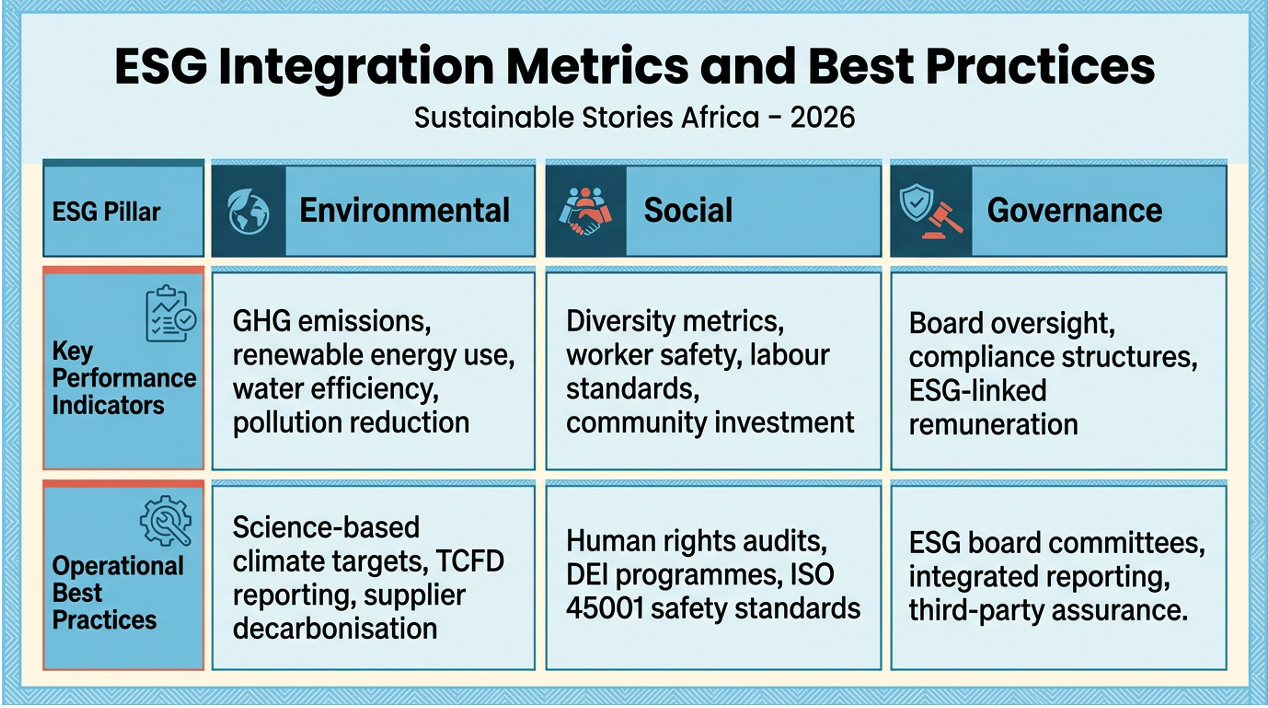
The ESG integration framework outlined in the document highlights three core pillars:
Environmental
Environmental metrics assess how corporate operations affect ecological systems and resource use. Key indicators typically include:
- Greenhouse gas emissions (Scope 1, 2 and 3)
- Energy efficiency and renewable energy adoption
- Water management
- Waste reduction and pollution control
- Alignment with climate frameworks such as TCFD and Science Based Targets.
These indicators increasingly influence how investors evaluate corporate transition risk in sectors such as energy, manufacturing and infrastructure.
Social
Social metrics assess how companies manage relationships with employees, communities and stakeholders. Core indicators include:
- Diversity and inclusion
- Worker health and safety
- Labour standards
- Human rights practices
- Community engagement programmes.
In African markets, where social impact expectations are high, this dimension often shapes corporate legitimacy and public trust.
Governance
Governance indicators examine how leadership structures ensure ethical conduct and strategic accountability. Key measures include:
- Board diversity and independence
- Ethics and compliance frameworks
- Risk management systems
- ESG-linked executive compensation
- Data protection and cybersecurity oversight.
Strong governance frameworks often determine whether sustainability commitments translate into measurable performance outcomes.
ESG Integration Metrics and Best Practices
ESG Pillar | Key Performance Indicators | Operational Best Practices |
|---|---|---|
Environmental | GHG emissions, renewable energy use, water efficiency, pollution reduction | Science-based climate targets, TCFD reporting, supplier decarbonisation |
Social | Diversity metrics, worker safety, labour standards, community investment | Human rights audits, DEI programmes, ISO 45001 safety standards |
Governance | Board oversight, compliance structures, ESG-linked remuneration | ESG board committees, integrated reporting, third-party assurance |
The ESG maturity framework presented in the document suggests that companies typically evolve through five stages of ESG adoption:
- Basic compliance
- KPI tracking
- Risk management integration
- Enterprise ESG management
- Value creation.
The final stage, value creation, is where sustainability initiatives contribute directly to operational efficiency, cost reduction and competitive positioning.
Why Sustainability Departments Are Becoming Strategic
As ESG expectations expand, many corporations are establishing dedicated sustainability departments to coordinate strategy, compliance and reporting.
The infographic in the document outlines several operational advantages of structured sustainability leadership.
- Risk Management and Compliance – Sustainability teams monitor regulatory developments and environmental risks, enabling companies to anticipate compliance requirements and avoid reputational damage.
- Cost Efficiency – Energy efficiency programmes, waste reduction initiatives and resource optimisation can significantly reduce operational costs over time.
- Brand Reputation and Trust – Companies demonstrating credible ESG commitments often strengthen their brand reputation among customers, regulators and investors.
- Investor Attraction – Institutional investors, including pension funds and development finance institutions, are increasingly directing capital toward companies with strong ESG governance systems.
- Innovation and Growth – Sustainability initiatives frequently drive product innovation, new market opportunities and improved operational resilience.
For African firms navigating volatile economic environments, these benefits provide compelling incentives for deeper ESG integration.
Where Sustainable Finance Capital Flows
Global capital markets are increasingly channelling investment toward projects delivering measurable environmental and social outcomes.
The sustainable finance framework in the document identifies two major asset categories:
- Green Assets – These include investments that directly address environmental challenges, such as:
- Renewable energy infrastructure
- Energy efficiency projects
- Clean transportation systems
- Green buildings
- Waste management and pollution prevention.
- Social Assets – These investments focus on societal outcomes, including:
- Affordable housing
- Healthcare and essential services
- Employment generation
- Socioeconomic empowerment initiatives
- Infrastructure development.
For African economies facing infrastructure gaps and climate vulnerabilities, sustainable finance provides a potential bridge between development needs and global capital markets.
Common ESG Implementation Mistakes
Risk Factor | Consequence |
|---|---|
Ignoring Scope 3 emissions | Incomplete climate risk assessments |
Weak ESG data controls | Reduced credibility with investors |
Treating ESG as public relations | Loss of investor trust |
Limited board oversight | Strategic sustainability failures |
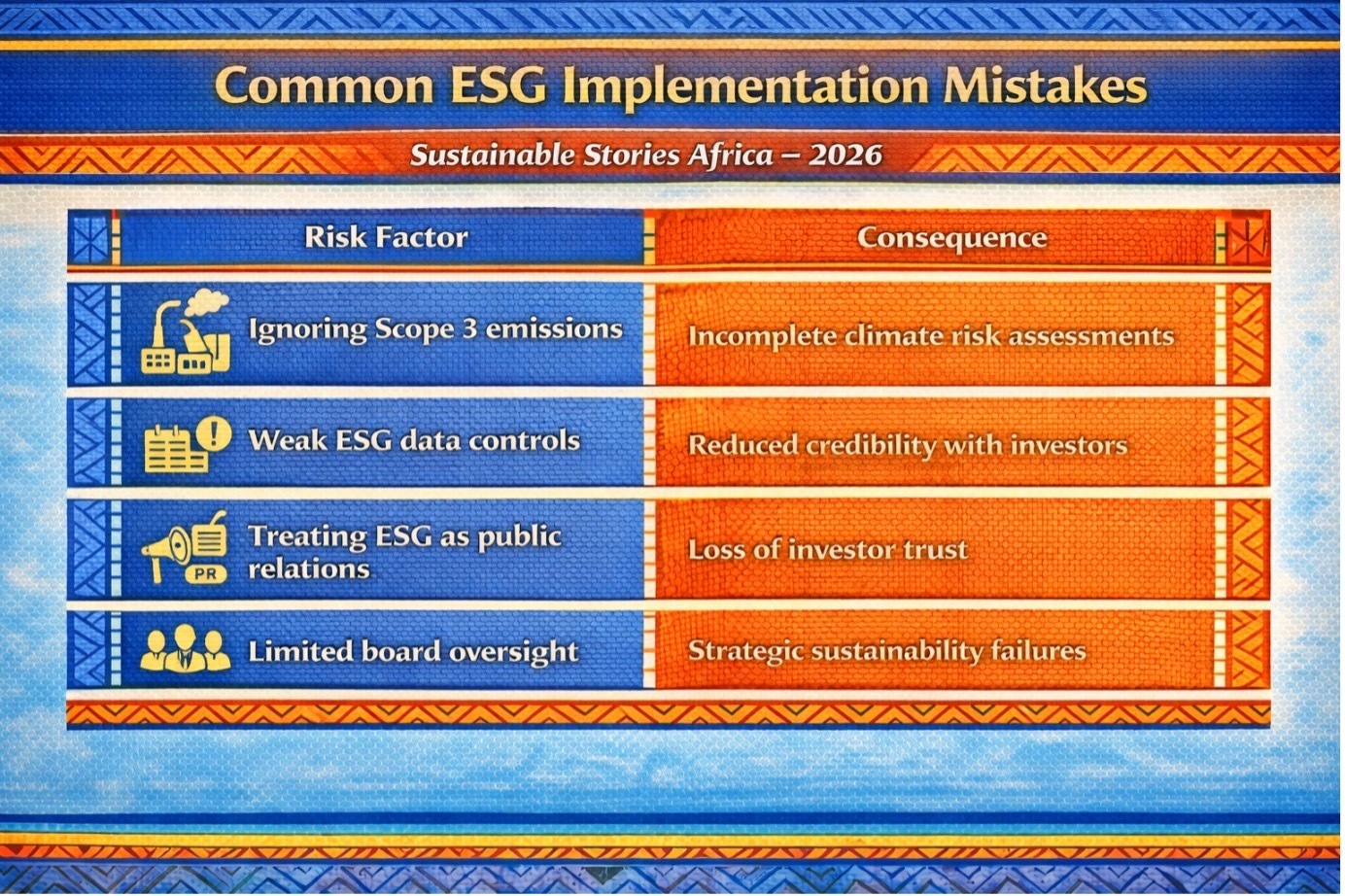
These weaknesses often explain why some ESG programmes fail to deliver measurable impact.
PATH FORWARD – Embedding ESG Into African Corporate Strategy
African companies are entering a new phase of sustainability integration where ESG systems must evolve beyond reporting exercises toward operational frameworks embedded in corporate strategy, governance oversight and risk management.
Firms that institutionalise ESG practices, through measurable metrics, board accountability and transparent reporting, are likely to gain improved investor confidence, stronger operational resilience and greater access to global capital markets.