Ghana’s renewable energy reforms are moving distributed solar from policy ambition to market opportunity, with licensing, net-metering and competitive procurement now central to private-sector participation.
The question is whether streamlined rules can overcome grid, tariff and credit risks quickly enough to make rooftop solar, embedded generation and energy trading bankable at scale.
Regulation Becomes Ghana’s Solar Growth Test
Ghana is entering a decisive phase in its clean energy transition, as recent regulatory reforms seek to make distributed solar easier to license, finance and deploy across households, businesses and industrial sites.
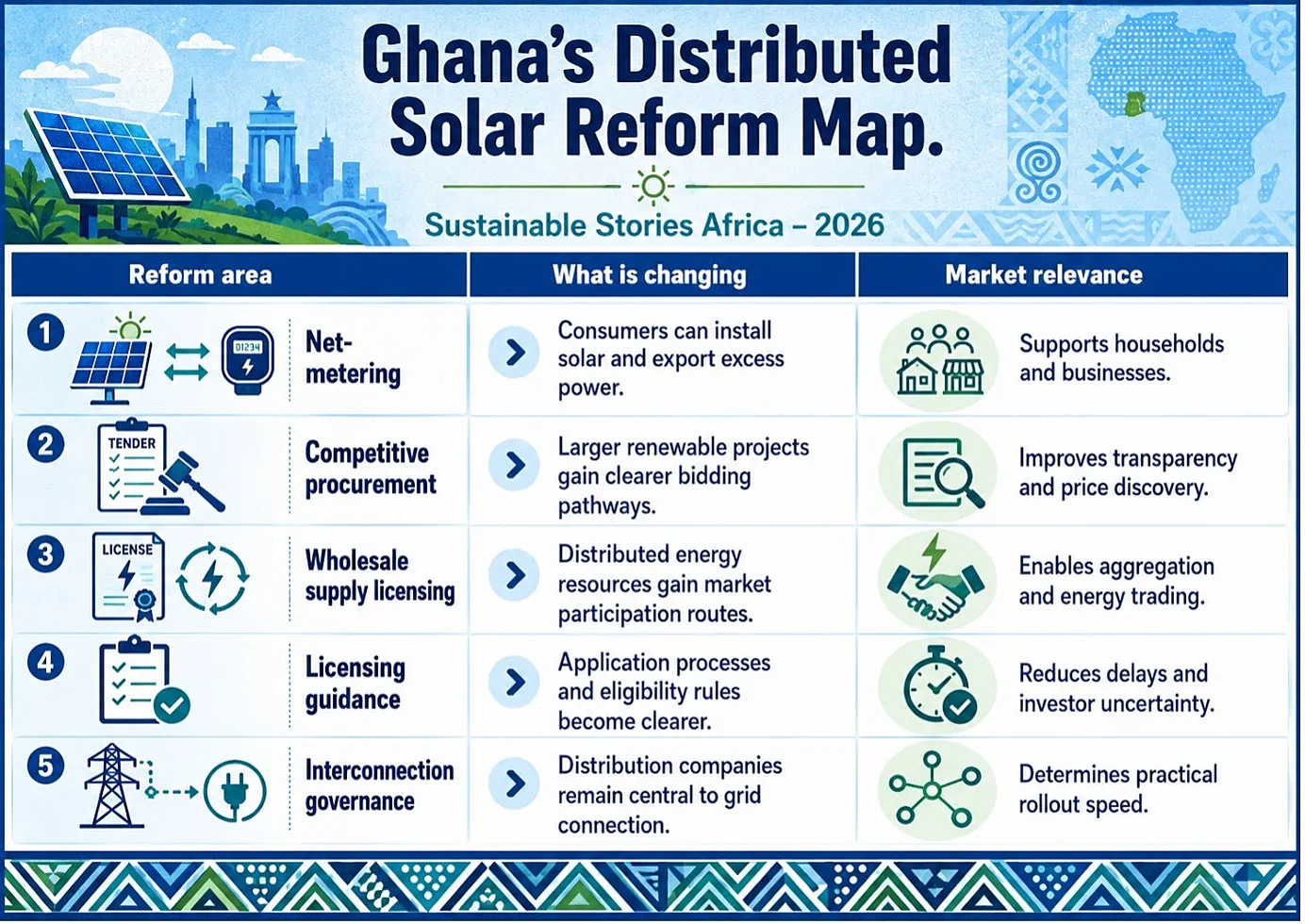
A Regulatory Insight Note by Electricity Lawyer frames the shift in light of amendments to Ghana’s renewable energy framework, including the Renewable Energy Act, 2011 and the Renewable Energy Amendment Act, 2020, which introduced net metering and competitive procurement.
The note also highlights Ghana’s more recent move to lift restrictions on Wholesale Electricity Supply Licences for distributed energy resources.
For African markets, the lesson is broader than Ghana. Energy transition does not happen through technology alone.
It depends on the rules that decide who can generate power, sell power, connect to the grid, secure tariffs, raise finance and serve customers.
Solar Rules Now Shape Markets
The strongest signal from Ghana’s regulatory shift is simple: distributed solar is no longer only a household energy solution; it is becoming a regulated market platform for private capital, commercial power supply and climate-aligned investment.
The reforms place licensing at the centre of Ghana’s renewable energy transition. The Energy Commission remains the primary regulator for licensing, permitting and compliance.
The Public Utilities Regulatory Commission provides tariff oversight and consumer protection. The Ministry of Energy sets policy direction, while the Electricity Company of Ghana and Northern Electricity Distribution Company manage interconnection and distribution.
That architecture matters because distributed solar sits between public infrastructure and private enterprise.
- A factory installing rooftop panels needs predictable licensing.
- A developer aggregating commercial solar clients needs confidence that electricity supply rules will hold.
- A bank financing embedded generation needs clarity on tariffs, off-taker risk and grid access.
Ghana’s reforms, therefore, speak to a larger African development question: can regulation move quickly enough to support cleaner, cheaper and more reliable power without destabilising electricity systems?
Licensing Reform Meets Power Demand
Ghana's renewable energy governance has evolved significantly over the past decade. The Renewable Energy Act established the foundational framework.
The 2020 amendment deepened it through net-metering and competitive procurement, shifting solar from a standalone technology purchase into a regulated electricity service.
Net-metering allows consumers to install systems within defined capacity limits and export surplus power to the grid.
- For small businesses, this transforms solar into a productivity tool.
- For households, it reduces dependence on unstable or expensive electricity.
Competitive procurement further strengthens the framework by creating transparent pathways for larger renewable projects, directly improving investor confidence, pricing clarity and bankability.
The most significant commercial opening, however, is the lifting of restrictions on Wholesale Electricity Supply Licences for distributed energy resources.
This creates new pathways for aggregation and energy trading, enabling distributed energy providers to participate more directly in Ghana's electricity market.
This matters because Africa's electricity challenge extends beyond national grids.
Distributed solar can serve commercial districts, industrial clusters, hospitals, schools and fast-growing urban neighbourhoods more quickly than large centralised projects.
However, only where regulations allow developers to connect, sell and recover revenue predictably.
Ghana's growing power demand, rising interest in renewable finance and climate commitments collectively position distributed solar as a bankable, climate-aligned solution for both urban and rural markets.
Clear Rules Can Unlock Capital
Ghana's licensing reforms carry significant potential; however, their value depends entirely on the quality of implementation.
Well-executed reforms can reduce the friction that keeps renewable energy projects trapped between policy announcements and actual deployment.
The benefits span multiple stakeholders.
- Developers gain from faster, clearer licensing that lowers transaction costs.
- Banks benefit from standardised rules that make project risks easier to price.
- Businesses access greater energy security through net-metering and embedded generation.
- The Government can expand cleaner power without relying exclusively on large public infrastructure spending.
The social impact is equally consequential. Reliable electricity underpins jobs, cold storage, digital services, healthcare and small-enterprise growth.
- For a clinic powering medical equipment, a shop maintaining refrigeration or a factory avoiding production stoppages, energy reform translates directly into everyday resilience.
Ghana also has an opportunity to build a stronger local clean-energy economy.
Reducing dependence on imported solar components over time could lower costs, limit currency exposure and generate new industrial opportunities, a priority explicitly identified in the Regulatory Insight Note.
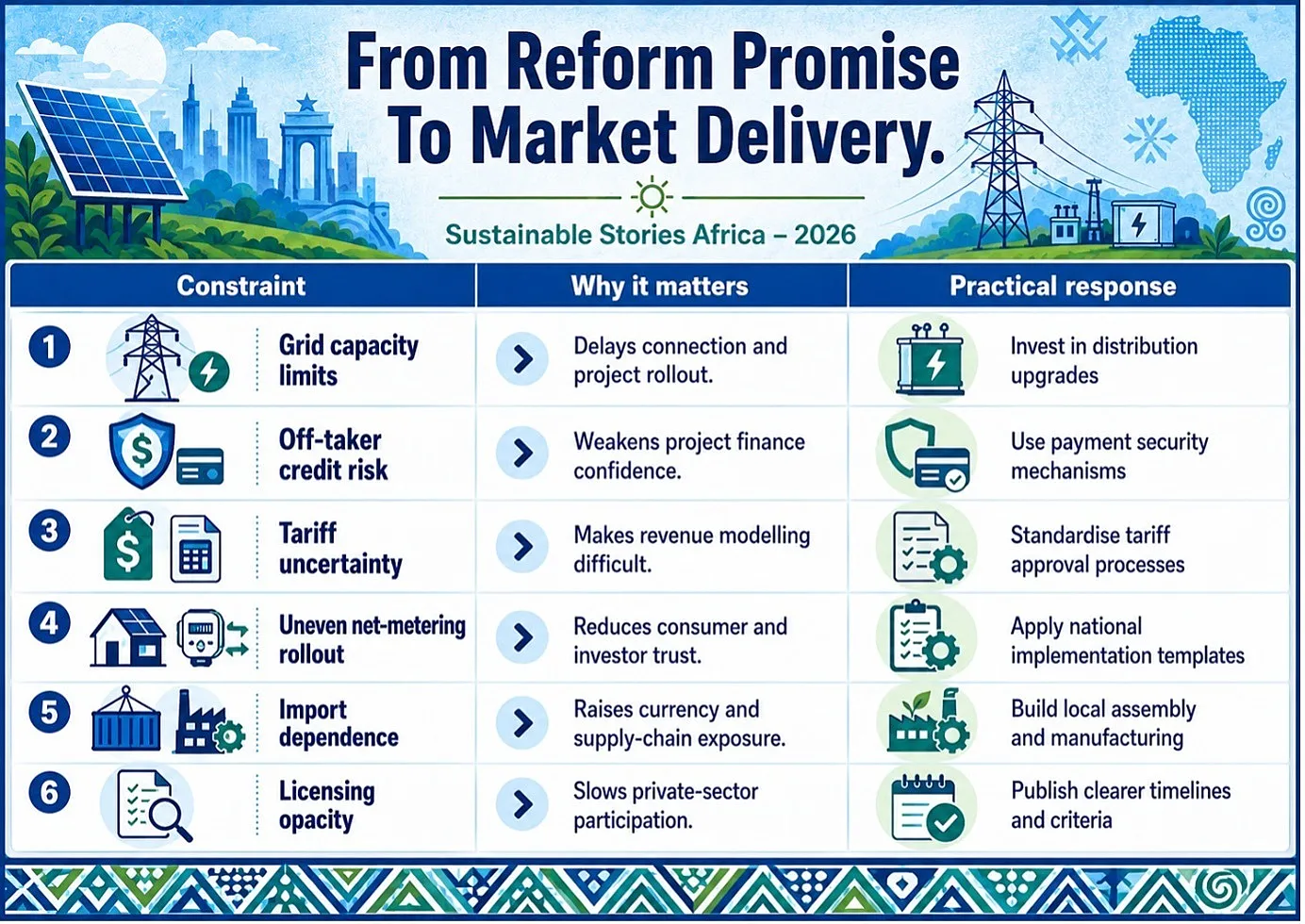
However, However, the upside is not guaranteed. Net-metering rules must be applied consistently, tariff approvals must remain predictable, grid access must be transparent, and distribution companies must be financially credible.
Ghana's reforms are ultimately a warning for African markets broadly: passing energy legislation is the beginning, , building investment-grade systems is the real test.
Implementation Must Now Reduce Risk
The next phase requires disciplined execution from regulators, utilities, developers, financiers and policymakers.
- First, Ghana must standardise net-metering agreements and tariff frameworks. The note warns that variability in tariff approvals and net-metering implementation across regions could affect investor confidence. Standard templates, predictable approval timelines and transparent tariff rules would help reduce uncertainty.
- Second, interconnection processes need faster coordination. Grid capacity and connection procedures can still delay project rollout, especially in areas with weaker infrastructure. For distributed solar, the speed of regulatory approval is only useful if grid connection follows.
- Third, off-taker credit risk must be addressed. The note identifies credit risks associated with distribution companies and off-takers as a financing challenge. Payment security mechanisms, guarantees or stronger bilateral agreements could help financiers view distributed solar projects as credible long-term assets.
- Fourth, investors must engage early with regulators and distribution companies. The note argues that early entrants who secure strong bilateral agreements, align with Energy Commission licensing guidance and establish reliable interconnection arrangements will be best positioned to capture emerging opportunities.
- Fifth, Ghana should link licensing reform to industrial strategy. Local manufacturing and assembly of solar components can reduce import exposure, improve supply-chain resilience and create jobs. Without this, solar expansion may deepen clean-energy deployment while leaving much of the value chain outside the country.
Path Forward – Rules Must Become Bankable Projects
Ghana’s next priority is to move renewable energy rules into bankable projects: clearer licences, reliable interconnection, stronger off-taker confidence, predictable tariffs and transparent net-metering.
If regulators, utilities and investors coordinate execution, distributed solar can support cleaner power, stronger businesses and climate-aligned growth.
The reform story will be judged not by policy design alone, but by how quickly it delivers reliable electricity to people and markets.