
Deferred tax is not a future invoice waiting in the post. It is today’s accounting recognition of tax consequences that will reverse as assets are recovered, liabilities are settled, and tax losses are used.
Drawing on Gafar Ojeleye’s IAS 12 presentation, this explainer shows why the gap between book values and tax bases can change reported tax, investor confidence and boardroom decisions across African markets.
Why Deferred Tax Demands Executive Attention
A company can report the same profit before tax in two consecutive years and still face sharply different current tax charges.
The difference may not signal tax avoidance, deteriorating performance or an accounting error.
It may simply reflect when tax law allows the deduction of depreciation expenses.
That timing gap sits at the centre of IAS 12, the International Financial Reporting Standard governing income-tax accounting.
It requires companies to look beyond tax currently payable and recognise future tax consequences arising from differences between the accounting values of assets and liabilities and their tax bases.
The underlying presentation was prepared by Gafar Ojeleye, ACA, FMVA®, an associate chartered accountant, financial analyst, tax specialist and compliance-and-control professional.
His analysis breaks IAS 12 into current tax, deferred tax assets, deferred tax liabilities and the temporary differences connecting them, concepts that increasingly matter to African executives, investors, regulators and audit committees seeking reliable financial information.
Deferred Tax Is Tomorrow’s Balance-Sheet Reality
The most revealing number in Ojeleye’s illustration is $5,625.
A hypothetical company, Leisure Tours, reports profit before tax of $100,000 in both Year One and Year Two.
However, its current tax rises from $21,250 in the first year to $26,875 in the second, a $5,625 increase despite unchanged accounting profit.
The explanation is not the profit figure. It is depreciation timing.
The company buys a $60,000 laptop with a four-year accounting life, producing annual accounting depreciation of $15,000.
Tax rules, however, allow a $30,000 deduction in Year Only $7,500 in Year Two. The accelerated tax deduction initially lowers current taxable profit, but that advantage reverses later.
IAS 12 captures that future reversal through deferred tax. Without it, the financial statements would suggest that the company’s effective tax burden had changed dramatically, even though its accounting profit and underlying 25% tax rate remained constant.
That is why deferred tax is not an optional forecast or a separate tax levy. It is an accounting mechanism that shows the tax consequences of transactions with the periods in which their economic effects are reported.
Why Equal Profits Produce Unequal Tax Charges
IAS 12 splits income-tax accounting into two connected components.
- Current tax reflects tax payable or recoverable on taxable profit for the period, measured at enacted or substantively enacted rates.
- Deferred tax captures future tax consequences already embedded in recognised assets, liabilities, losses, and credits, using rates expected to apply on recovery or settlement.
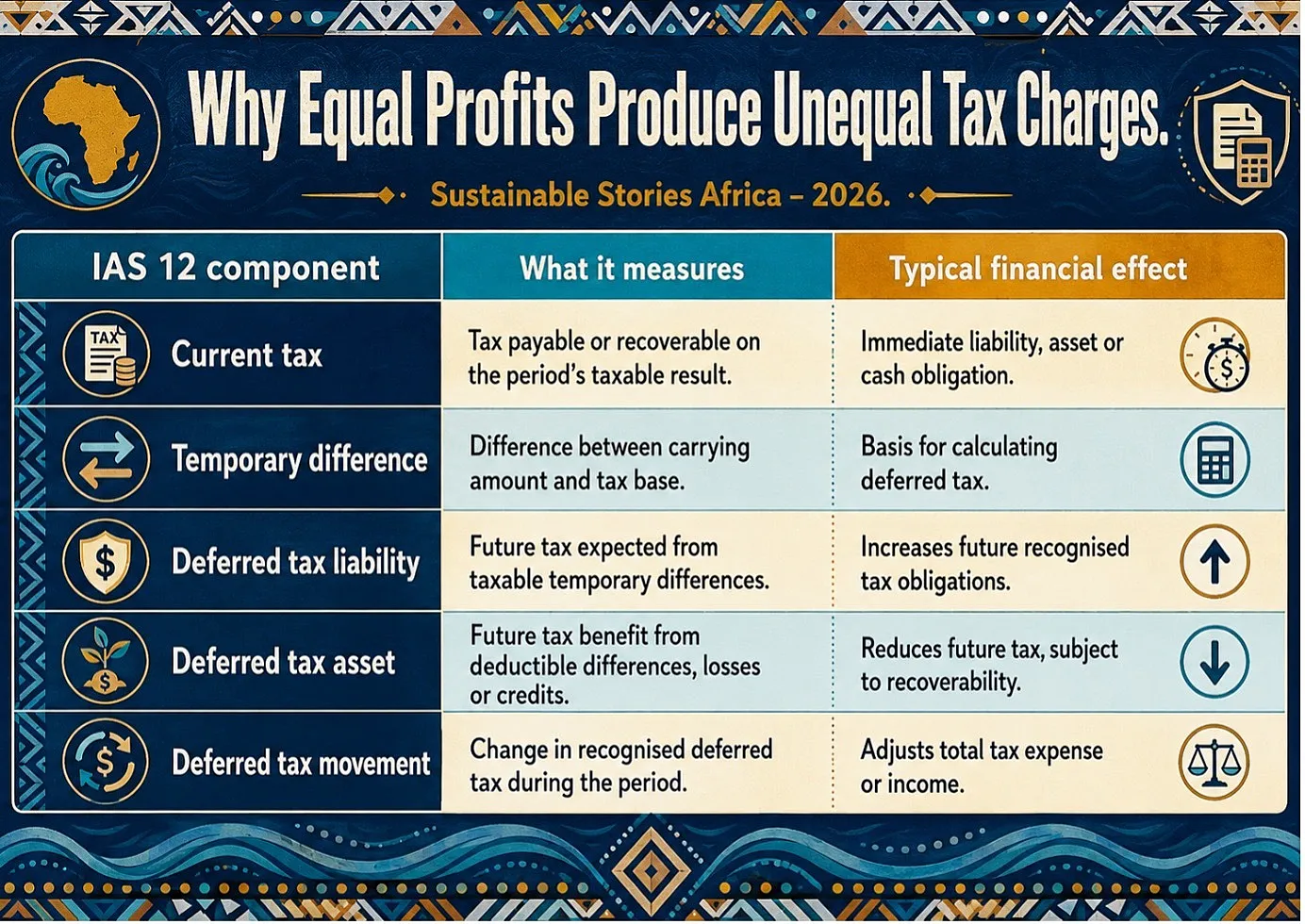
A taxable temporary difference typically arises when an asset's carrying amount exceeds its tax base, signalling a future tax obligation.
A deductible temporary difference can arise when the carrying amount falls below the tax base, or when liability settlement yields a future deduction.
Deferred tax assets from unused losses and credits are recognised only where probable future taxable profit or reversing differences support them.
Ojeleye's presentation traces recurring sources, such as depreciation, impairment, write-offs, revaluations, and intercompany transactions, particularly relevant to capital-intensive sectors like energy, telecoms, manufacturing, and extractives.
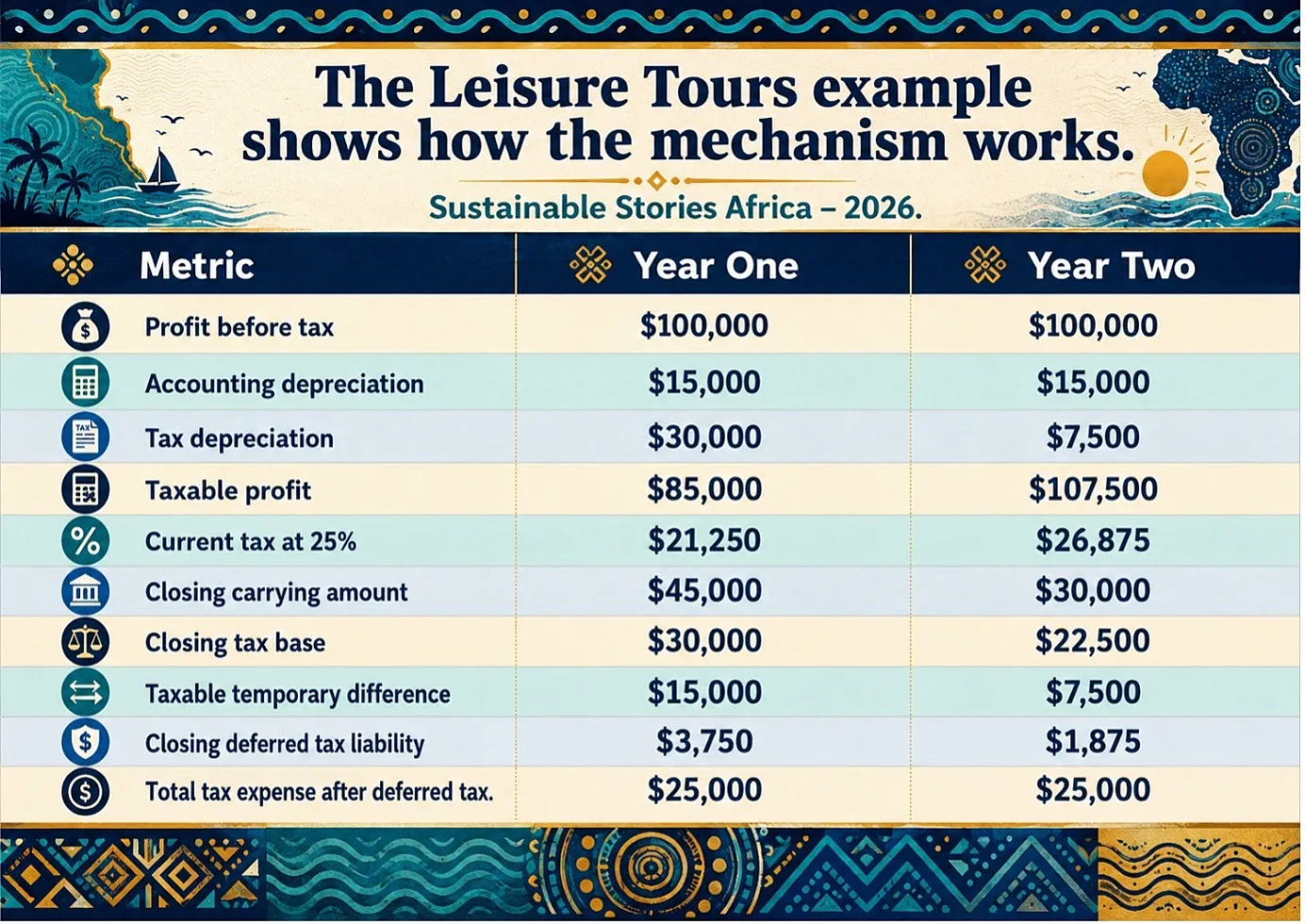
In Year One, a larger tax deduction than book depreciation lowers current tax to $21,250, creating a $3,750 deferred tax liability; combined, total tax expense equals $25,000, exactly 25% of accounting profit.
In Year Two, current tax rises to $26,875, but the deferred liability falls to $1,875, generating a $1,875 credit, total expense again $25,000.
Crucially, deferred tax movements affect accounting tax expense, not cash tax payable. Confusing the two can distort cash-flow forecasts and reconciliations, per IAS 12.
Transparent Tax Accounting Strengthens Market Confidence
Applied properly, IAS 12 gives investors a fuller view of what today's transactions mean for tomorrow's tax payments.
A deferred tax liability signals that current savings are temporary; a deferred tax asset hints at future relief but risks exposing optimistic assumptions if management cannot evidence sufficient future taxable profit.
This distinction matters where earnings are volatile, investment incentives shift, and gaps persist between accounting depreciation and tax capital allowances.
- For boards, credible deferred-tax accounting sharpens dividend decisions, valuations, and capital-allocation planning, reducing the risk that strong earnings could be eroded due to foreseeable tax costs.
- For investors and lenders, it supports comparability, separating timing effects from underlying profitability when similar companies report different current tax due to accelerated deductions or carried-forward losses.
It is also a governance matter: aggressive profit forecasts can inflate deferred tax assets and overstate net assets.
OECD Pillar Two reforms add complexity, with IAS 12 now offering temporary recognition exceptions and targeted disclosures, raising the stakes for tax data systems in African multinationals.
Five Controls Finance Leaders Must Build
Finance leaders should build five core controls to strengthen deferred-tax governance:
- Maintain a reliable tax-base register: asset-by-asset and liability-by-liability records showing carrying amounts, tax bases, reversal dates, and applicable rates.
- Separate permanent from temporary differences: permanent items affect effective tax-rate reconciliation without creating deferred tax; timing differences reverse in future periods.
- Apply disciplined forecasting for deferred tax assets, documenting taxable profits, reversing liabilities, expiry periods, and available tax-planning opportunities, especially where recent losses exist.
- Ensure boards and audit committees scrutinise major balance movements, whether from revaluations, impairments, acquisitions, leases, or tax-rate changes, rather than burying them in one line.
- Align tax, finance, legal, sustainability, and strategy teams on shared data, since incentives, renewable-energy projects, and cross-border transactions create consequences beyond the current reporting period.
IAS 12 should therefore be treated not merely as a year-end compliance exercise, but as part of enterprise risk management and financial planning.
Path Forward – Turning Tax Timing Into Better Governance
African companies should strengthen tax base records, test deferred tax assets against credible profit forecasts, and explain significant movements clearly to boards and investors.
The objective is not to eliminate differences between accounting and tax rules, but to report their future consequences honestly.
Better IAS 12 compliance supports transparent earnings, more reliable valuations and stronger corporate accountability.
In increasingly scrutinised markets, recognising tomorrow’s tax implications today is both sound accounting and responsible governance.