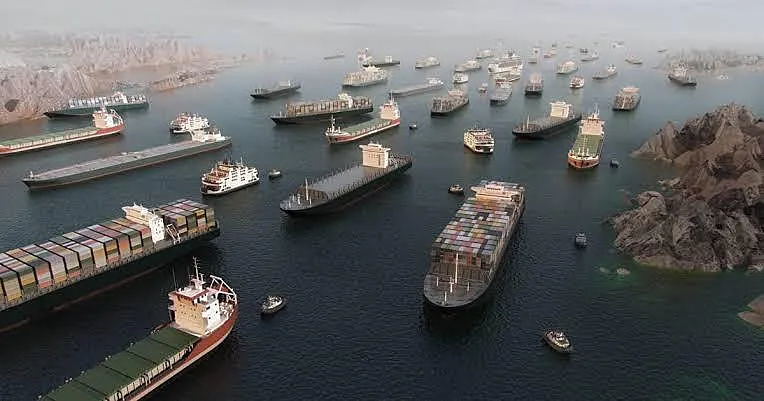
More than 1,500 commercial ships stranded around the Strait of Hormuz may be accumulating marine organisms on their hulls.
When trade resumes, those vessels could disperse invasive species through a highly connected port network.
Scientists say prevention, cleaning, route forecasting and early surveillance must begin before shipping restarts at scale.
An Ecological Crisis Grows Below Decks
The closure of the Strait of Hormuz has already carried severe humanitarian, energy and trade consequences.
A new study warns that another risk is growing largely out of sight: idle vessels are becoming settlement surfaces for algae, barnacles and other organisms that could travel with them when the shipping corridor reopens.
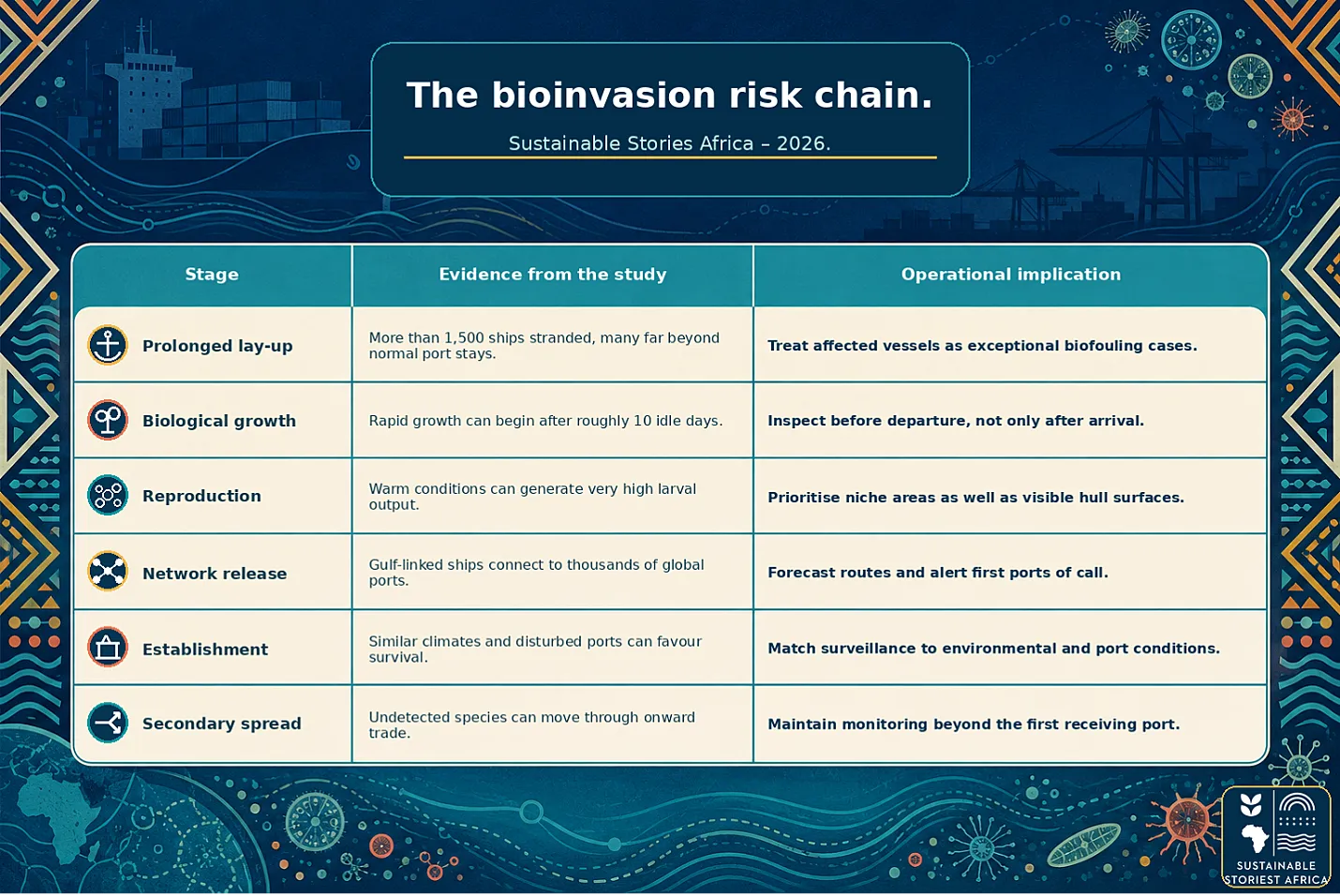
Published in Biological Invasions on July 22, 2026, the brief report estimates that more than 1,500 large commercial ships were stranded in the Persian/Arabian Gulf after the February 28 closure, with hundreds more anchored in the Gulf of Oman.
The authors describe the scale and duration of the lay-up as unparalleled in modern shipping history.
Their warning is not that a global invasion has already occurred. It is that the ingredients for a marine “super-spreader” event are present: prolonged immobility, warm water, dense vessel clustering and eventual links to thousands of ports.
Whether ecological harm follows will depend heavily on what ship operators, ports, regulators and environmental agencies do before and immediately after traffic resumes.
Idle Hulls Are Becoming Living Vectors
Commercial ships usually spend only one to three days in Gulf ports.
According to the study’s assessment, stranded vessels remained idle at least 40 times longer than an average stay.
That matters because antifouling coatings perform less effectively when ships stop moving, allowing marine microbes, algae and invertebrates to colonise submerged hulls, rudders, sea chests and piping.
Research cited by the authors indicates that biofouling on static surfaces can enter rapid growth after about 10 days.
The International Maritime Organisation’s 2023 guidance identifies extended idle periods of between 18 and 30 days as requiring immediate biofouling management action before the next voyage. The Hormuz lay-up exceeded those thresholds on an exceptional scale.
The Gulf is also a demanding biological filter
Its shallow, semi-enclosed waters can reach summer surface temperatures of about 38°C, with high salinity and limited exchange.
Organisms that survive there may be unusually tolerant of heat and stress, potentially improving their prospects in warming or disturbed recipient ports.
Heat, Time And Traffic Multiply Risk
The researchers describe a powerful amplification process. Vessels arrived carrying organisms from many source regions, accumulated Gulf species while stationary and provided new surfaces for reproduction.
The common barnacle Amphibalanus improvisus, for example, can release up to 36 larvae per adult per day at 30°C.
On densely fouled structures, that can translate into millions of larvae around a single vessel.
The risk is not limited to visibly attached species.
- Biofouling communities can transport parasites and pathogens, while new genetic material can strengthen non-native populations already established elsewhere.
- Ports disturbed by pollution, construction or warming may be especially vulnerable because damaged native communities offer less resistance to fast-growing opportunists.
The network effect is what makes the episode globally significant.
- The paper’s shipping analysis covered 3,027 unique vessels making 248,362 calls at 3,517 ports and anchorages over a year.
- It identified likely first-call pathways eastward through Jeddah, Mumbai, Colombo and Singapore, and westward through Alexandria, Piraeus, Algeciras and Rotterdam.
- These are not predictions of invasion; they show the reach through which risk could travel.
Prevention Costs Less Than Global Eradication
The most effective intervention is to remove biofouling before ships depart. In-water cleaning can reduce drag, fuel use and ecological risk, but cleaning debris must be captured and properly disposed of. Otherwise, the process can release live organisms, coating biocides and microplastics directly into surrounding water.
Capacity is the constraint. The urgency to evacuate crews and restart commerce may leave little time for comprehensive cleaning in the Gulf. Local service providers may not be able to treat the backlog, while some jurisdictions restrict in-water cleaning. Demand could therefore surge at the first ports receiving affected vessels, overwhelming their facilities too.
For African coastal states, the warning belongs inside trade and climate-resilience planning. Alexandria is named among likely westbound ports, while Red Sea, Indian Ocean, Mediterranean and Atlantic routes connect African gateways to the broader network. Fisheries, tourism, aquaculture and coastal ecosystems can all bear the long-term cost of an introduced species even when the original vessel has departed.
Early action can also protect shipping economics. Heavy biofouling increases hydrodynamic drag and fuel consumption, making speed or power-loss data a useful proxy for the amount of growth below the waterline. A response that combines environmental protection with operational efficiency gives shipowners a practical reason to cooperate.
Ports Need Coordinated Cleaning And Surveillance
The most effective intervention is removing biofouling before ships depart.
- In-water cleaning reduces drag, fuel use, and ecological risk.
- However, debris must be captured and properly disposed of; otherwise, the process releases live organisms, coating biocides, and microplastics directly into surrounding water.
Capacity is the constraint.
- The urgency to evacuate crews and restart commerce in the Gulf may leave little time for comprehensive cleaning.
- Local providers struggle with backlogs, and some jurisdictions restrict in-water cleaning altogether, risking surging demand at the first receiving ports.
For African coastal states, this warning belongs inside trade and climate-resilience planning.
Alexandria features among likely westbound ports, with Red Sea, Indian Ocean, Mediterranean, and Atlantic routes connecting African gateways to the broader network; fisheries, tourism, aquaculture, and coastal ecosystems bear long-term costs from introduced species long after vessels depart.
Early action also protects shipping economics, since heavy biofouling increases drag and fuel consumption, giving shipowners practical incentive to cooperate on environmental protection.
Path Forward – Biosecurity Must Move Before Shipping Restarts
The ecological outcome is still avoidable. Prevention becomes harder once vessels disperse, turning a manageable hull-cleaning backlog into years of detection, containment and possible eradication costs.
Ports should identify incoming Hormuz-linked ships, forecast routes, expand safe cleaning capacity and begin targeted monitoring now.
The window for low-cost action closes quickly when the engines restart.