Africa's infrastructure shortfall looms at up to US $170 billion annually. An S&P Global Ratings report reveals that without dramatic institutional reform and private-capital mobilisation, the continent's industrial and social ambitions risk being undermined.
Bridging Africa's institutional infrastructure gap
Africa stands at a decisive inflexion point: the gap in infrastructure investment is vast, yet the political and financial impetus for change is arguably stronger than ever.
A current S&P Global report shows annual infrastructure needs ranging between $130 billion and $170 billion, with private investment still largely constrained by institutional fragilities.
In recognition of this, policymakers and capital-market actors are rallying behind frameworks aimed at strengthening governance, clarifying legal contracts and improving project environments, key levers that could unlock previously inert capital.
The Scale and Nature of the Infrastructure Deficit
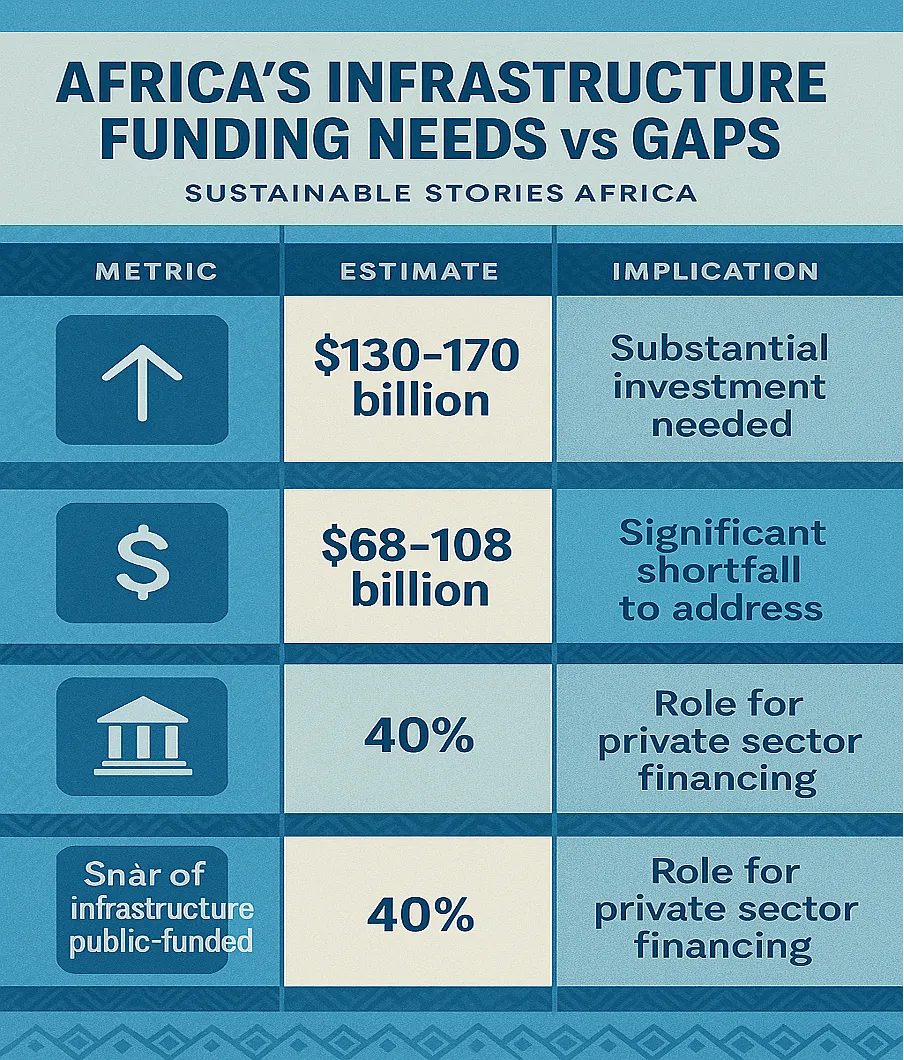
The report details that Africa's infrastructure requirement ranges from $130 billion to $170 billion per year.
On the financing side, annual funding gaps are estimated between $68 billion and $108 billion.
Africa's Infrastructure Funding Needs vs Gaps
| Metric | Estimate | Implication |
|---|---|---|
| Annual infrastructure requirement | $130-170 billion | High scale of challenge |
| Annual funding gap | $68-108 billion | Large unmet need despite investment impetus |
| Share of infrastructure public-funded | 40% | Implies ~60% needs private or external funding. |
Africa's Infrastructure Funding Needs vs Gaps
The sectors most stressed include energy, transport/logistics and digital infrastructure, all foundational to industrialisation and social connectivity. Awareness of this magnitude is critical: without full appreciation of both scale and sectoral need, investment strategies risk being misaligned or under-scaled for Africa's real challenge.
Institutional Barriers and Investor Hurdles
Despite the urgency, the report highlights persistent institutional and governance barriers that restrict infrastructure investment across Africa. These include unclear legal frameworks, weak contract enforcement, regulatory fragmentation and high perceived risk.
Key insight: Creditworthiness and investment risk are shaped far more by institutional settings than by raw need. The report emphasises that sovereign credit profiles and operational environments "significantly influence the performance of financial transactions but are not hard ceilings for ratings."
Further, many projects face high funding costs, currency risk and shallow domestic capital markets, limiting scale. For example, Africa added only about 6.5GW of utility-scale generation capacity in 2024, when compared to 18GW in India and 49GW in the US, highlighting the depth of under-investment.
Institutional Risk vs Investment Pipeline
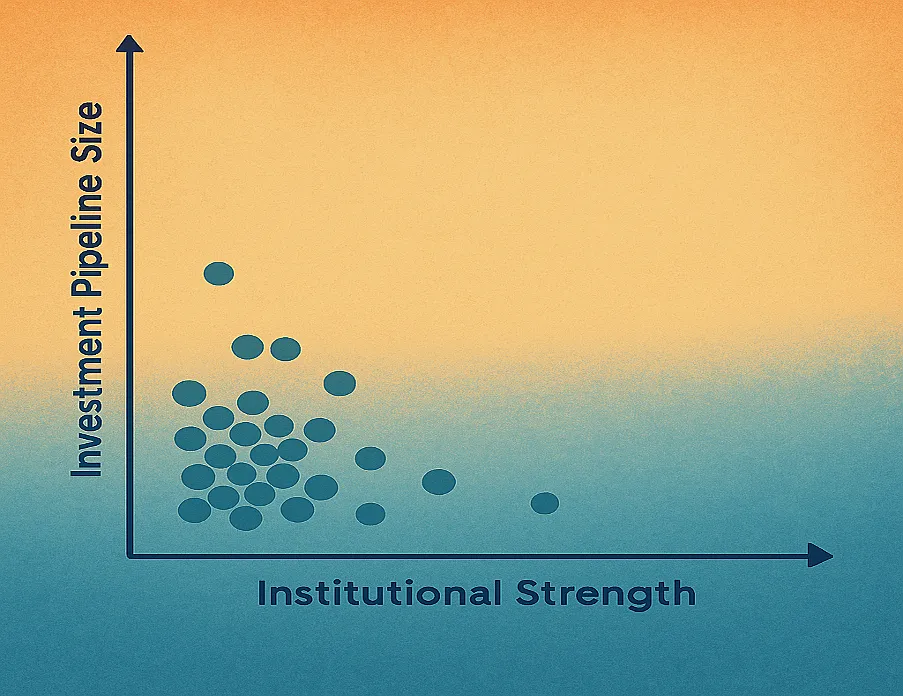
The implication: Simply increasing funding is insufficient unless institutions, governance, legal clarity and market structures are strengthened simultaneously.
Strategic Choices for Stakeholders
Informed by the insight stage, this section outlines the key decisions required by major stakeholder groups.
For governments and policymakers
- Adopt clear legal and regulatory frameworks: standardised contracts, enforceable dispute resolution, transparent procurement.
- Prioritise institutional capacity building: assign dedicated infrastructure units, improve risk assessment practices and project pipeline management.
For investors (domestic and international)
- Assess institutional environment rigorously: understanding legal clarity, governance mechanisms and risk mitigation is as important as yield.
- Engage in blended-finance and risk-sharing structures: leverage concessional layers or first-loss capital to enable viable returns in high-risk markets.
For development finance institutions (DFIs) and multilaterals
- Deepen support for catalytic financing: provide guarantees, credit enhancements and structuring support to de-risk projects.
- Align assistance with pipeline development and institutional reform: enabling project preparation, feasibility, and contracting standards.
Decision-Lever Framework
| Stakeholder | Decision Lever | Intended Outcome |
|---|---|---|
| Governments | Legal/regulatory reform, capacity building | Lower risk, better project execution |
| Investors | Risk-adjusted strategy, blended-finance participation | Access to frontier opportunities with mitigated risk |
| DFIs/Multilaterals | Catalytic capital, project preparation | Larger scalable pipelines, improved investability |
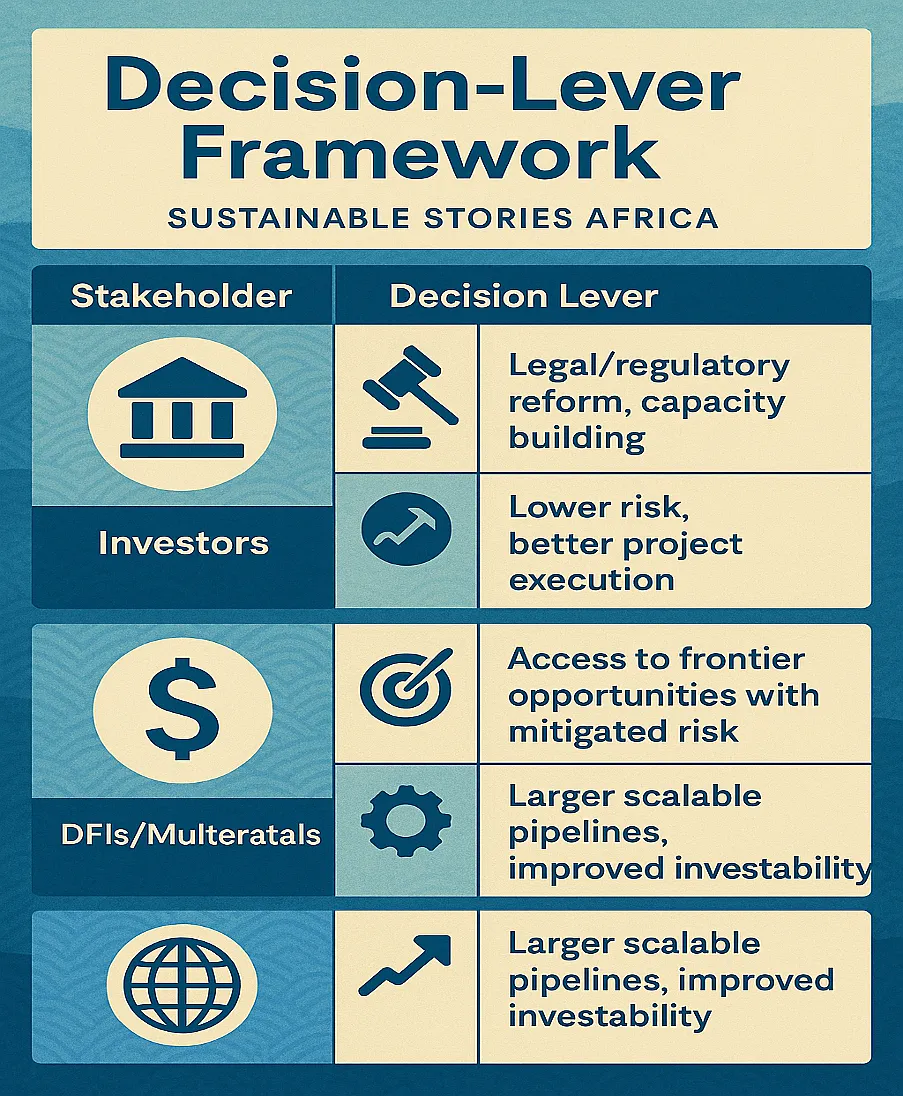
The choices made now will determine whether the continent's infrastructure gap narrows or remains entrenched.
Implementation Blueprint for Africa
Turning decisions into action means mobilising a set of coordinated measures across policy, financing and market architecture.
- Establish project-pipeline platforms – Governments should create centralised infrastructure-project registers with standardised documentation, risk profiles and contracting templates to attract investors.
- Deploy blended-finance structures – DFIs and governments can roll out risk-sharing mechanisms that combine concessional funds (e.g., first-loss, guarantees) with private capital—thereby unlocking new pools of investment.
- Strengthen institutional and governance frameworks – This includes contracting best practices, transparent procurement, capacity building for public-sector infrastructure units and regulatory stability. The report argues that strong governance and legal clarity are "will not be nice-to-haves, but are essential prerequisites for success."
- Promote domestic capital-market development – African infrastructure financing should increasingly leverage domestic currency issuance, local institutional investors and regional capital-markets integration to reduce foreign-currency risk and fund long-term assets.
Action Roadmap
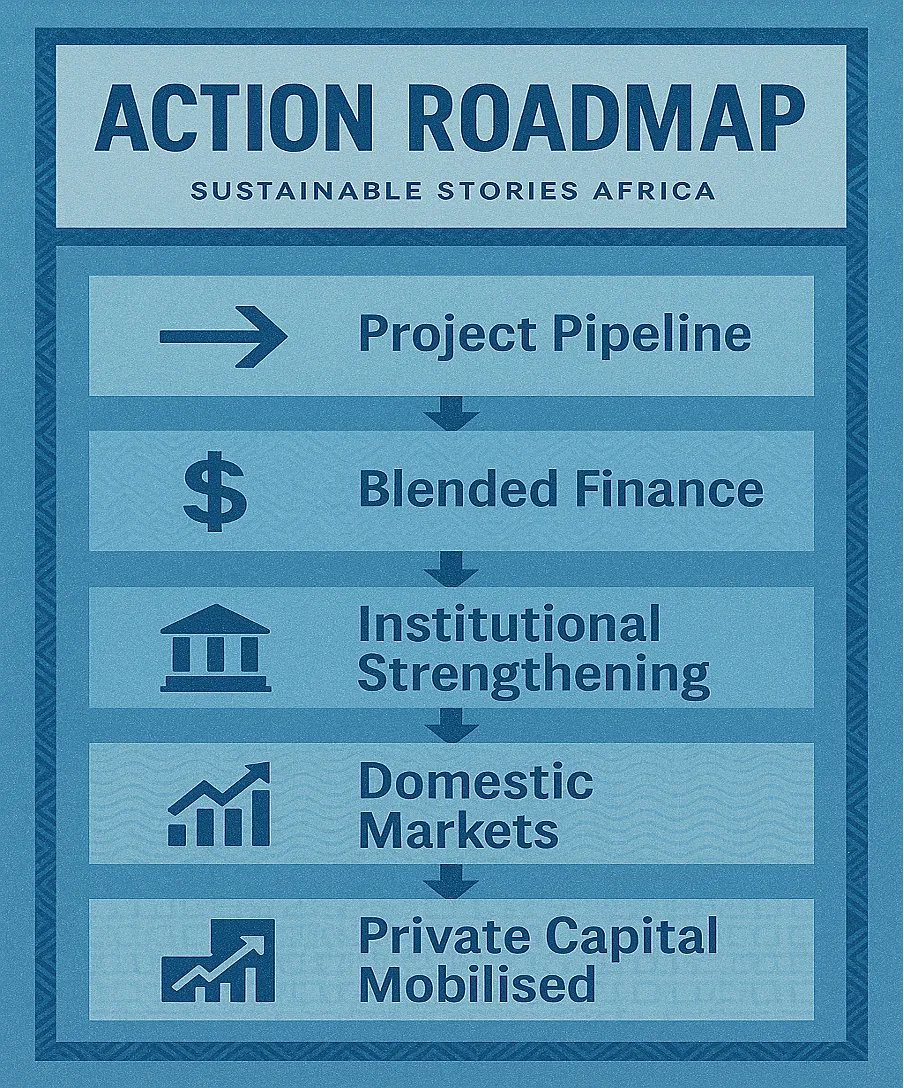
Together, these steps form the bridge between strategic decisions and operational delivery.
- Institutional reform – Deepen governance, legal frameworks and contracting to create credible investment environments.
- Pipeline maturation – Develop robust, bankable projects with standardised documentation and transparent risk profiling.
- Blended-finance scaling – Expand risk-sharing instruments and leverage private capital through concessional mechanisms.
- Market deepening – Foster local capital-market frameworks—domestic issuance, local currency financing, regional investor pools.
- Stakeholder coordination – Governments, DFIs, private investors and capital-markets platforms must align to reduce fragmentation and accelerate deal flow.
- Performance measurement – Implement rigorous standards for project execution, impact reporting and investor accountability to build trust and scalability.
This five-pillar approach underscores that beyond raising dollars, Africa's real task is to reshape the investment ecosystem.
Path Forward – Institutional Reform Unlocks Africa's Growth
To close the gap and scale infrastructure investment, Africa must execute on multiple fronts:
- Institutional reform – Deepen governance, legal frameworks and contracting to create credible investment environments.
- Pipeline maturation – Develop robust, bankable projects with standardised documentation and transparent risk profiling.
- Blended-finance scaling – Expand risk-sharing instruments and leverage private capital through concessional mechanisms.
- Market deepening – Foster local capital-market frameworks—domestic issuance, local currency financing, regional investor pools.
- Stakeholder coordination and performance measurement – Align stakeholders and implement rigorous execution and reporting standards to build trust and scalability.
The latest S&P Global report offers a roadmap, but execution will separate promise from progress. Africa's infrastructure story is no longer just about need; it is about execution.
Culled From: https://www.spglobal.com/en/research-insights/special-reports/look-forward/unlocking-africa/institutional-strategies-infrastructure-success-africa