
ESG is entering a new era defined by stricter regulations, deeper investor scrutiny, and a shift from voluntary, verifiable reporting. As global markets evolve, companies are expected to demonstrate measurable sustainability impact rather than rely on branding-led narratives.
Across Africa, Europe, Asia, and the Americas, boards are confronting rising expectations around climate transparency, supply-chain traceability, responsible artificial intelligence, and nature-related risk management. The next decade will redefine corporate governance as regulators align global standards, investors demand credible metrics, and stakeholders link corporate legitimacy to ethical outcomes, and they will transform how companies build trust, secure capital, and compete globally.
Ten ESG Trends Reshaping Global Corporate Behaviour
The global sustainability landscape is undergoing a rapid transformation, with ESG performance now shaping corporate valuation, regulatory exposure, and long-term competitiveness. The Corporate Governance Institute's latest analysis identifies ten emerging ESG trends that organisations must monitor closely as global expectations tighten.
These trends span climate reporting reforms, biodiversity disclosure, supply-chain accountability, human-capital expectations, and the expanding role of technology in corporate governance.
For African companies, the implications are profound. As global investors increasingly embed ESG metrics into due diligence and risk assessment, markets that fail to modernise disclosure frameworks risk capital flight and reputational damage.
Meanwhile, regulators across Europe, North America, and Asia are synchronising reporting mandates, from the EU's CSRD to ISSB-aligned global standards. This shift marks the beginning of a new era, one where ESG competence is no longer optional but a core determinant of resilience and investment attractiveness.
Global ESG Rules Accelerate as Investors Demand Measurable Impact
The Corporate Governance Institute's ESG Trends Report highlights a decisive shift from voluntary sustainability claims to regulatory-backed, data-driven accountability.
As climate disruption intensifies and stakeholder expectations expand, corporations face mounting pressure to show measurable governance, environmental, and social performance.
The report identifies ten transformational trends set to shape the next decade of corporate responsibility and investor expectations.
Ten ESG Trends Boards Must Watch Closely
Below is a consolidated summary of the ten trends reshaping global ESG governance:
The 10 Global ESG Trends
| Trend | Summary | Key Impact |
|---|---|---|
| 1. ESG Regulation Surge | Mandatory disclosures accelerate globally | Higher compliance obligations |
| 2. Climate Risk Integration | More climate stress-testing | Stronger resilience planning |
| 3. Nature & Biodiversity | New TNFD reporting norms | Expanded eco-risk oversight |
| 4. Supply Chain Scrutiny | Forced-labour risk audits | Transparent procurement |
| 5. Responsible AI | Ethics + governance frameworks | AI-risk accountability |
| 6. Diversity, Equity & Inclusion | DEI data expectations rise | Workforce transparency |
| 7. Anti-Greenwashing Enforcement | Penalties for ESG exaggeration | Credibility or liability |
| 8. Board ESG Expertise | Governance skills required | ESG-aware leadership |
| 9. Investor Activism Grows | Shareholder demands intensify | Strategic shift for boards |
| 10. ESG Tech Adoption | Data automation spreads | Reliable audit-ready metrics |
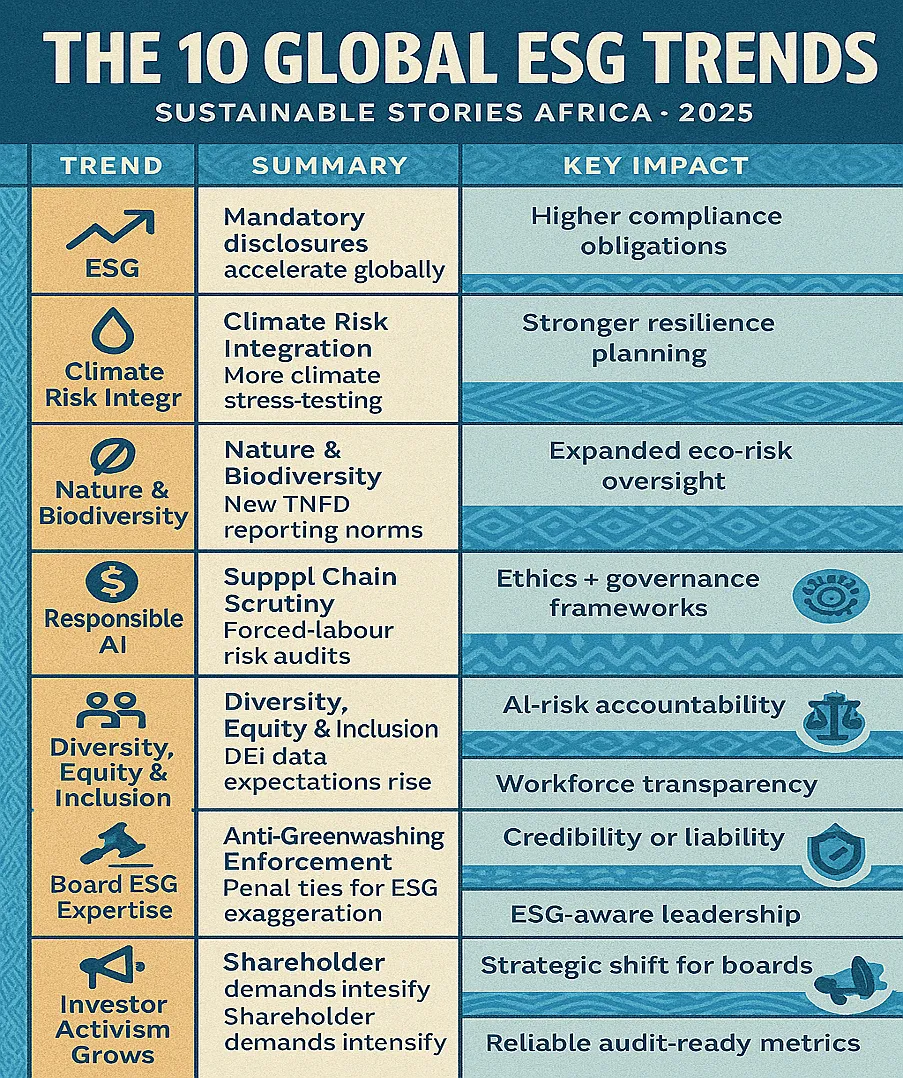
These trends reflect tightening global norms and investor expectations that require executives and boards to embed sustainability deeply into strategy.
Evidence Behind the Repositioning of ESG as Core Governance
The report underscores that ESG is no longer a communications function but a performance-driven assessment tool. Markets such as the EU are enforcing CSRD, which demands audited sustainability data. Regulators are also cracking down on greenwashing through financial penalties, legal actions, and stronger truth-in-advertising requirements.
Investors and rating agencies increasingly value companies that demonstrate credible decarbonisation plans, ethical supply chains, social-protection mechanisms, and diversity metrics linked to business outcomes.
Why ESG Now Drives Corporate Valuation
| ESG Area | Investor Influence | Corporate Effect |
|---|---|---|
| Climate | Transition-risk modelling | Impacts cost of capital |
| Biodiversity | Nature-loss exposure | Supply-chain volatility |
| Governance | Board skills, ethics | Trust + regulatory stability |
| Workforce Rights | Labour compliance | Brand & talent attraction |
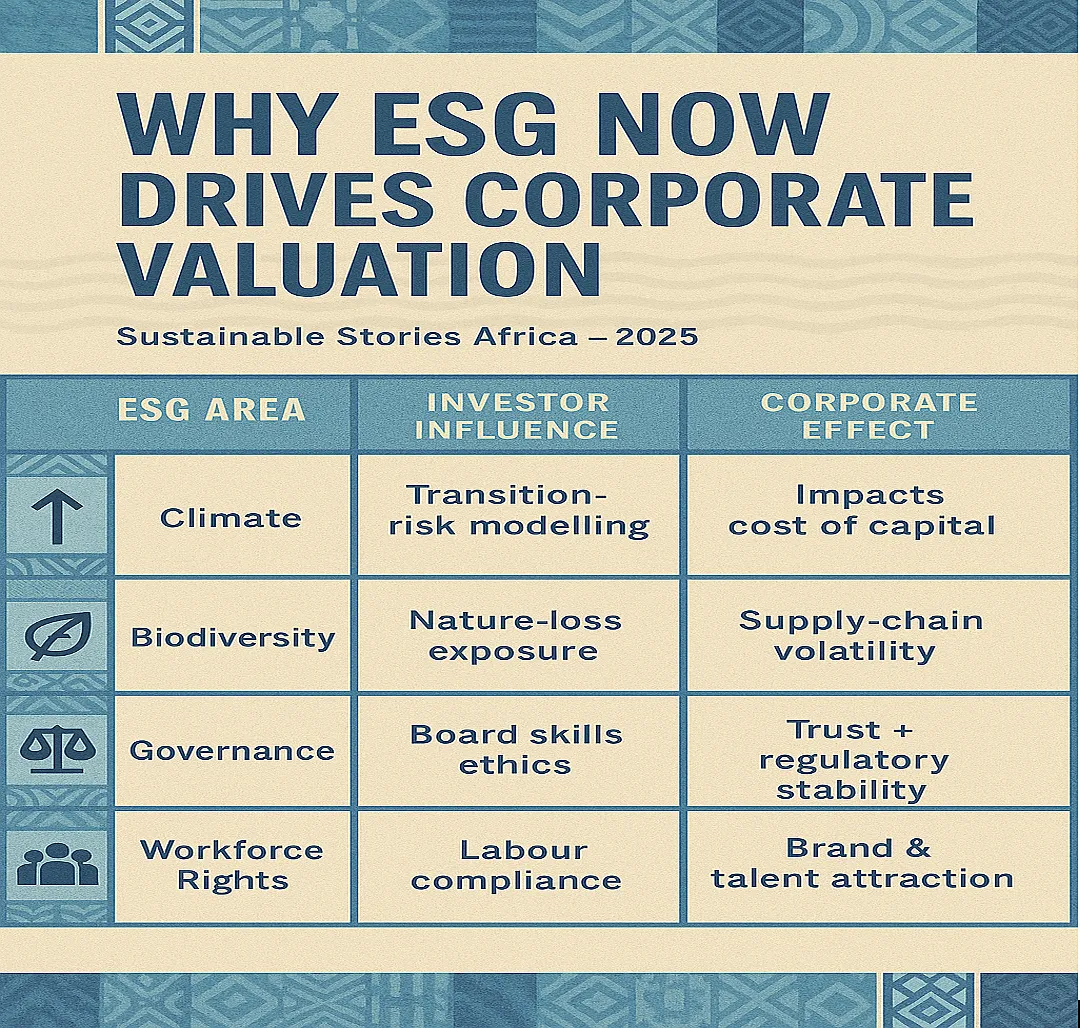
Organisations without structured ESG systems now face higher risk premiums, capital-access challenges, and operational uncertainties.
What Organisations Must Implement to Remain Competitive
The report outlines several imperatives for boards and management teams:
- Strengthen governance architecture – Boards must recruit ESG-skilled directors, establish sustainability committees, and adopt enterprise-wide risk frameworks aligned with ISSB, GRI, and TNFD standards.
- Invest in reliable ESG data systems – Companies should deploy ESG data platforms to automate metrics, centralise reporting, and support external assurance.
- Prevent greenwashing through transparency – Firms must ensure claims are supported by evidence, third-party verification, and clear methodologies.
- Benchmark against global standards – Companies must align reporting with CSRD, IFRS S1/S2, SEC climate rules, and national legislation.
- Scale climate adaptation and supply-chain due diligence – Climate-risk modelling, scenario planning, and procurement audits should be integrated into business strategy.
PATH FORWARD – Embedding ESG to Strengthen Corporate Accountability
The report makes clear that businesses must institutionalise ESG across governance, operations, and reporting systems to remain competitive in the global market. A future defined by mandatory disclosures demands credible data, oversight, and expertise.
Organisations that invest in ESG readiness now, especially across Africa, will be better positioned to attract investors, strengthen resilience, and build trust among customers and regulators.
Culled From: https://www.thecorporategovernanceinstitute.com/insights/guides/10-esg-trends-to-watch/