As floods, droughts, heatwaves and erosion intensify, a World Bank-backed policy guide argues that nature can no longer be treated as scenery.
It must be planned, financed and governed as resilience infrastructure.
The central challenge is policy: nature-based solutions are growing, but fragmented laws, weak incentives and grey-infrastructure bias still stop many countries from scaling them.
Nature Becomes Infrastructure For Resilience Now
Nature-based solutions (NBS) are moving from the margins of climate action into the centre of disaster-risk policy, as governments search for cheaper, more inclusive ways to protect people, infrastructure and local economies from climate shocks.
A 2026 World Bank and GFDRR policy guide, Unlocking Nature for Disaster Resilience, says ecosystems such as mangroves, wetlands, floodplains, forests, reefs, green corridors and urban open spaces can reduce disaster risks while supporting health, jobs, biodiversity and carbon storage.
For African markets, the message is practical. In cities facing flash floods, coastal erosion and urban heat, nature is not a soft add-on.
It is drainage, cooling, water protection, slope stabilisation, food security and insurance against the next shock.
Nature Is Becoming Risk Infrastructure
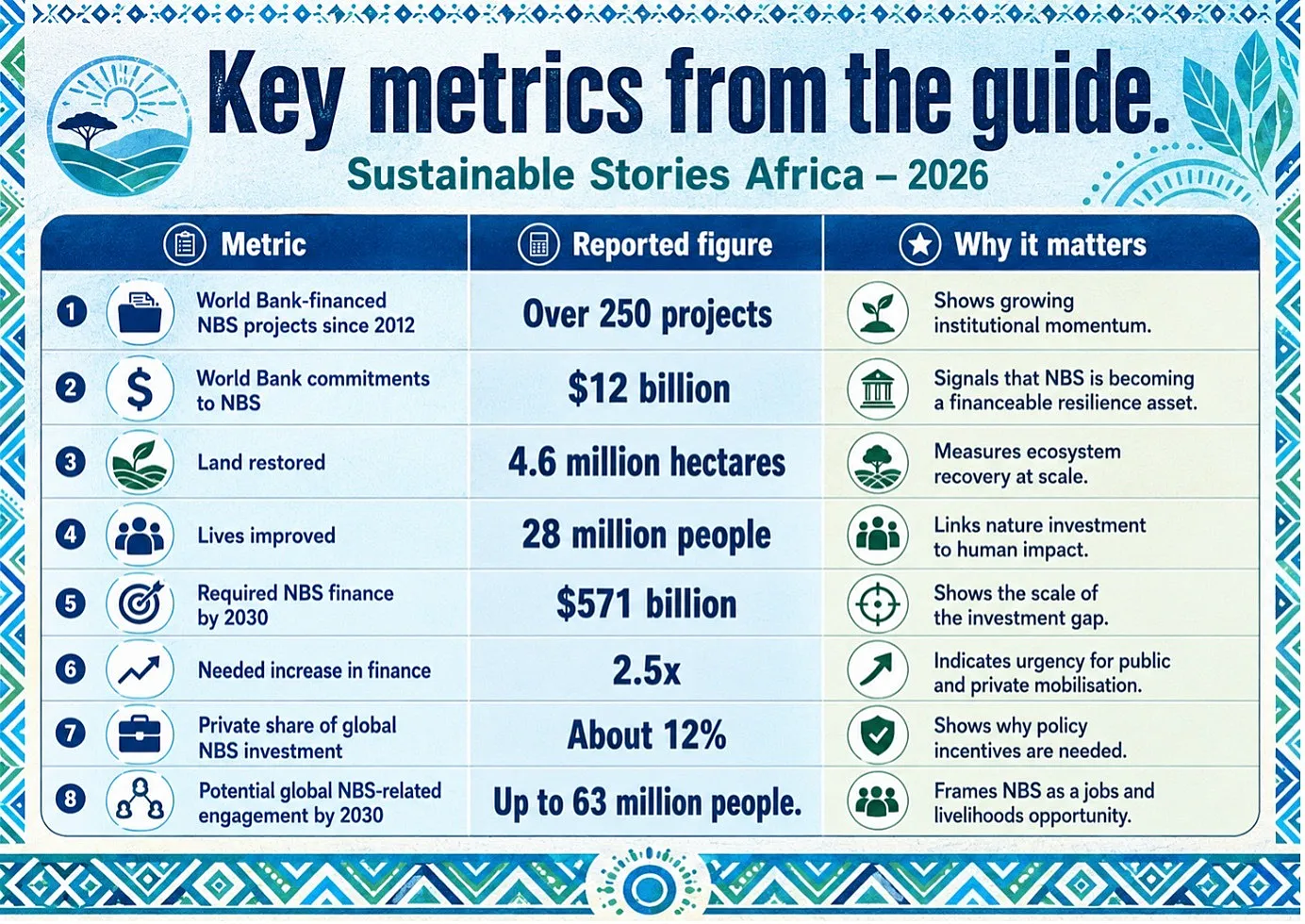
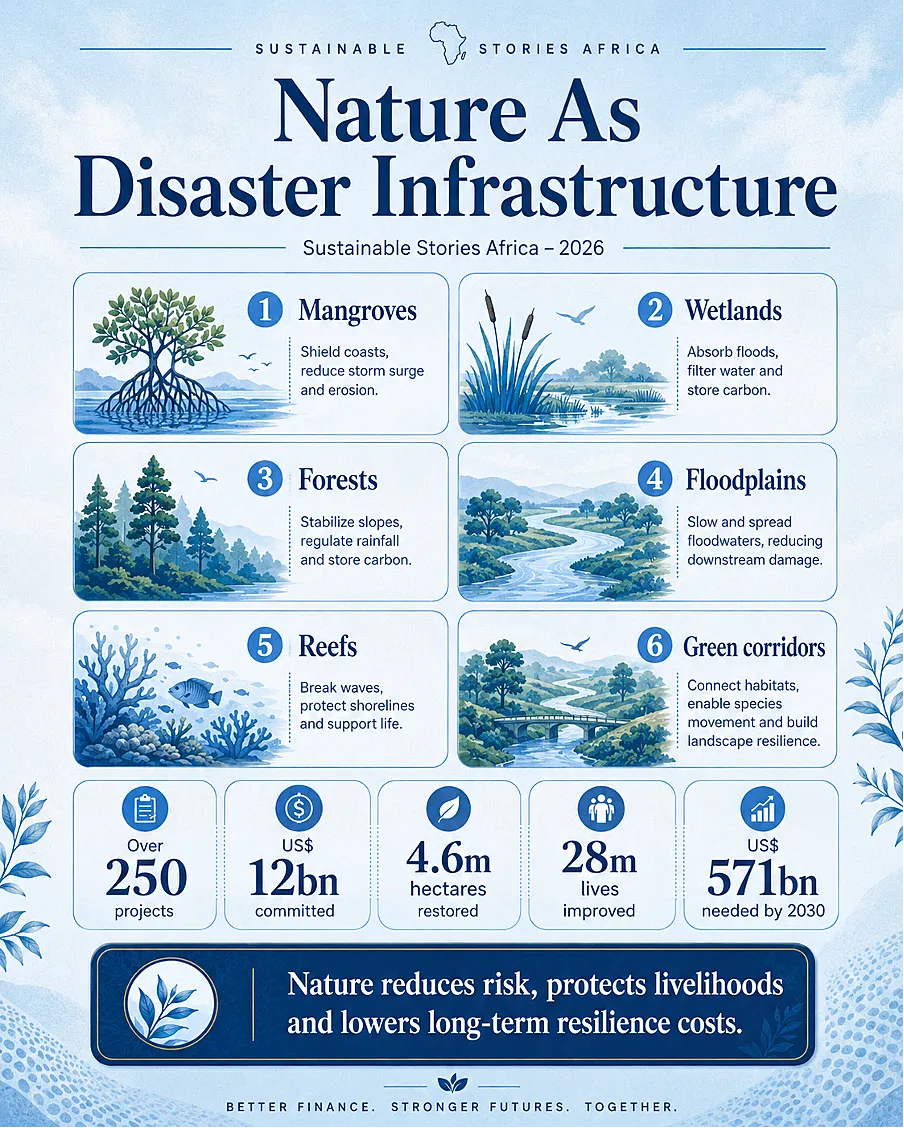
The strongest metric in the guide is also the clearest signal of momentum: since 2012, the World Bank has financed more than 250 nature-based solution projects, committing $12 billion, restoring 4.6 million hectares and improving 28 million lives.
However, the same guide warns that finance remains far below climate targets, with global NBS funding needing to rise two-and-a-half-fold to $571 billion by 2030.
That gap matters because disasters are no longer occasional disruptions. Floods wash away roads, droughts weaken food systems, erosion threatens coastal livelihoods, and heat turns dense cities into public-health risks.
For communities in Lagos, Dakar, Accra, Mombasa or informal settlements along vulnerable waterways, resilience is not only about emergency response. It is about whether planning laws, budgets and investment rules protect the natural systems that already reduce risk.
The guide’s central argument is direct: policies enable scale. Public policy must create the legal, financial and operational mechanisms that enable and incentivise, and, where appropriate, require nature-based solutions for disaster-risk reduction and climate resilience.
The Numbers Show Policy Gaps
Nature-based solutions work by using ecosystem services to reduce hazards such as floods, droughts and erosion.
The guide defines them broadly as actions that protect, conserve, restore and manage natural or modified ecosystems while addressing social, economic and environmental challenges.
These can include mangrove restoration, river floodplain protection, wetland rehabilitation, urban forests, green corridors, bioretention areas, terraces, slopes and reef ecosystems.
However, uptake remains uneven. The guide says NBS are still overlooked by many public policy frameworks, which often fail to remove legal barriers, create incentives or provide maintenance systems.
Prevailing regulations and technical standards still tend to favour grey infrastructure, while even countries that mention NBS in national policy often struggle to translate ambition into subnational rules and implementation.
One revealing number explains why public policy matters: private actors provide only about 12% of global NBS investments.
Without clear rules, bankable models, tax incentives, standards, trust funds, insurance structures and local implementation capacity, many private investors will continue to see nature projects as risky, small or difficult to measure.
Better Policy Can Protect Communities
The development opportunity is significant. Urban forests and green spaces can reduce stormwater runoff and lower urban temperatures.
Mangroves can dissipate wave energy, reduce storm-surge height, stabilise sediments and help prevent erosion.
These benefits can complement or substitute grey infrastructure and often come with wider gains, including carbon sequestration, biodiversity, recreation and local livelihoods.
For African cities, this means flood control does not have to rely only on concrete channels. Coastal defence does not have to mean seawalls alone.
Heat adaptation does not have to be limited to air-conditioning. A greener resilience model can combine wetlands, drainage upgrades, zoning reforms, community stewardship and targeted public finance.
The guide estimates that up to 63 million people could be engaged globally in NBS-related activities by 2030 across planning, construction, operation and maintenance.
That makes NBS a labour-market story as well as a climate story, particularly for ecosystem restoration, urban green infrastructure, coastal protection and disaster-risk-reduction activities.
South Africa offers one of the clearest examples in Africa. The guide highlights a mix of regulatory, financial and voluntary instruments, including the Disaster Management Amendment Act 2015, tax deductions for ecosystem conservation, the Green Fund and the Kruger to Canyons Catchment Investment Programme.
It also notes that the National Water Act and Integrated Urban Development Framework support water resource protection and urban ecosystem restoration.
Examples of other countries show how NBS can be mainstreamed across sectors. Ethiopia integrates NBS into climate and economic strategies.
- Senegal’s River Basin Masterplan 2050 addresses flood and drought risks through action plans promoting NBS
- Costa Rica uses payments for ecosystem services.
- The Philippines has used risk data and planning guidelines to support resilient and green settlements.
Move From Pilots To Systems
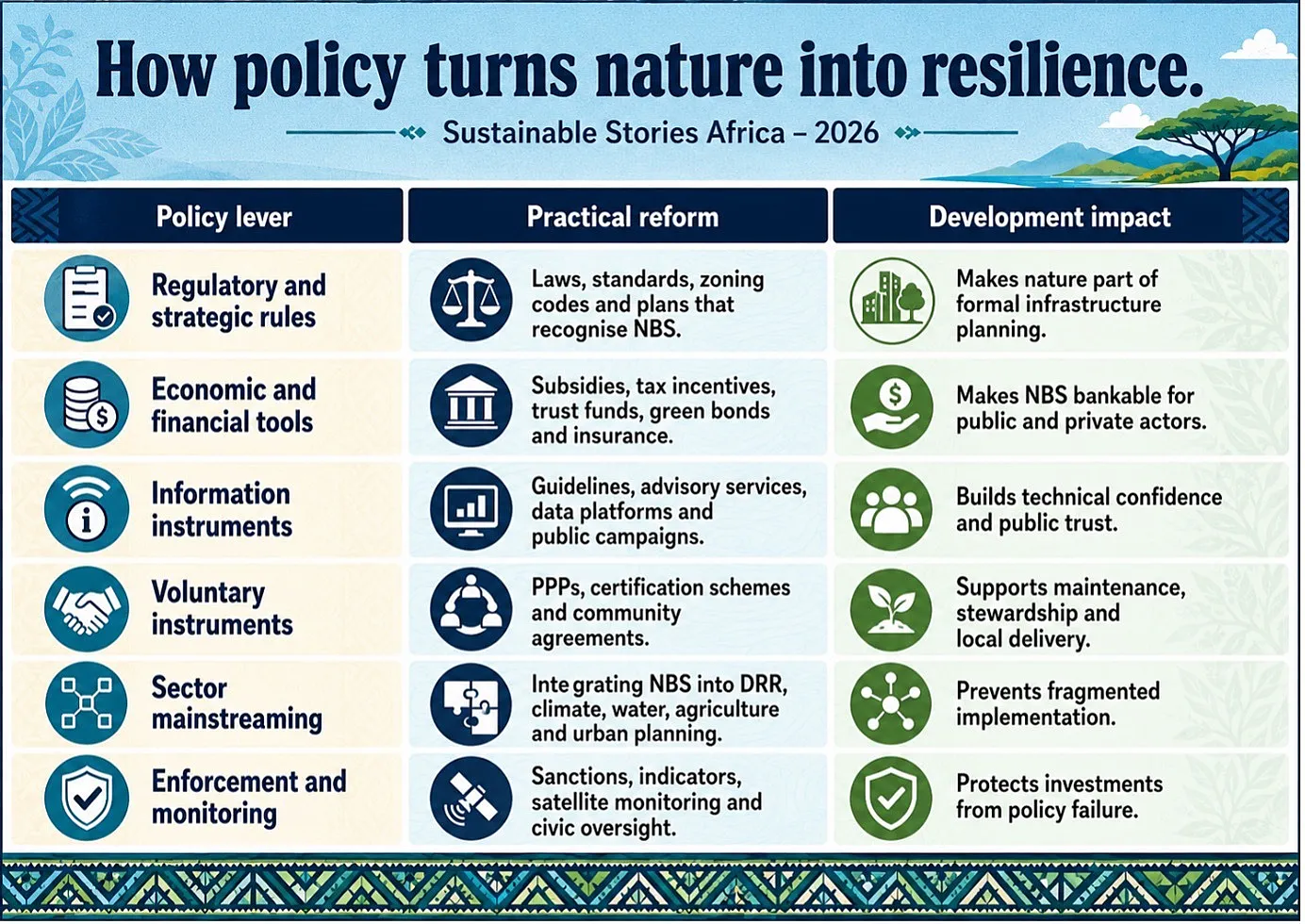
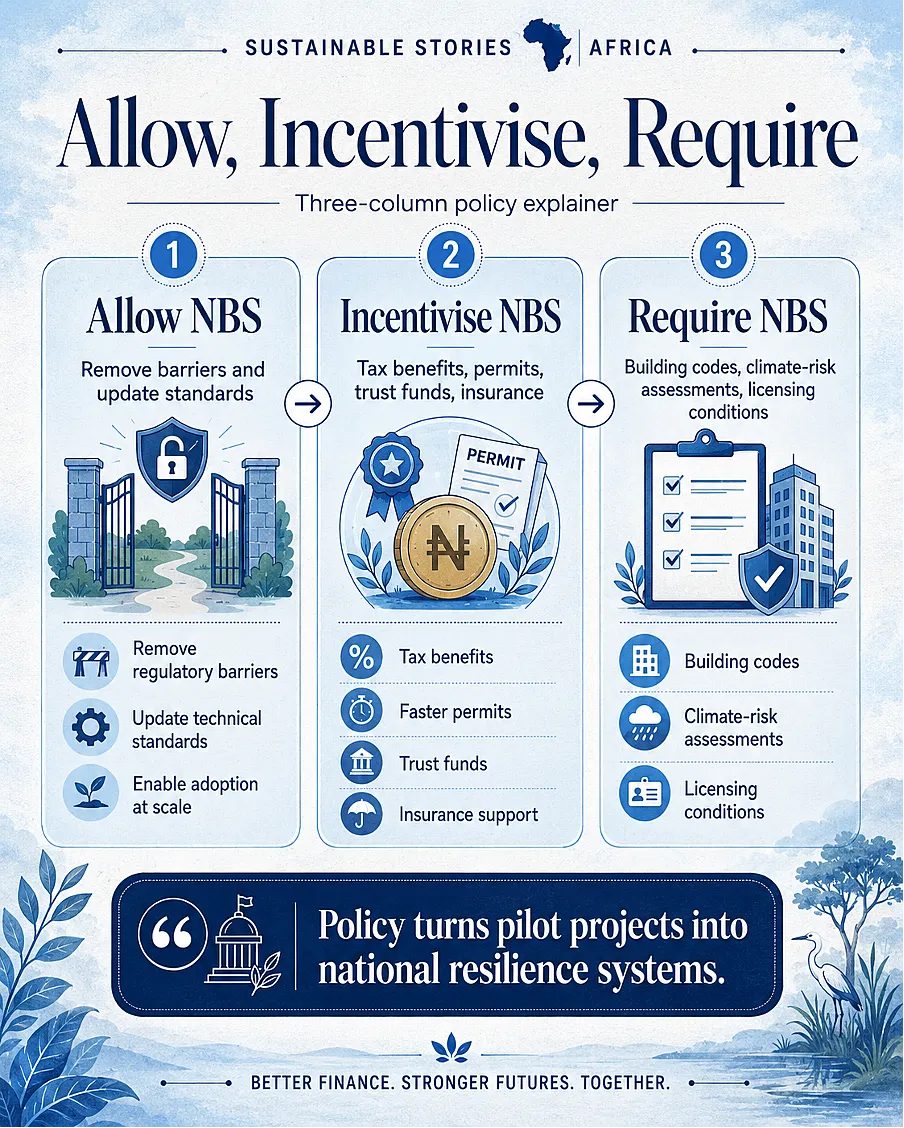
The guide’s most actionable framework is simple: allow, incentivise and require. Governments can first allow NBS by removing rules that force only grey infrastructure. They can incentivise NBS through simplified permits, public funds, tax benefits or preferred technical guidelines.
They can require NBS by embedding it in building codes, climate-risk assessments, environmental regulations, and public investment standards.
This is especially relevant for African finance ministries, environment ministries, planning agencies, city governments and development banks.
The guide recommends assigning finance ministries climate and NBS budget mandates, designing adaptive policies based on monitoring frameworks, and establishing clear enforcement mechanisms for regulations.
The policy opportunity also sits inside development finance.
The guide says World Bank instruments such as Development Policy Financing and Catastrophe Deferred Drawdown Options have helped advance disaster-risk-management reforms.
Investment financing can support regulatory requirements, institutional arrangements and technical standards for NBS.
For businesses, the relevance is growing in tourism, extractives, energy, transport and real estate.
The guide notes that tourism policies can mandate dune restoration, mangrove conservation, green roofs and vegetative buffers.
Extractive-sector rules can require post-extraction rehabilitation, reforestation, wetland recovery and soil regeneration.
Botswana’s mining framework is cited as an example of a legal basis for environmental management plans, mine closure and rehabilitation obligations.
 |  |
Path Forward – Make Nature Count In Resilience Planning
The next step is not only more tree planting or wetland restoration.
It is policy reform: integrating NBS into national plans, city codes, DRR laws, climate finance, water management, agriculture, tourism, mining and infrastructure standards.
For African markets, the promise is clear.
Resilience can be greener, cheaper and more inclusive when nature is treated as public infrastructure, financed with discipline and protected by enforceable rules.