
Nigeria’s tax system crossed a critical line on 1 January 2026, when new rules for the 2025 Tax Acts began to govern how citizens, companies and government agencies file, dispute, and negotiate tax obligations.
For regulators, the guidelines promise non‑retroactivity and consistency; for businesses, they protect contracts and cash flows; for investors, they signal a more predictable, ESG‑aligned tax environment in Africa’s largest economy.
New era, new rules, shared stakes
When Nigeria’s new Tax Acts fully kick in on 1 January 2026, the real story will not just be new rates or fresh acronyms, but how smoothly the country crosses from an old rulebook to a new one.
The Federal Ministry of Finance has now issued General Transition Guidelines to demonstrate that shift, covering income taxes, transaction taxes and incentives under the Nigeria Tax Act and Nigeria Tax Administration Act 2025.
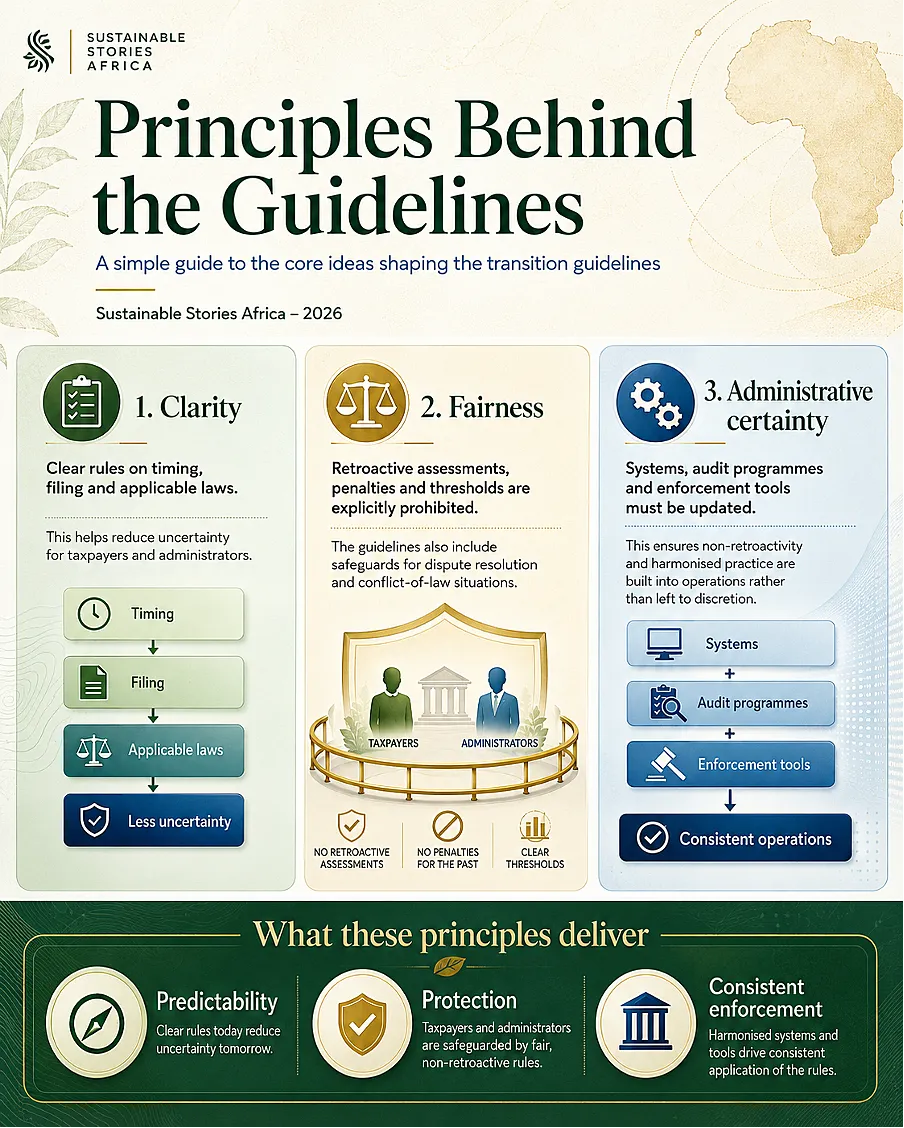
Anchored on three principles, clarity, fairness and administrative certainty, the guidelines are designed to ensure that retroactive rules do not affect taxpayers and that authorities apply the new Acts consistently across federal, state and local tiers.
For a market where policy U‑turns and inconsistent enforcement often undermine ESG, governance and investment outcomes, the signal is deliberate: clear rules today, stronger tax administration tomorrow.
What happens in Nigeria will reverberate across Africa and emerging markets.
This observes how a major economy retools its tax architecture without derailing business continuity, public trust or growth. The guidelines show how the state can enhance revenue mobilisation while protecting taxpayers from retrospective shocks, which goes to the heart of sustainable finance, social licence and long‑term development.
Clear rules for a critical transition
A single date defines Nigeria's tax transition: obligations from 1 January 2026 fall under the new tax Acts, while all pre-2026 liabilities remain governed by repealed legislation.
Critically, no taxpayer faces reassessment for previously compliant transactions, and new penalties, thresholds or definitions cannot be applied retroactively.
Issued under sections 144 and 200 of the new legislation, the General Transition Guidelines cover the Nigeria Revenue Service, State Internal Revenue Services, the FCT Internal Revenue Service and local government Joint Revenue Committees.
They guide employers, companies, small businesses, and individuals through the shift from legacy PAYE, company income tax and transaction tax rules, including VAT, WHT and stamp duties, to the 2025 regime.
For ESG-minded investors, the guidelines represent an early signal of Nigeria's commitment to predictable governance, rule of law and an investment-friendly fiscal environment.
How the transition will actually work
Nigeria's General Transition Guidelines establish three governing principles: the new tax Acts apply prospectively from commencement; no penalty or administrative requirement applies retroactively to pre-2026 periods; and enforcement for earlier obligations continues under repealed laws.
This creates a clean legal boundary that limits jurisdictional disputes between old and new regimes.
- For businesses, the filing rules are straightforward. Returns due before 1 January 2026 use existing forms and procedures, while those due on or after that date follow new schedules and electronic templates, with current forms remaining valid until replacements are issued to prevent filing gaps.
- Investors and lenders benefit from reduced timing uncertainty. Pre-commencement appeals continue under repealed laws, while objections raised after that date follow the new Acts regardless of the assessment year, providing clearer interpretive guidance for legacy exposures.
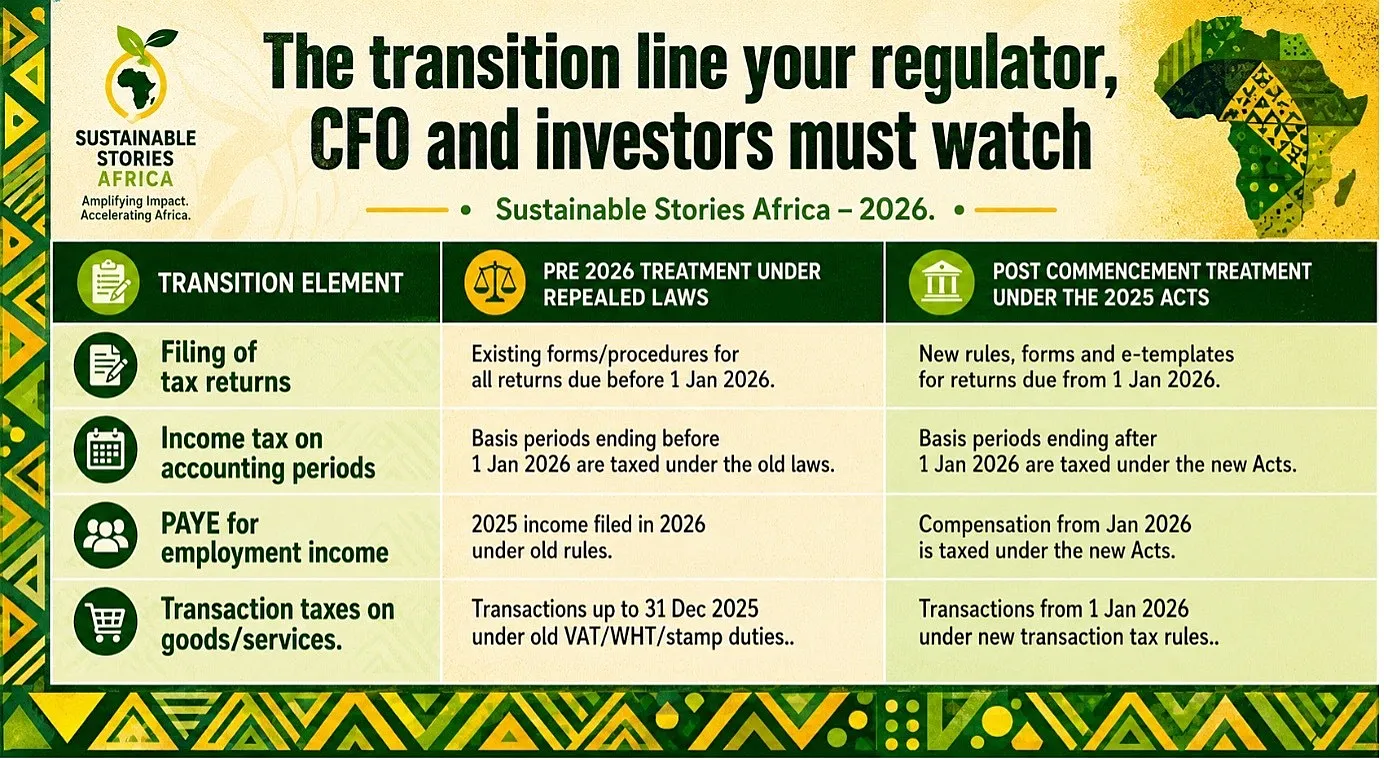
- For workers and HR teams, 2025 PAYE deductions remain under repealed laws, while salaries paid from January 2026 fall under the new regime.
- Corporate tax planners should note that accounting periods ending before 1 January 2026 stay under the old regime even where returns fall due later.
- Special levies are also rationalised. Pre-2026 periods retain earmarked levies for TETFUND, NASENI and NITDA. Post-2026 periods adopt a single development levy.
- Small companies gain recalibrated thresholds: turnover not exceeding N100 million and assets not exceeding N250 million, broadening MSME protection and supporting financial inclusion goals.
What a successful transition looks like
If implemented as written, Nigeria's tax transition guidelines offer something rare: a defensible legal boundary that strengthens regulators in courtrooms, tribunals and audits through non-retroactivity, clear conflict-resolution rules and taxpayer-favourable interpretations.
For CEOs and MSME founders, the clarity is transformative.
- Knowing that old periods follow old laws and new periods follow new rules allows finance teams to price projects, structure contracts and plan incentives with confidence, particularly for multi-year deals in energy, infrastructure and technology where only post-January 2026 activity falls under the new Acts.
For investors and lenders, governance risk edges downward.
- Honouring legal expectations, preserving existing incentives and consolidating earmarked levies into a single development levy signals policy stability, a critical consideration for ESG-screened funds, green bonds and blended-finance vehicles that increasingly flag tax unpredictability alongside corruption and environmental risk.
For citizens, the deepest gain is trust: a tax system that is transparent, consistent and fair rebuilds the social contract.
One playbook, different roles to execute
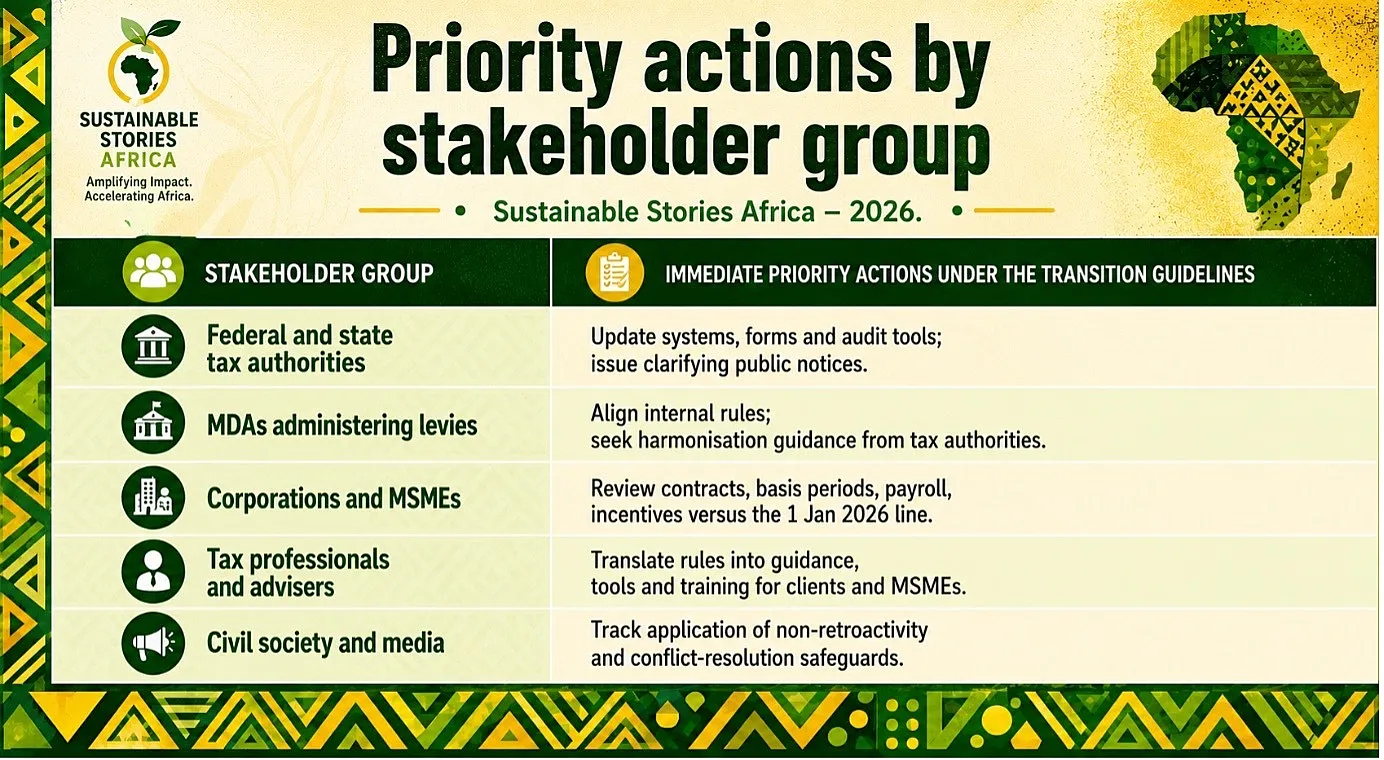
Nigeria's tax transition demands deliberate action from three key stakeholders.
Regulators and tax officials must ensure:
- That they modernise audit programmes, case-management tools and e-filing platforms to ensure the automatic application of the correct regime by date rather than discretion.
- Clear, public-facing notices, particularly around contracts spanning both regimes, and internal review gates to intercept retroactive assessments will be essential to credible implementation.
CEOs, CFOs and MSME founders should convert
- January 1, 2026, boundary into a practical working tool. Mapping payroll cycles, accounting periods, major contracts and incentive approvals into pre- and post-2026 categories, with documented legal rationale, reduces exposure.
- Particular attention should go to transitional contracts where delivery and payment straddle the line, requiring upfront agreement on VAT, WHT and transaction tax treatment.
For investors, lenders and rating analysts:
- The transition rules warrant direct integration into risk models and covenants.
- Where the new framework reduces ambiguity, that improvement should be reflected in pricing, rewarding consistency with longer tenors, lower spreads and stronger capital commitments, especially in climate-critical sectors.
Across all groups, the guidelines must be treated as a living framework: tracked, stress-tested and collectively refined as implementation unfolds.
Path Forward – Turning rules into shared confidence
The transition guidelines give Nigeria a chance to show that tax reform can be both technically sound and socially fair, if administrators stick to non‑retroactivity, businesses actively map their exposure, and investors reward predictable governance with longer‑term capital.
By using this window to fix systems, communicate clearly and resolve conflicts transparently, authorities, firms, and citizens can turn a complex legal handover into a visible ESG win: stronger revenue, fairer treatment and a more investible Nigerian and African market story.