Global climate finance has reached historic levels, yet only a small share reaches Africa.
The missing link is increasingly institutional: projects are scattered, governance is weak, and pipelines are rarely investment-ready.
A climate finance desk can change that equation by connecting strategy, products, risk, data and partnerships into a single operating capability.
Climate Capital Exists, Institutional Capacity Lags
The global climate finance pool is no longer small. Climate Policy Initiative reported that flows reached about $1.9 trillion in 2023, while the African Development Bank has said Africa receives only about 3% to 4% of global climate finance.
The contrast asks the central question less about whether capital exists and more about why African institutions are not consistently able to access, structure and deploy it.
That question framed Abiola Oshunniyi’s presentation, Building a Climate Finance Desk, at the Climate Finance Preparedness Clinic 2026.
The argument is direct: Africa has energy, healthcare, agriculture, waste, water and transport challenges that can become investable climate opportunities; however, only when institutions develop the machinery to convert them into credible portfolios.
For Nigerian banks, development finance institutions and large corporates, the proposed desk is not a decorative sustainability unit.
It is an enterprise capability to link governance, origination, credit, risk, technology, product design, partnerships, capital mobilisation and impact reporting.
Without that connective tissue, good ideas can remain too small, too fragmented or too weakly documented to attract funding.
Africa’s Finance Gap Is Operational First
CPI’s African landscape data sharpens the urgency. Average annual climate finance to Africa rose from $29.5 billion in 2019/20 to $43.7 billion in 2021/22, crossing $50 billion in 2022.
Even so, tracked flows met only 23% of the continent’s estimated annual needs for implementing existing nationally determined contributions. CPI concluded that annual flows must at least quadruple through 2030.
Nigeria illustrates the imbalance. CPI’s 2025 country landscape found that adaptation received about $0.74 billion in 2021/22, covering only 6% of the country’s estimated adaptation needs.
Flood resilience, climate-smart agriculture, distributed energy, cleaner transport and water infrastructure may all be necessary; however, necessity does not automatically produce bankable transactions.
The presentation revisits an earlier warning from the Clean Development Mechanism.
Africa had projects, natural resources and development needs; however, it lacked adequate institutional capabilities, project preparation, aggregation and investment-ready portfolios. Article 6 of the Paris Agreement offers new routes for international cooperation and carbon market finance.
Repeating the old pattern would mean watching capital pass by again.
Desks Connect Governance, Products, Data, Capital
Oshunniyi’s framework asks institutions to stop building isolated projects and start building portfolios.
- A national solar-schools programme is easier for major investors to evaluate than dozens of unrelated school installations.
- The same logic can aggregate healthcare energy efficiency, climate-smart agriculture, circular-economy assets or nature-based adaptation into repeatable pipelines with common standards.
Scale, however, cannot substitute for governance.
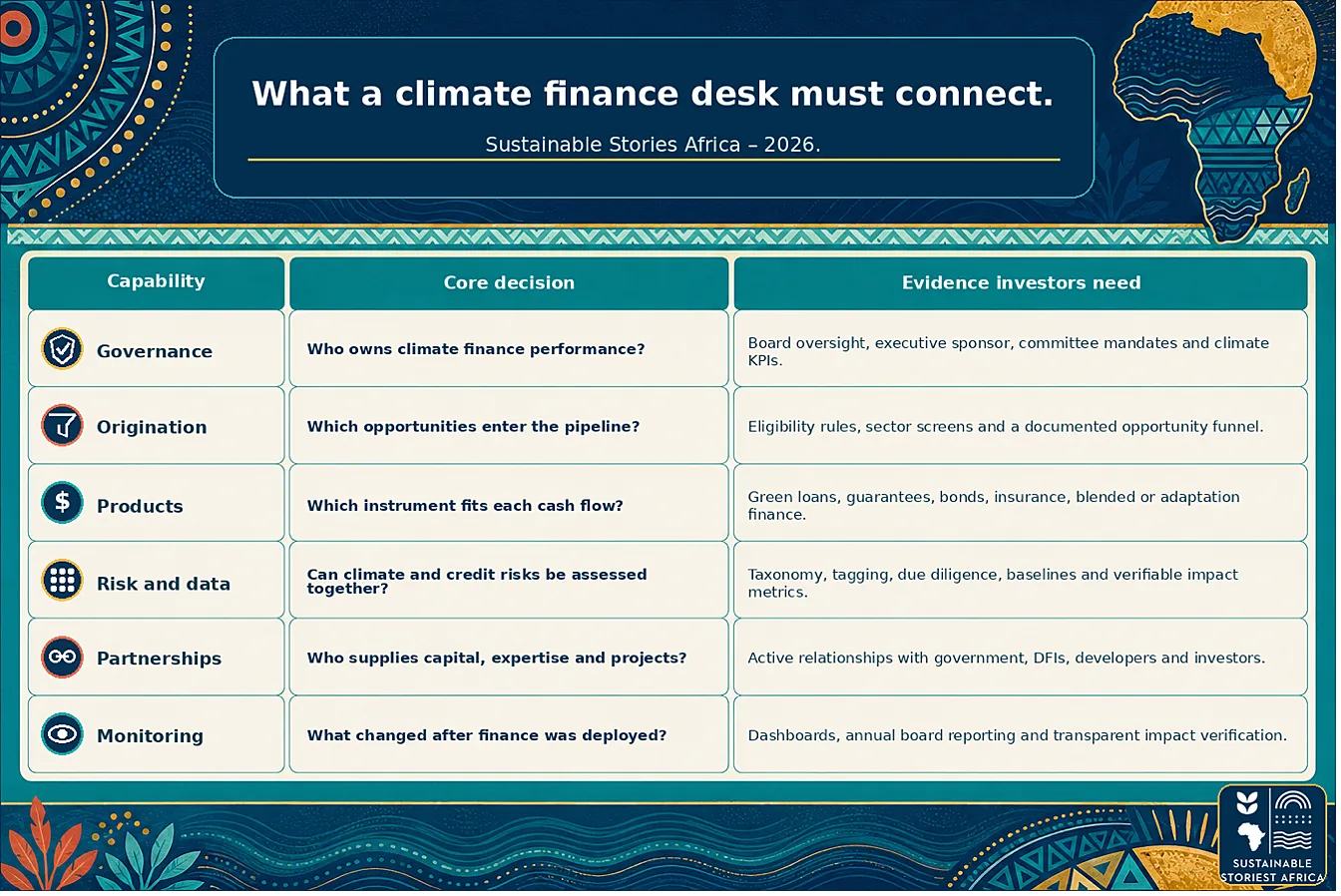
- A credible desk needs board oversight, an executive champion, defined risk and investment committee roles, climate KPIs and reporting. Its location can vary.
- A sustainability division may be appropriate for an institution beginning its journey; corporate or investment banking places it closer to products and revenue; a chief executive or strategy office gives it enterprise-wide authority.
- A hybrid model can work if treasury, risk, legal, sustainability and deal teams remain connected.
The product range must also reflect the problem being financed.
- Green and sustainability-linked loans suit some cash-generating assets.
- Green bonds can refinance larger portfolios.
- Guarantees and blended finance can absorb risks commercial lenders cannot initially carry.
- Adaptation finance, climate insurance, nature finance, carbon transactions and Article 6 structures require specialist capabilities and strong integrity controls.
A desk becomes valuable when it can select and combine these instruments rather than label every transaction “green”.
Portfolios Can Convert Problems Into Assets
The opportunity is wider than renewable energy.
- Reliable power for clinics can protect medicines and improve patient care.
- Efficient irrigation and climate information can reduce agricultural losses.
- Waste collection can feed recycling or biogas systems.
- Resilient roads, urban drainage and water networks can protect economic activity and communities from shocks.
Turning those needs into portfolios can reduce transaction costs, standardise documentation and create diversification across locations or asset types.
It can also make smaller community-scale projects visible to institutional capital that would not assess them singularly.
For banks, this can open fee income, lending, advisory and capital-markets opportunities while improving the quality of climate-related risk information.
The social test is essential.
- A climate portfolio should not become bankable by shifting costs to households, workers or communities.
- Eligibility rules must examine affordability, consent, livelihoods, environmental integrity and who receives the benefits.
- Climate finance is successful only when the financial structure and the development outcome reinforce each other.
A Ninety-Day Build Can Start Now
The proposed first move is a readiness assessment across ten capabilities;
- Leadership
- Governance
- Strategy
- Products
- Human capital
- Climate risk
- Technology
- Tagging
- Partnerships
- Reporting
Each is scored from one to five for a theoretical maximum of 50 points, identifying evidence gaps rather than rewarding polished policy statements.
A 90-day roadmap follows:
- Days 1 – 30 secure executive sponsorship, appoint a cross-functional team, and map the pipeline.
- Days 31 – 60 define governance, reporting lines, eligibility criteria, product priorities, and data requirements.
- Days 61 – 90 launch a pilot desk, test one product or portfolio, and establish a dashboard tracking capital mobilisation and outcomes.
Within 12 months, management should target at least one functioning climate finance product, a documented portfolio development process, and formal board reporting, building partnerships with the Green Climate Fund, African Development Bank, IFC, World Bank, Africa Finance Corporation, government agencies, and capital-market institutions ahead of urgent funding needs.
Success metrics should extend beyond announced capital to pipeline quality, approval timelines, private capital mobilised, financial close rates, and community outcomes.
Path Forward – Institutions Must Prepare Before Capital Arrives
Africa’s climate finance gap will not close through conferences and isolated projects alone.
Nigerian institutions need governance, specialist teams, investable portfolios, appropriate products and credible data before capital providers arrive.
The practical path is clear: appoint an executive sponsor, assess readiness, build the desk, pilot a portfolio and report annually to the board.
Institutional capability is the bridge between climate need and climate investment.