
Nigeria’s corporate governance landscape is entering a stricter phase, shaped by new securities legislation, sector-specific codes and rising sustainability disclosure expectations.
The central question is whether boards can move beyond formal compliance to credible oversight, investor trust and ESG-linked accountability.
Governance Now Defines Market Trust
Nigeria’s boardrooms are facing a sharper governance test as regulators, investors and stakeholders demand stronger disclosure, better board independence and more credible sustainability oversight.
This article draws on Panoramic Corporate Governance: Nigeria, generated on June 17, 2026, with law stated as of March 13, 2026, and contributions by Tamuno Atekebo, Otome Okolo, Naomi Kabowei and Cynthia Kanu of Streamsowers & Köhn.
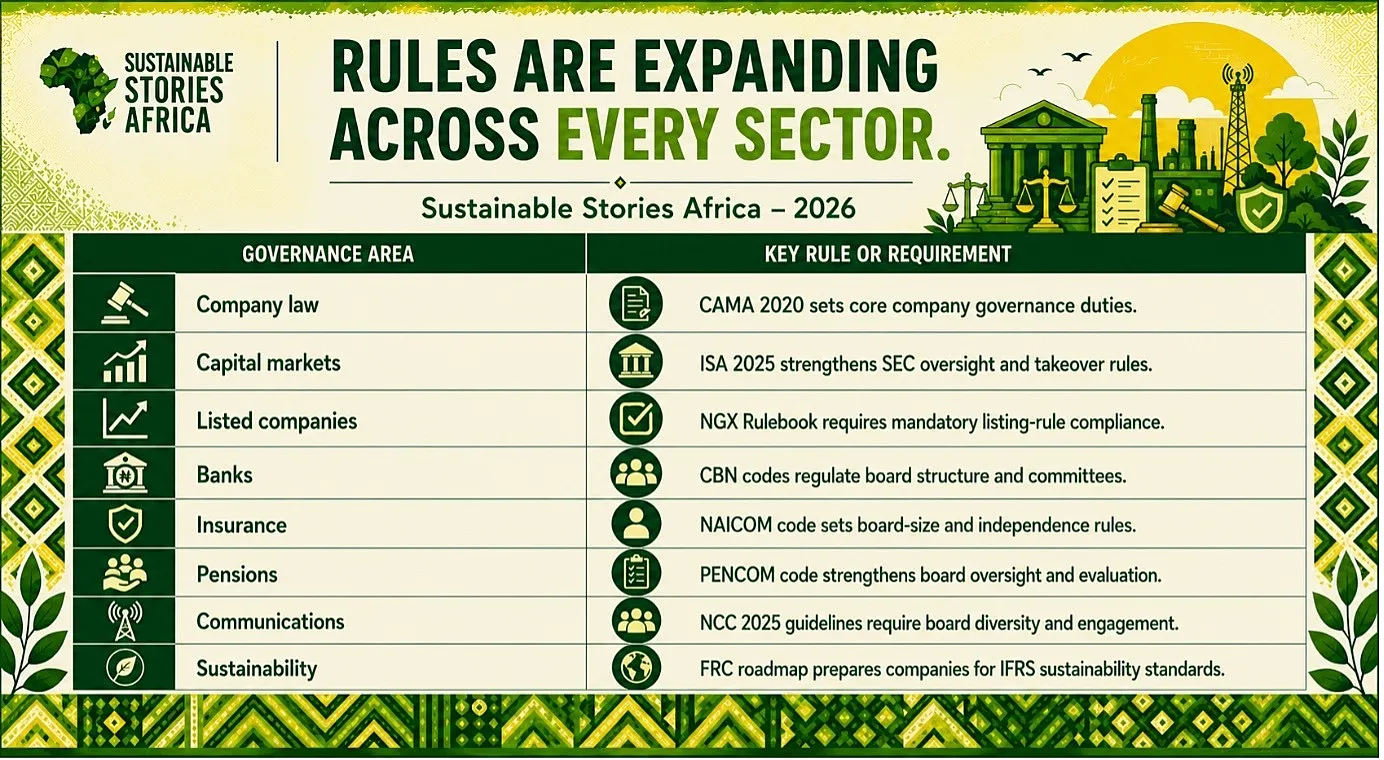
The report shows a governance system built around multiple laws and regulators, including CAMA 2020, the Investment and Securities Act 2025, the Nigerian Code of Corporate Governance, SEC rules, CBN governance codes, NAICOM rules, PENCOM guidelines, NCC guidelines and NGX listing requirements.
For African markets, Nigeria’s direction is clear: governance is becoming a capital-market credibility issue.
Nigeria’s Boardrooms Face A Stricter Era
Corporate governance in Nigeria was strengthened in 2025 through legislative reforms, regulatory interventions and sector-specific governance frameworks.
The most significant shift was the enactment of the Investment and Securities Act 2025, which repealed the 2007 Act and expanded the Securities and Exchange Commission’s supervisory and enforcement powers.
The ISA 2025 strengthened takeover rules by requiring mandatory bids where an investor acquires 30% or more of voting rights, subject to SEC approval.
It also reinforced internal controls, annual reporting and auditor escalation duties, requiring auditors to report material irregularities to the SEC within 10 working days.
This is not just legal architecture. It changes the tone of corporate accountability.
A board that once viewed governance as a filing obligation must now treat it as a live risk system covering ownership, control, disclosure, board conduct, sustainability and investor protection.
Rules Are Expanding Across Every Sector
Nigeria’s corporate governance framework is not governed by a single law alone. It is a layered system.
- The Corporate Affairs Commission oversees company registration and compliance with CAMA. The SEC regulates the capital market.
- The CBN supervises banks and financial institutions.
- NAICOM regulates insurers.
- PENCOM oversees pension operators.
- The NCC governs communications companies
- The Financial Reporting Council of Nigeria enforces accounting, auditing, corporate governance and reporting standards.
This multiplicity reflects the scale of Nigeria’s economy; however, it also creates a practical challenge: companies must navigate general corporate law, listing rules and sector-specific codes all at once.
Shareholders Gain Power, But Limits Remain
The report confirms that in general meetings, shareholders can appoint or remove directors by simple majority vote.
They can determine directors’ remuneration, alter share capital, approve major asset sales, appoint auditors and wind up a company.
CAMA also provides shareholders with tools to challenge illegal, fraudulent or ultra vires acts by directors.
Members holding at least 5% of voting rights may circulate resolutions for general meetings. Holders of one-tenth of the shares may apply to the Corporate Affairs Commission to investigate a company.
However, the framework also preserves board authority. Shareholders cannot simply take over day-to-day management where the law or articles vest powers in directors.
Their remedy, where necessary, is to amend the articles or seek legal relief.
This balance matters because strong governance is not shareholder domination. It is an accountable authority: boards must lead, but shareholders must have credible routes to challenge abuse.
Independence Is Becoming A Harder Standard
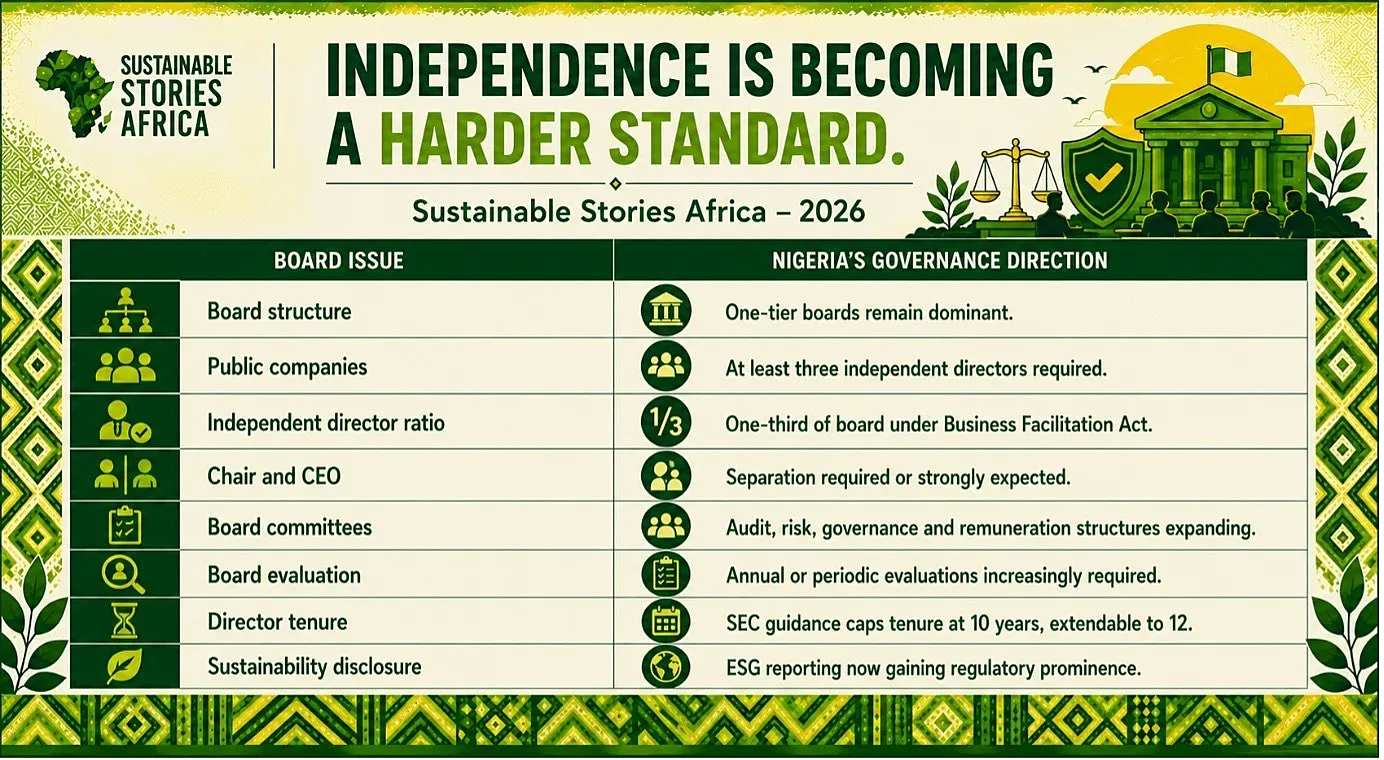
Board independence is one of the strongest signals in the report. Public companies must have at least three independent directors, and the Business Facilitation Act 2023 now requires independent directors to constitute one-third of the board.
The SEC Code recommends;
- At least five board members, with a mix of executive and non-executive directors. Non-executive directors should outnumber executive directors, and at least one non-executive director should be independent.
Sector rules go further.
- NAICOM requires insurance companies to have between seven and 15 directors, with at least one independent director and executive directors not exceeding 40% of the board.
NCC guidelines require licensed communications companies to have;
- At least five directors and a mix of executive, non-executive and independent non-executive directors.
Disclosure Is The New Governance Currency
Transparency is now central to Nigeria’s governance regime. Annual reports and accounts must be filed with the CAC and made publicly accessible.
- Quoted companies must also make periodic disclosures to the NGX and SEC, including financial statements, capital structure changes, acquisitions, redemption of securities and interim reports.
- Annual reports must disclose directors’ direct and indirect shareholdings, substantial shareholdings of 5% or more and five-year financial summaries.
- Public companies must also disclose board composition and provide corporate governance reports outlining governance structure, policies and practices.
- The Nigerian Code of Corporate Governance requires companies to include statements on environmental, social and governance activities.
- The SEC Code also requires annual reporting on ethical, health, safety and environmental policies, including environmental impacts, disadvantaged persons, anti-corruption initiatives and social investment policies.
This is where governance connects directly to ESG. If companies cannot disclose clearly, investors cannot price risk properly.
If boards cannot explain sustainability oversight, stakeholders cannot trust corporate commitments.
Sustainability Reporting Raises The Bar Further
Sustainability reporting has gained prominence under the Financial Reporting Council’s Sustainability Reporting Roadmap for 2024 to 2027, with 2025 serving as a preparatory phase for the International Financial Reporting Standards’ sustainability disclosure standards.
The FRC’s Sustainability Reporting Guideline 1, issued in 2025, guides reporting and strengthens ESG compliance.
In November 2025, the FRC also announced plans to adopt accounting and auditing standards for Islamic financial institutions, creating a Shariah-compliant reporting framework for Islamic banks, Takaful operators and Sukuk issuers.
The signal is important:
Nigerian governance is expanding from legal compliance to integrated reporting.
- Boards must now understand climate risk, social impact, ethical conduct, digital assets, virtual meetings, shareholder engagement and capital-market disclosure within one accountability framework.
Better Governance Can Unlock Market Confidence
The upside of stronger governance is substantial. Better board independence can reduce insider abuse.
- Stronger audit committees can improve financial reporting.
- Clearer disclosure can lower information asymmetry.
- Stronger shareholder engagement can reduce disputes.
- Better ESG reporting can improve access to responsible capital.
For citizens, governance reform may sound technical, but its effects are practical.
- It can determine whether pension assets are protected, whether banks manage risk responsibly, whether insurers honour trust, whether listed companies communicate honestly and whether communities can assess the social and environmental footprint of corporate activity.
This is the deeper story: governance is not only about board papers. It is about trust in markets, institutions and the companies that shape livelihoods.
Boards Must Treat Governance As Strategy
The next step is for boards to move governance from the company secretary’s checklist to the centre of strategy.
- Directors should review board composition, committee effectiveness, independence rules, tenure limits, shareholder communication and ESG oversight.
- Regulators should harmonise guidance where possible to reduce duplication while preserving sector-specific discipline.
- Companies should strengthen internal controls, improve disclosure systems, train directors and prepare for sustainability reporting requirements before mandatory pressure arrives.
Investors also have work to do.
- Stewardship should go beyond annual general meeting attendance. Institutional investors, pension funds and shareholder associations must ask sharper questions on board independence, related-party transactions, climate risk, internal controls and executive remuneration.
Path Forward – For Accountable Nigerian Boards
Nigeria’s governance reform agenda should focus on enforcement, board competence, sustainability disclosure and shareholder trust.
The next phase is credibility. If boards strengthen oversight, regulators consistently enforce, and companies disclose honestly, corporate governance can become a driver of capital confidence, ESG maturity and long-term market resilience.