
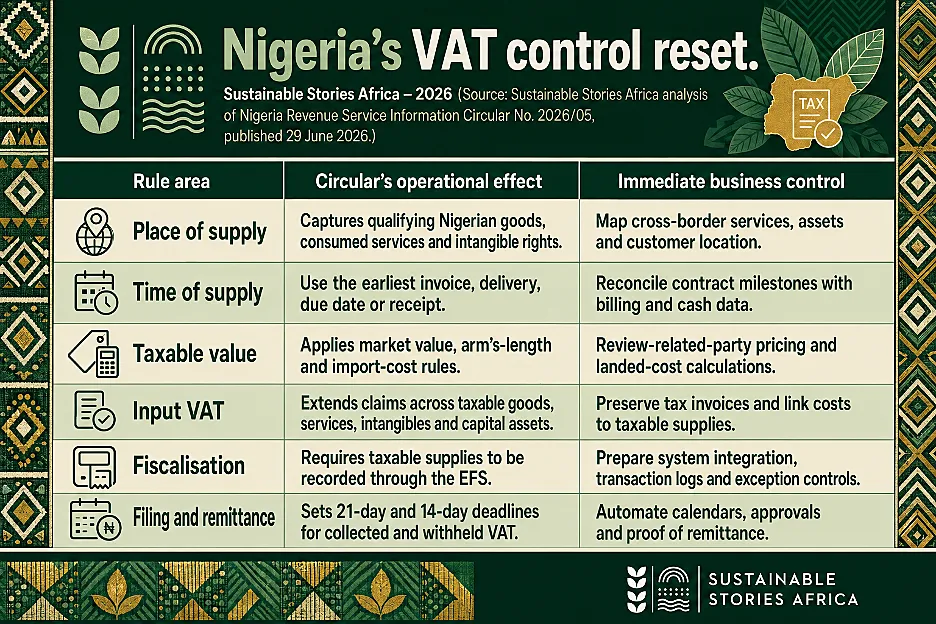
Nigeria’s latest VAT circular leaves the 7.5% rate in place; however, it rewrites the operational questions that determine liability: where a supply occurs, when tax becomes chargeable, what value is taxed and which input costs can be credited.
The biggest shift is digital. Taxable people must use the Electronic Fiscal System, while non-compliance can attract ₦200,000, the full tax due and interest linked to the Central Bank’s policy rate.
Nigeria’s VAT system enters digital enforcement
For Nigerian businesses, the next VAT dispute may begin before an accountant calculates the tax.
It may begin when a sales team issues an invoice, a customer pays a deposit, goods are delivered or a contract milestone is certified.
Under the new rules, the earliest of those events can determine when VAT becomes chargeable.
Nigeria Revenue Service Information Circular 2026/05, published on 29 June 2026, explains the VAT provisions of the Nigeria Tax Act 2025 and Nigeria Tax Administration Act 2025.
It replaces and withdraws the former FIRS circular issued in April 2022.
The circular is less about a new headline rate than a new compliance architecture.
- It clarifies place and time of supply, valuation, input credits, withholding, filing and refunds.
- It also requires taxable persons to adopt the Electronic Fiscal System, making transaction data a central enforcement tool.
Earlier events now determine tax liability
The circular’s consequential provision is the time-of-supply test.
- A taxable supply generally occurs at the earliest of four events: issue of an invoice or receipt; delivery or availability of goods; the date payment becomes due; or payment received.
The sequencing has cash-flow and month-end implications.
- VAT may be payable when a company is invoiced before cash arrives; advance payment can create liability before service delivery; and a late invoice does not defer tax when goods have changed hands.
- Sales, operations, treasury and tax teams need a transaction timeline.
Special rules apply to connected-person transactions without invoices, periodic contracts, progressive construction or repair work, and hire-purchase arrangements.
- Payment periods and instalments may constitute separate supplies, while hire purchase is triggered by delivery or payment, whichever occurs first.
The circular’s examples clarify rules; however, the same example shows a date inconsistency:
- A 2026 service and 15 January 2026 upfront payment receive treatment dated 15 January 2025.
Taxpayers should seek clarification and avoid relying on a drafting error.
Supply rules widen across transactions and borders
VAT remains payable on taxable supplies in Nigeria except items excluded under section 185 of the Nigeria Tax Act.
- For goods, the Nigerian connection can arise from physical presence, importation, assembly or installation, or from rights held by a taxable person where the goods or rights are situated, registered or exercisable in Nigeria.
Services can be taxable where they are rendered to or consumed by a person in Nigeria, even when the provider is outside the country.
Services connected to Nigerian immovable property are also captured.
For incorporeal property, the test includes exploitation by a Nigerian person or resident, registration or acquisition in Nigeria, and a connection to a tangible or immovable asset in Nigeria.
Valuation rules are equally important.
- Money transactions use the price before VAT. Non-cash supplies use market value. Transactions between connected people are tested at arm’s length, while consideration covering taxable and other transactions must be apportioned.
- Imported taxable supplies include duties, levies and incidental costs such as commissions, packaging, freight, transportation and insurance up to the point of entry, excluding VAT itself.
Broader credits could improve cash efficiency
The circular’s input VAT treatment could materially affect cash flow. Input VAT may be claimed on taxable goods, services, intangibles and capital assets.
Where output VAT exceeds input VAT, the difference is remitted; where input VAT exceeds output VAT, the excess becomes a credit or refund.
This matters for service-heavy and capital-intensive businesses facing uncertainty over recoverability.
Manufacturers buying equipment, technology firms procuring taxable services and businesses acquiring intangible assets can assess credits under an explicit framework.
The benefit is conditional. Deductions must relate to consumption, use or supply in making taxable supplies; mixed taxable and non-taxable activity requires proportionate allocation
Claims must be made within five years of the tax period, and deductible input VAT applies only from commencement of the new tax laws.
At the prevailing 7.5%;
- Sales of N200 million produce N15 million output VAT.
- N180 million purchases yield N13.5 million input VAT
- That leaves a N1.5 million.
- Purchases of N220 million create N16.5 million input VAT and N1.5 million credit or refund.
For controlled companies, this reduces cascading and improves working-capital visibility.
Without evidence linking costs to taxable supplies, credits remain inaccessible.
Businesses need stronger systems before enforcement
The Electronic Fiscal System (EFS) reshapes VAT enforcement.
- Taxable persons making taxable supplies must record and report transactions through the EFS, maintain accurate records, and comply with the Service’s specifications and transition arrangements.
Failure to process a taxable supply through the system may attract a N200, 000 administrative penalty, 100% of tax due, and annual interest at the Central Bank of Nigeria’s prevailing Monetary Policy Rate.
As that rate changes, non-compliance costs can rise independently of the transaction.
Businesses should map transaction data:
- Invoice origin, delivery confirmation, payment due dates, cash recognition and tax evidence.
- They must reconcile these events, define exceptions and allocate correction responsibilities.
- Enterprise systems, point-of-sale tools and manual processes must generate consistent timestamps.
Core obligations remain:
- Registration, VAT disclosure on invoices, collection or withholding where applicable, record retention and returns.
- Collected VAT is due within days after the transaction month; withheld VAT within days.
- Withholding agents remit tax, relieving suppliers of collection responsibility.
Uncertainty surrounds withholding, refund guidelines and EFS specifications.
Businesses should identify dependencies; regulators must provide guidance, testing windows and support.
Path Forward – Align invoices, data and controls
Companies should align contracts, invoicing, delivery evidence, payment records and VAT ledgers around the earliest-event rule.
They should also validate input-credit documentation, related-party values, import costs and filing calendars before connecting transactions to the EFS.
The Service should correct drafting inconsistencies and publish clear fiscalisation transitions.
Well done, the reform can broaden legitimate credits while improving visibility and collection.
Poorly done; it could turn ordinary timing errors into expensive disputes.