Nigeria’s startup story is entering a new phase: less hype, more discipline, and a sharper test of whether technology can solve real economic problems.
From Lagos to Abuja, founders are navigating tighter capital, rising costs, regulation and consumer pressure, while Africa’s largest market remains one of the continent’s strongest innovation engines.
Nigeria’s Innovation Moment Is Changing
Nigeria’s startup landscape is no longer only a story of young founders raising foreign capital, building payment apps and pitching Africa’s next unicorn from Lagos.
It is now a story about survival, scale and trust. The market still has energy, talent and demand; however, the operating environment has become tougher: inflation, naira volatility, funding selectivity, regulatory scrutiny and pressure for profitability are reshaping how startups build.
For Africa, Nigeria remains a critical test case. If startups can solve payments, logistics, food systems, energy, health, mobility and climate resilience in Nigeria, they can build models relevant to other high-growth, infrastructure-constrained markets.
Funding Reality Tests Startup Ambition
Nigeria’s startup ecosystem is maturing at the same time that easy capital has become harder to find.
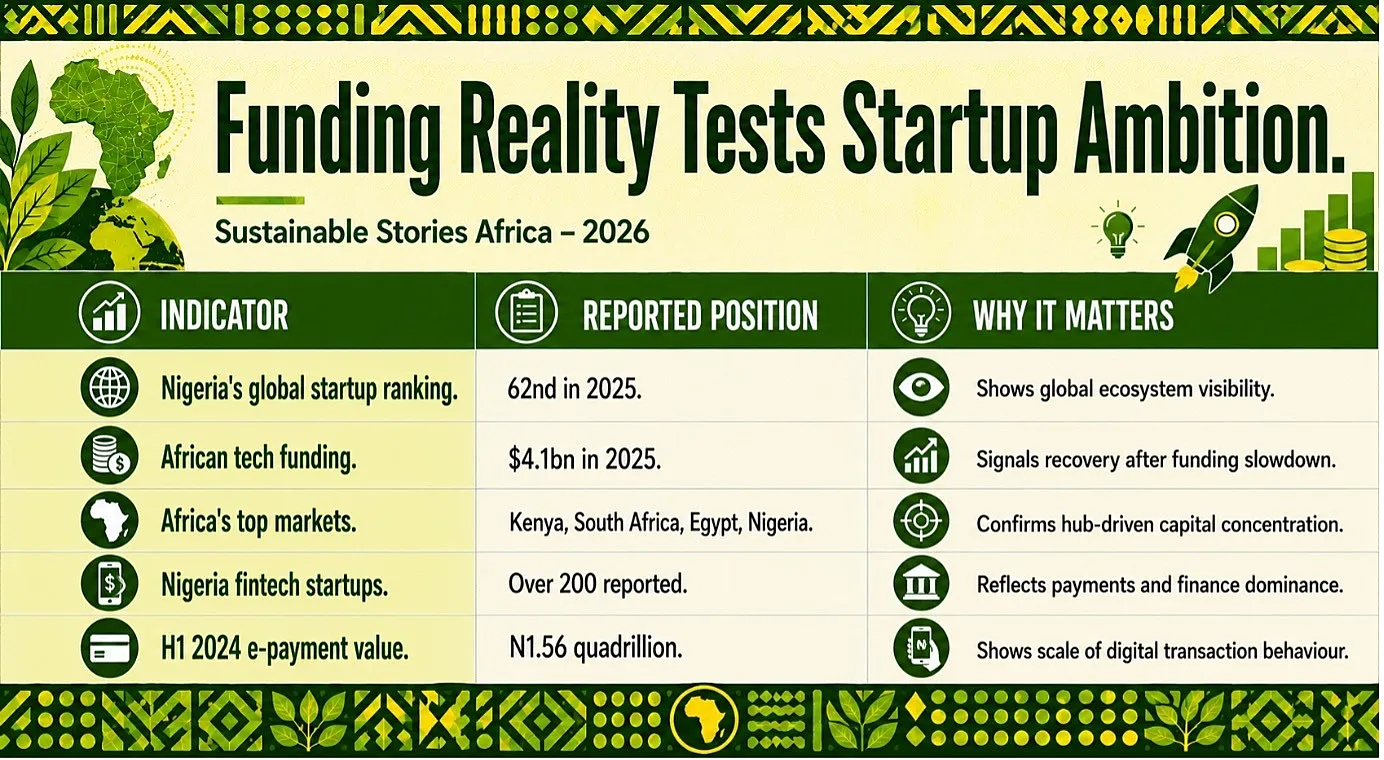
After years of rapid growth, African startup funding entered a more disciplined cycle. Partech reported that African tech startups raised $4.1 billion in 2025, up 25% from 2024, with the continent’s top four markets, Kenya, South Africa, Egypt and Nigeria, continuing to capture most capital.
The recovery suggests investor appetite has not disappeared; it has become more selective.
Nigeria remains central to that story. StartupBlink’s 2025 ecosystem ranking placed Nigeria 62nd globally, with Lagos retaining strong continental relevance and the country’s ecosystem showing continued growth.
However, the headline is no longer just about ranking. It is about what Nigerian startups are building, how they survive volatility and whether their solutions improve everyday life.
For a small business owner in Yaba, a market trader in Aba, a logistics operator in Ogun or a young graduate in Abuja, startup innovation is meaningful only when it reduces friction.
- Can payments settle instantly?
- Can credit reach informal businesses responsibly?
- Can farmers get better market access?
- Can health, learning and energy tools become affordable?
That is the new startup test: not valuation alone, but utility.
Fintech Still Leads, But Markets Broaden
Fintech remains Nigeria’s most visible startup engine. Payments, agency banking, digital wallets, credit, savings, remittances and merchant tools have become part of the country’s daily economy.
That strength is rooted in necessity. Nigeria has a large population, a wide informal economy, uneven banking access and a strong appetite for mobile-first financial tools.
The result is a fintech sector that does not merely imitate global models; it adapts to local realities.
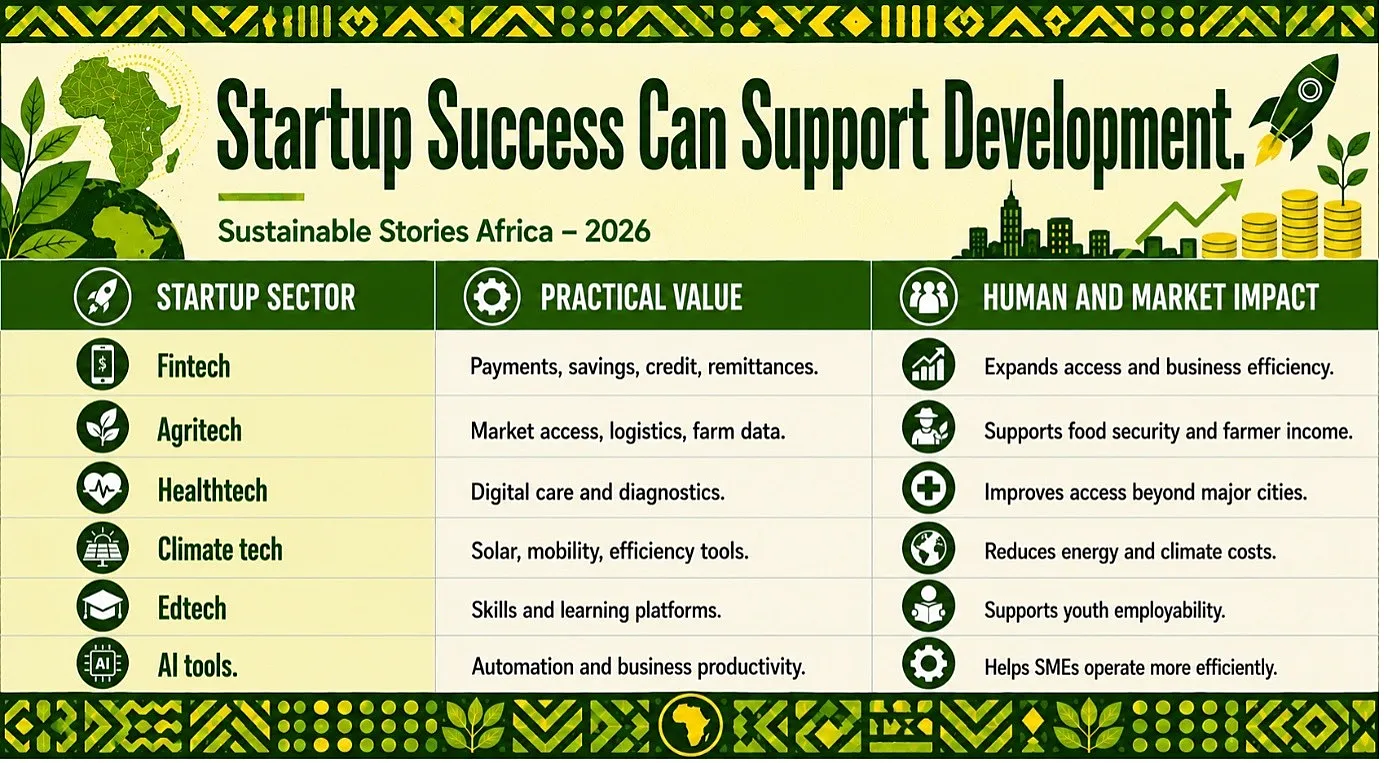
However, the next phase is broader. Startups are increasingly building across climate technology, health technology, logistics, education, creative infrastructure, agritech, artificial intelligence and energy access. This shift matters because Nigeria’s biggest problems are not only financial. They are structural.
- A startup helping small retailers manage inventory is addressing productivity.
- A solar financing platform is addressing energy poverty.
- An agritech logistics company is addressing food inflation.
- A digital health provider is addressing access.
- An AI-enabled business tool is addressing efficiency for small firms.
The African context is also important. Nigeria’s startups are building for a continent where infrastructure gaps are market opportunities.
However, weak regulation, poor purchasing power and currency instability can destroy fragile business models.
Startup Success Can Support Development
If Nigeria gets the startup equation right, the benefits can extend beyond founders and investors.
Startups can support job creation, expand financial inclusion, digitise small businesses, improve access to essential services and help the government deliver more efficiently.
They can also deepen ESG outcomes by reducing waste, expanding clean energy access, improving data transparency and building tools for underserved communities.
The opportunity is not theoretical. Nigeria’s digital payments boom has already changed how citizens transact.
- Agency banking brought financial services closer to communities.
- Fintech lending, when responsibly managed, can support micro and small enterprises.
- Climate and energy startups can help households and businesses reduce dependence on diesel.
However, there are also risks. Weak governance, poor consumer protection, unsustainable lending, data misuse and overdependence on foreign capital can undermine trust.
When startups fail badly, customers suffer, workers lose income and investor confidence weakens.
The best version of Nigeria’s startup future is therefore not a race for hype. It is a disciplined ecosystem where innovation solves hard problems, capital supports real productivity, and regulation protects consumers without killing enterprise.
Policy Must Match Founder Reality
Nigeria has already taken important policy steps. The Nigeria Startup Act created a framework for startup labelling, incentives and ecosystem coordination.
The startup portal is designed to register startups, investors, accelerators, incubators and other ecosystem actors. NITDA’s Startup Labelling Committee is also part of the implementation process.
However, policy only matters when founders can feel it.
- For startups, the priority is clarity: predictable regulation, faster approvals, easier tax compliance, access to local capital, stronger intellectual property protection and practical support for expansion beyond Lagos.
- For investors, the priority is confidence: transparent rules, credible exits, stable policy and stronger corporate governance.
- For the government, the opportunity is to treat startups as development partners, not just youth entrepreneurship stories.
With the right set of policies;
- Procurement can open markets for local technology firms.
- Digital public infrastructure can create new use cases.
- State governments can build innovation clusters around agriculture, logistics, climate resilience, manufacturing and creative industries.
Founders must also adapt. The funding environment now rewards discipline: stronger unit economics, clearer revenue, tighter governance, better compliance and deeper understanding of local consumers.
The era of growth at any cost is giving way to growth that can survive economic pressure.
Path Forward – Scale With Trust
Nigeria’s startup future depends on trust, patient capital, regulatory clarity and solutions built around real economic pain points.
The ecosystem must move from headline funding to measurable productivity, jobs, inclusion and resilience.
The path forward is practical: implement the Startup Act fully, deepen local capital, protect consumers, support regional expansion and help founders build companies that solve African problems at scale.
Culled From: Nigeria’s evolving startup landscape