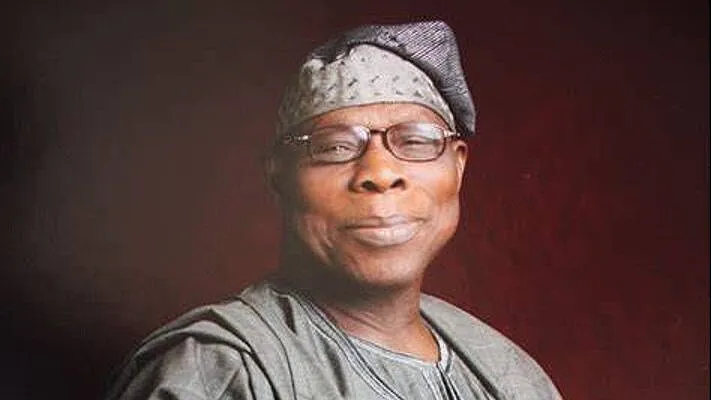
Olusegun Obasanjo remains one of Africa’s most consequential political figures: soldier, president, mediator, critic and continental elder.
His relevance today lies less in nostalgia than in the unresolved questions his career still raises.
For Africa, the central issue is clear: can leadership, institutions and diplomacy deliver growth, peace and accountability fast enough for a younger, more demanding generation?
Leadership Still Shapes Africa’s Future
Olusegun Obasanjo’s story is also Nigeria’s modern political story: military rule, democratic transition, economic reform, anti-corruption ambition, foreign policy activism and the unfinished struggle to make institutions stronger than personalities.
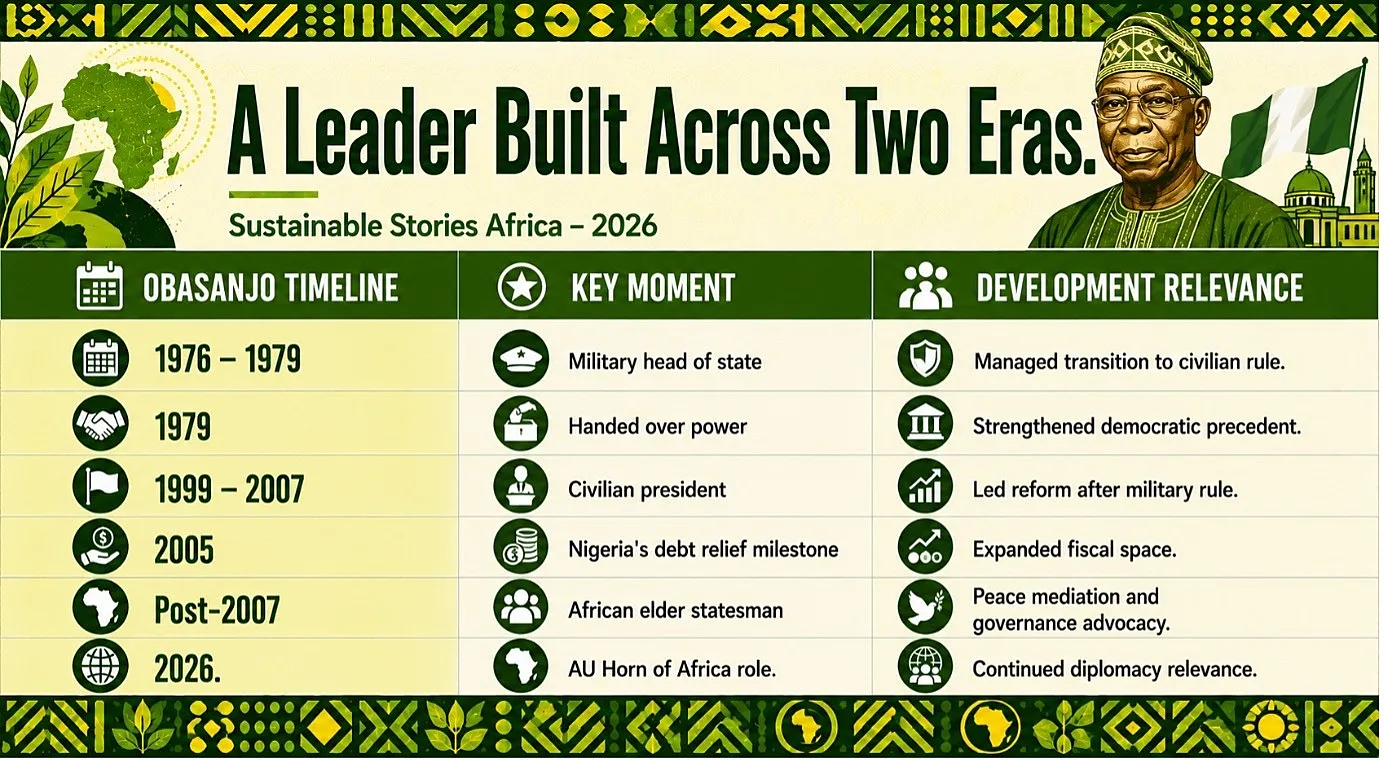
He served as Nigeria’s military head of state from 1976 to 1979 and later as elected civilian president from 1999 to 2007, making him one of the few African leaders to hold power in both military and democratic eras.
At 89, his public relevance continues through mediation, governance commentary and continental diplomacy, including the African Union’s May 2026 appointment of him to support peace efforts in the Horn of Africa.
A Leader Built Across Two Eras
Few African leaders carry Obasanjo’s institutional weight. He first entered Nigeria’s highest office after the 1976 assassination of General Murtala Mohammed, then handed power to a civilian government in 1979, a rare move in an era when military rulers often extended their stay.
Two decades later, after years of military rule, imprisonment under Sani Abacha and a fragile transition, Obasanjo returned as elected president in 1999.
His administration inherited weak institutions, damaged investor confidence, debt pressure, and a democracy still finding its feet.
His presidency pursued debt relief, telecommunications liberalisation, banking reform and anti-corruption architecture.
Nigeria secured major external debt relief in 2005, while the mobile phone revolution helped open one of Africa’s most important consumer markets.
However, the record remains contested. Critics point to allegations of political overreach, disputed elections, centralised power and the failed third-term controversy.
Supporters argue that his administration stabilised Nigeria after military rule and restored the country’s diplomatic influence.
Governance Remains The Central Question
Obasanjo’s legacy matters because Africa’s governance challenges are no longer abstract political debates.
They affect food prices, currency stability, climate resilience, security, investment and citizen trust.
In recent interventions, Obasanjo has repeatedly linked Africa’s future to leadership quality, institutional reform and debt fairness.
In April 2025, he argued that African countries often borrow at punitive rates to respond to crises they did not create, calling for reform of the global lending system.
That argument sits at the centre of Africa’s current development dilemma. Governments need capital for roads, power, agriculture, digital systems and climate adaptation; however, many face high borrowing costs and limited fiscal room.
Citizens, meanwhile, want practical outcomes: jobs, security, electricity, affordable food and accountable government.
This is where Obasanjo’s career becomes more than a biography. It becomes a framework for examining whether African leadership can move from personal authority to institutional delivery.
Reform Can Build Durable Prosperity
The positive lesson from Obasanjo’s public life is that political decisions can shift economic direction.
Debt relief created room for public finance. Telecommunications reform helped expand access. Regional diplomacy showed that African leaders can influence peace beyond national borders.
For citizens, good governance is not a theory.
- It is whether public money builds clinics instead of disappearing, whether elections produce legitimacy instead of litigation, and whether economic reforms protect the vulnerable while attracting investment.
For markets, stronger governance reduces risk.
- Investors may tolerate volatility, but they price uncertainty. Countries with credible institutions, transparent regulation and predictable policy have a better chance of attracting long-term capital into infrastructure, agriculture, manufacturing and clean energy.
For Africa’s youth, the stakes are even sharper.
- A continent with a young population cannot afford leadership models that recycle old conflicts, ignore climate risks or treat public office as private possession. The demand is for systems that deliver.
Institutions Must Outgrow Strongmen
The action agenda from Obasanjo’s legacy is straightforward: African states must build institutions capable of surviving powerful personalities.
- Governments need credible elections, independent oversight, stronger public procurement and fiscal discipline.
- Regional bodies must invest in preventive diplomacy before conflicts become humanitarian and economic disasters.
- Development finance institutions should support reform without weakening domestic accountability.
Businesses also have a role.
- Corporate integrity, tax compliance, environmental standards and responsible investment are now central to African development.
- Private capital cannot demand stability while ignoring governance standards that create it.
- Citizens, civil society and media must remain part of the accountability chain.
The lesson of Obasanjo’s career is not that one leader can solve national problems.
It is leadership that matters most when it strengthens the systems that outlast it.
Path Forward – Delivery Over Personality
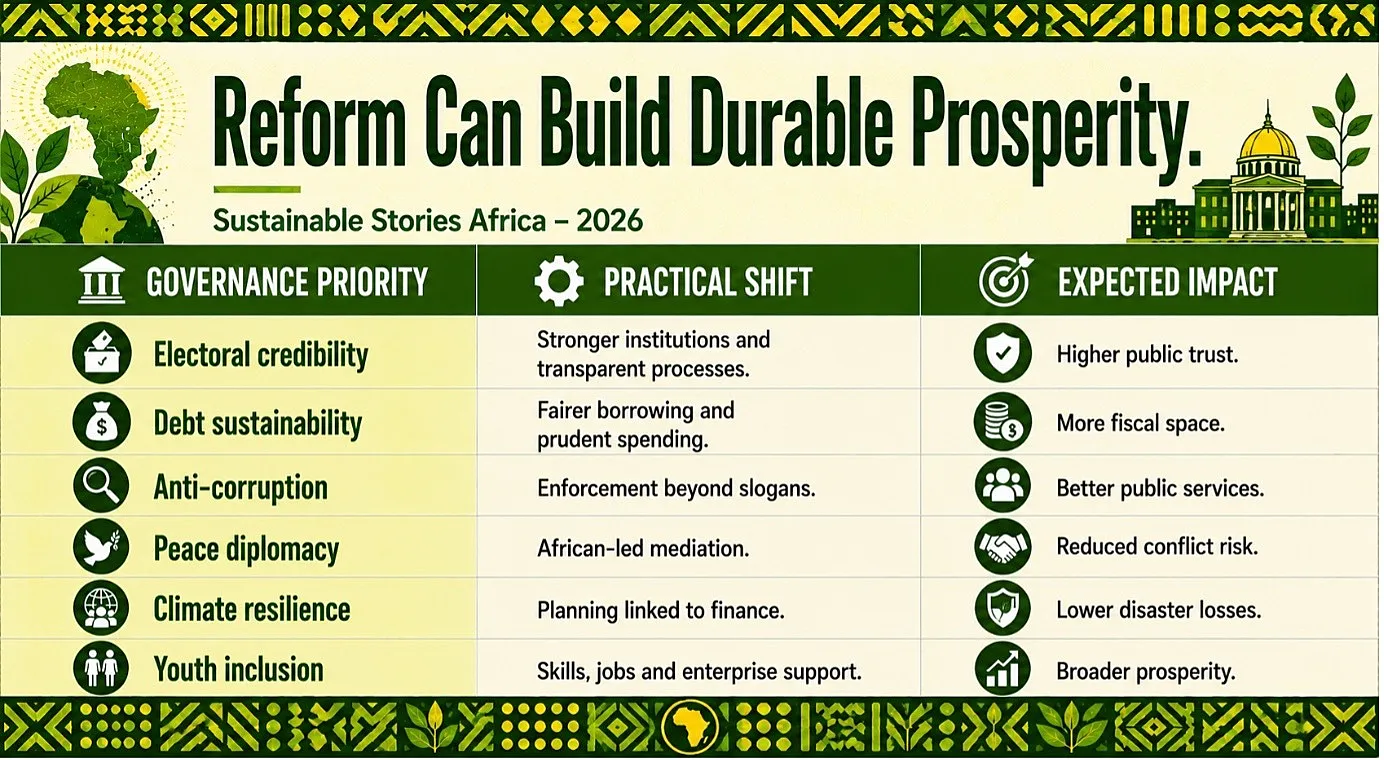
Africa’s next governance bargain must prioritise institutions, peace, debt fairness, climate resilience and youth opportunity.
Obasanjo’s continuing role shows the value of experience, but the future cannot depend on elder statesmen alone.
The real test is whether African countries can turn leadership memory into institutional muscle.
That means accountable power, credible reforms and development choices that improve daily life.
Culled From: Olusegun Obasanjo