
Resourcefulness can turn constraints into evidence, but disciplined action must replace both delay and reckless improvisation.
Waiting for ideal funding, perfect certainty or complete support can become a respectable form of inaction.
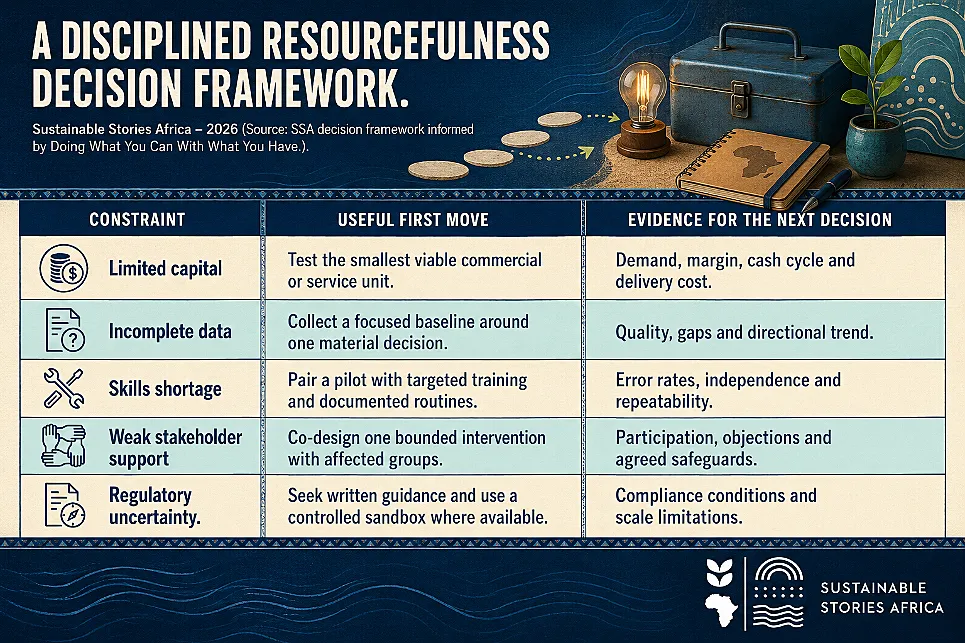
The stronger alternative is not reckless speed. It is disciplined resourcefulness: define a useful first step, protect what matters, measure the result and let evidence determine whether to stop, adapt or scale.
Waiting Can Become Its Own Risk
Many individuals and organisations postpone action because one input is missing: more money, better timing, senior approval, stronger skills or clearer market conditions.
According to the infographic analysis, “Ugly Action Beats Unfinished Perfection”, ideal conditions rarely arrive fully formed, and that progress usually begins with resources already available.
That idea is particularly relevant in African markets, where businesses and public institutions often operate with constrained capital, infrastructure and data.
Delay may feel prudent, yet it can preserve the very uncertainty to justify waiting. A small, designed action can produce information that planning alone cannot.
The choice is not between perfection and chaos. Responsible action begins by defining what can be tested safely, what must not be compromised and what evidence would justify the next step. Resourcefulness becomes valuable when it is joined to governance.
Small Actions Should Produce Useful Evidence
The first step should answer a question.
- A retailer might test demand in one location before signing a long lease.
- A manufacturer might run a limited production batch before buying a full line.
- A bank could pilot a cash-flow lending product with a defined segment before changing its entire credit policy.
The action should be small enough to contain downsides but real enough to reveal behaviour.
Token pilots are built only to support a predetermined conclusion waste time.
Teams need baseline measures, an owner, a review date and criteria for success, adaptation or closure.
This approach turns scarce resources into learning assets.
- Customer feedback, operating data, defect rates, repayment behaviour and community response can strengthen future decisions.
- Even a failed test can create value if the organisation records why it failed and changes course.
Documentation need not be heavy.
- A one-page experiment record can state the question, assumptions, resources, safeguards, measures and decision rule.
- The discipline matters more than the format because it allows another team to understand what happened and avoid repeating the same uncertainty.
Resourcefulness Is Not An Excuse For Harm
“Start with what you have” can be misused to normalise unsafe work, unpaid labour, weak controls or poor-quality services.
- A constrained budget does not remove responsibility for worker safety, consumer protection, environmental care or financial integrity.
- Some conditions are gates, not preferences.
Leaders should therefore define non-negotiables before acting. A pilot involving customer data needs privacy controls.
- A construction test needs safety supervision.
- A health intervention needs qualified oversight.
- An energy project needs community consent and environmental assessment.
- Moving early is defensible only when foreseeable harm is contained.
This distinction also protects staff.
- Organisations should not celebrate resilience while transferring chronic shortages onto workers.
- Resourcefulness should simplify scope, sequence investment and improve learning, rather than require people to absorb unmanaged risk indefinitely.
Leaders must also distinguish reversible from irreversible decisions.
- A marketing message can be changed quickly
- A land acquisition, community relocation or long-term technology lock-in cannot.
- The more irreversible the decision, the stronger the evidence, consultation and independent review required before movement begins.
Institutions Can Create Conditions Through Action
Progress is often presented as individual courage, but institutions shape whether early action succeeds.
- Clear approval thresholds, small innovation budgets, procurement flexibility and access to shared data can make experimentation responsible.
- Without those conditions, teams may either remain paralysed or act informally outside controls.
Governments and development partners can fund prototypes and learning, especially where the public value is high but commercial returns are uncertain.
- They should require transparent results, including failures, so each pilot contributes to a wider evidence base.
- Businesses can create internal stage gates that release capital as assumptions are validated.
The most important cultural change is rewarding accurate learning rather than only visible success.
If every pilot must be declared a triumph, problems will be hidden, and poor models will scale. Leaders should ask what changed in the decision, not merely what activity occurred.
Funding mechanisms should reflect that learning cycle.
- Instead of releasing a full budget on aspiration, organisations can set milestone-based tranches tied to safety, demand, unit cost and stakeholder evidence.
- This protects capital while giving capable teams room to move.
Momentum Needs Measurement And Strategic Direction
Activity can feel like progress even when it is disconnected from a goal.
- Organisations need a clear outcome, a theory of how the first step contributes and a metric that shows whether the situation improved.
- Financial, social and environmental effects should be reviewed together where they are material.
A useful rhythm is simple: define the constraint, protect the non-negotiables, run the smallest credible test, review evidence and decide.
- Scaling should be based on earned results.
- Stopping should be accepted when evidence weakens the case.
- This discipline converts movement into progress.
Boards and funders can monitor the portfolio of experiments, not only each project.
- They should see how many tests advanced, stopped or changed direction, what was learned and how much capital remains exposed.
- Portfolio learning prevents small pilots from accumulating without strategic purpose.
Path Forward – Start Small, Learn Honestly
Leaders should stop waiting for total certainty and begin with bounded actions that answer material questions.
Every pilot needs safeguards, ownership, measures and a decision date.
Resourcefulness becomes sustainable when it creates evidence, protects people and guides capital.
Progress starts before conditions are perfect, but it lasts only when learning is honest and the next step is earned.