When an energy project fails, silence rarely contains the problem. It allows rumours, fear and conflicting accounts to define it.
A seven-step framework from energy communicator Adeola Abu-alimi shows how verification, internal investigation, leadership alignment and audience-specific engagement can turn crisis communication into an operating discipline that protects people, accountability and long-term trust.
Silence Turns Technical Failure Into Distrust
A failed mini grid, a damaged pipeline, a delayed power plant or community safety incident begins as an operational problem.
It can quickly become a governance crisis when affected people do not know what happened, who is responsible or whether the risk is under control.
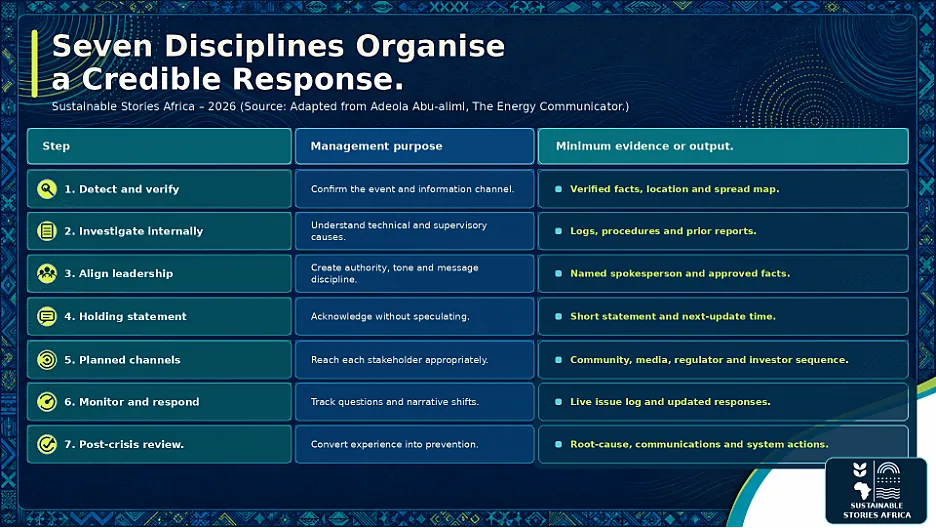
Adeola Abu-Alimi, writing as The Energy Communicator, sets out a seven-step response: detect and verify, investigate internally, align leadership, issue a holding statement, de-escalate through planned channels, monitor reaction and conduct a post-crisis review.
The sequence is simple, but it closes the gaps through which misinformation and mistrust usually spread.
The framework matters across African energy markets, where projects often depend on a dense network of community consent, regulatory approvals, public finance, private capital and political support.
Communication cannot repair poor engineering or erase harm. It can, however, ensure that verified facts drive decisions, that affected stakeholders receive timely information and accountability is visible.
The First Minutes Define the Narrative
The instinct to go quiet often comes from fear of liability, incomplete information or concern that acknowledgement will amplify a problem.
In practice, a vacuum is rarely empty. Community WhatsApp groups, local radio, employees, contractors, politicians, and news outlets begin assembling their own explanations, often with partial evidence.
The first task is therefore not to publish; it is to verify.
- The organisation must establish whether the incident is real, what is known, where it occurred and where the story is circulating.
- A technical outage discussed by customers online requires a different first response from an allegation already before a regulator, even when the underlying facts are the same.
Verification also protects credibility.
- A fast but inaccurate denial can become more damaging than the initial failure.
- Equally, an overly technical statement that ignores fear or disruption can make a company appear indifferent. Speed matters, but disciplined speed matters more.
A shared, time-stamped fact log helps teams separate confirmed information from assumptions, record who verified each point and identify the next decision deadline.
It also reduces the risk that executives, site teams and contractors circulate different versions of the same event while the investigation is still developing.
Seven Disciplines Organise a Credible Response
Once the incident is verified, the response must be reviewed inside the organisation.
- Technical teams should check procedures, supervision records and earlier incident reports.
- Communications teams need enough operational understanding to avoid speculation, while engineers need a clear account of the questions external stakeholders are asking.
Leadership then agrees who speaks, what tone the organisation will use and which facts can be released.
- One authorised spokesperson does not mean one channel.
- The community may need a trusted local intermediary
- The regulator needs a formal written update
- The media needs an accessible briefing
- Investors may require a direct call.
The core facts remain consistent while the conversation changes.
A holding statement bridges the period before the full investigation is complete.
- It should acknowledge the incident
- Show that it is being treated seriously
- Identify any immediate safety or service measures
- State when further information will follow.
It should not assign blame prematurely or promise a timeline the technical team cannot meet.
Transparent Action Can Preserve Social Licence
Good crisis communication protects more than reputation.
- It supports safety by directing people away from hazards and towards accurate instructions.
- It helps regulators judge whether the operator is in control.
- It gives lenders and investors evidence that governance systems work under pressure, not only during scheduled reporting cycles.
For communities, respect is visible in timing, language and presence.
- A technically correct statement delivered late, in inaccessible language and through an unfamiliar channel can still fail.
- A trusted community voice who explains what is known, what remains uncertain and what support is available can reduce fear without minimising the incident.
The goal is not to 'win' the story.
- It is to preserve the conditions for repair, investigation and continued engagement.
- As Abu-Alimi’s framework puts it, communication is not merely damage control; it is part of how trust survives.
That trust has financial value.
- Delays caused by community opposition, regulatory escalation or lender concern can extend downtime and raise project costs.
- A credible response does not guarantee that stakeholders will approve of every decision.
- Still, it shows that the operator can acknowledge disruption, explain uncertainty and remain accountable while corrective work continues.
Build Crisis Readiness Before Projects Are Commissioned
Energy companies should establish incident protocols before operations begin.
- Each project needs a verified stakeholder map, escalation thresholds, backup spokespersons, regulator-notification requirements, pre-approved holding-statement structures and multilingual community channels. Contact lists must be tested, not merely stored.
Crisis simulations should bring communications, engineering, legal, environmental and social teams into the same room.
- Exercises can test whether leaders receive reliable facts quickly, whether field staff know who may speak publicly, and whether a statement can be issued without overriding safety investigations or legal duties.
After an event, monitoring should continue until questions and pressure points stabilise.
- The post-crisis review must examine both root causes and response quality: which warning signs were missed, where information stalled, which audiences felt excluded, and which systems will change.
- Actions should be assigned to owners and tracked to completion.
Boards and project sponsors should receive a concise crisis dashboard covering safety, service restoration, stakeholder sentiment, regulatory exposure and agreed actions.
- This moves communications out of the public-relations silo and makes it part of enterprise risk oversight.
- The same evidence can improve lender reporting, insurance discussions and future project design.
Path Forward – Make Trust an Operating System
Energy operators should treat crisis communication as part of safety, governance and social performance management, with trained personnel, rehearsed channels and documented accountability.
The rule is straightforward: verify first, speak with one factual and empathetic voice, keep listening, and show what changes afterwards.
Trust survives when communication and corrective action move together.