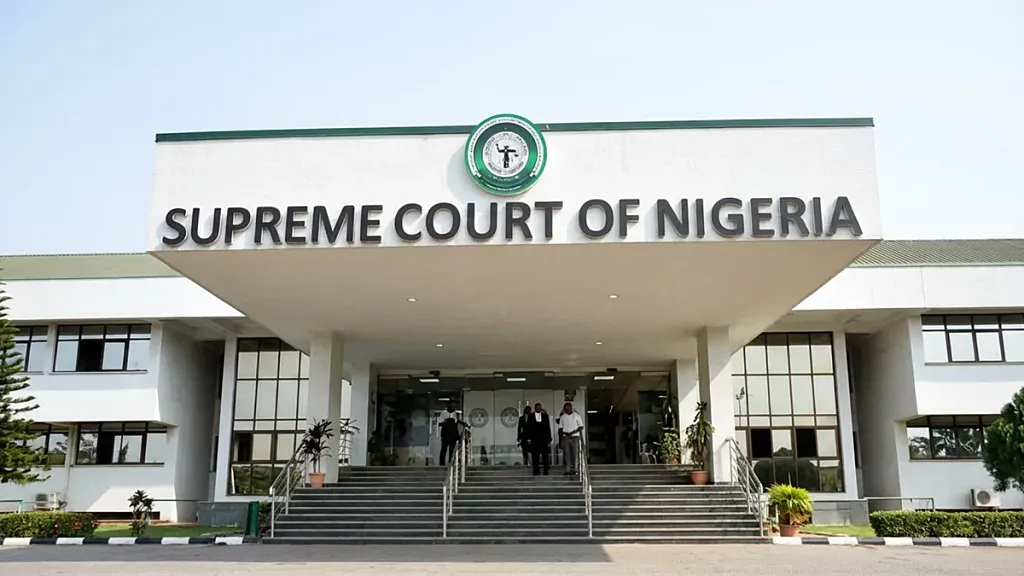
Nigeria’s Supreme Court has clarified when employment-related claims against public authorities can survive limitation statutes, especially under the Public Officers Protection Act.
The decision in Okoronkwo v INEC draws a practical line between claims for work already done and claims challenging wrongful termination. For workers, employers and governance teams, timing is now a core risk.
Legal Time Now Shapes Work Rights
In Nigeria’s public-sector employment disputes, three months can now determine whether a worker gets a full hearing or loses the right to proceed.
That is the practical governance signal from the Supreme Court’s decision in Okoronkwo v INEC (2025) 8 NWLR (Pt 1991) 131.
The source document for this article is SSKÖHN Notes, titled “Revisiting the Applicability of Limitation Statutes to Employment Contracts in Nigeria: A Critical Appraisal of the Supreme Court’s Decision in Okoronkwo v INEC (2025) 8 NWLR (Pt 1991) 131.”
It was authored by Omono Blessing Omaghomi, Yussuf Akinola Oyebanjo and Zaynab Abdussalam of Streamsowers & Köhn.
At the heart of the issue is a question that affects workers, public employers, lawyers, unions and institutions: does the Public Officers Protection Act apply to employment contracts? The answer is not a blanket yes or no.
The Court has clarified that claims for “labour or work done” are treated differently from wrongful termination and other employment-related claims.
A Three-Month Rule Gains Urgency
Under Nigeria's Public Officers Protection Act, any claim against a public authority must be filed within three months of the grievance.
If the harm is ongoing, time begins only when it ends; however, that window remains unforgiving.
This principle proved decisive in Okoronkwo v INEC, where a former Commission employee challenged his dismissal after the three-month period had lapsed.
Despite arguing that employment contract law should apply, the Supreme Court affirmed the action was statute-barred, drawing a critical distinction between claims for unpaid wages and claims for wrongful termination.
The latter falls squarely within the limitation rule.
The implications are far-reaching. Employees must act swiftly. Public employers gain stronger protection against delayed claims.
For ESG-conscious institutions, the ruling is a reminder that decent work demands not just fair hiring, but also transparent, timely and legally defensible workplace governance.
What The Court Actually Decided
The Supreme Court's ruling in Okoronkwo v INEC did not sweep all employment disputes under the Public Officers Protection Act's three-month limitation rule, nor did it exempt them entirely.
Instead, it sharpened the boundaries of existing exceptions.
Nigerian courts had long recognised that POPA does not apply to land recovery, breach of contract, or claims for labour and work already done.
However, workplace disputes are rarely that simple. An employee may sue for unpaid salaries, wrongful dismissal, pension miscalculation, or an employer acting outside lawful authority, each legally distinct.
Justice Adumein's concurring judgment drew the clearest line: "claims for labour or work done" cover payment for services already rendered, such as earned wages.
Wrongful termination is categorically different; it challenges the act of dismissal itself, and absent another recognised exception, the limitation period firmly applies.
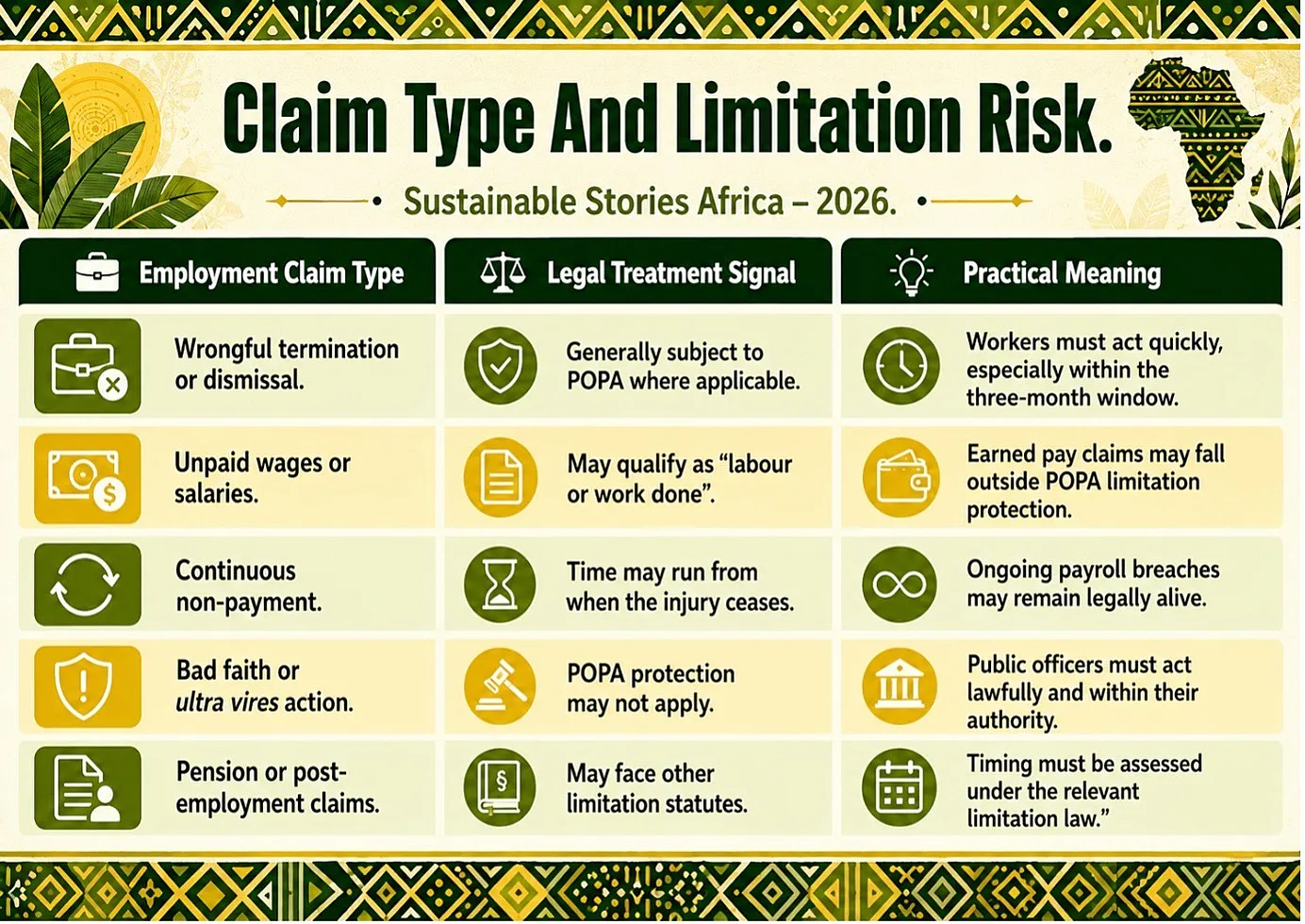
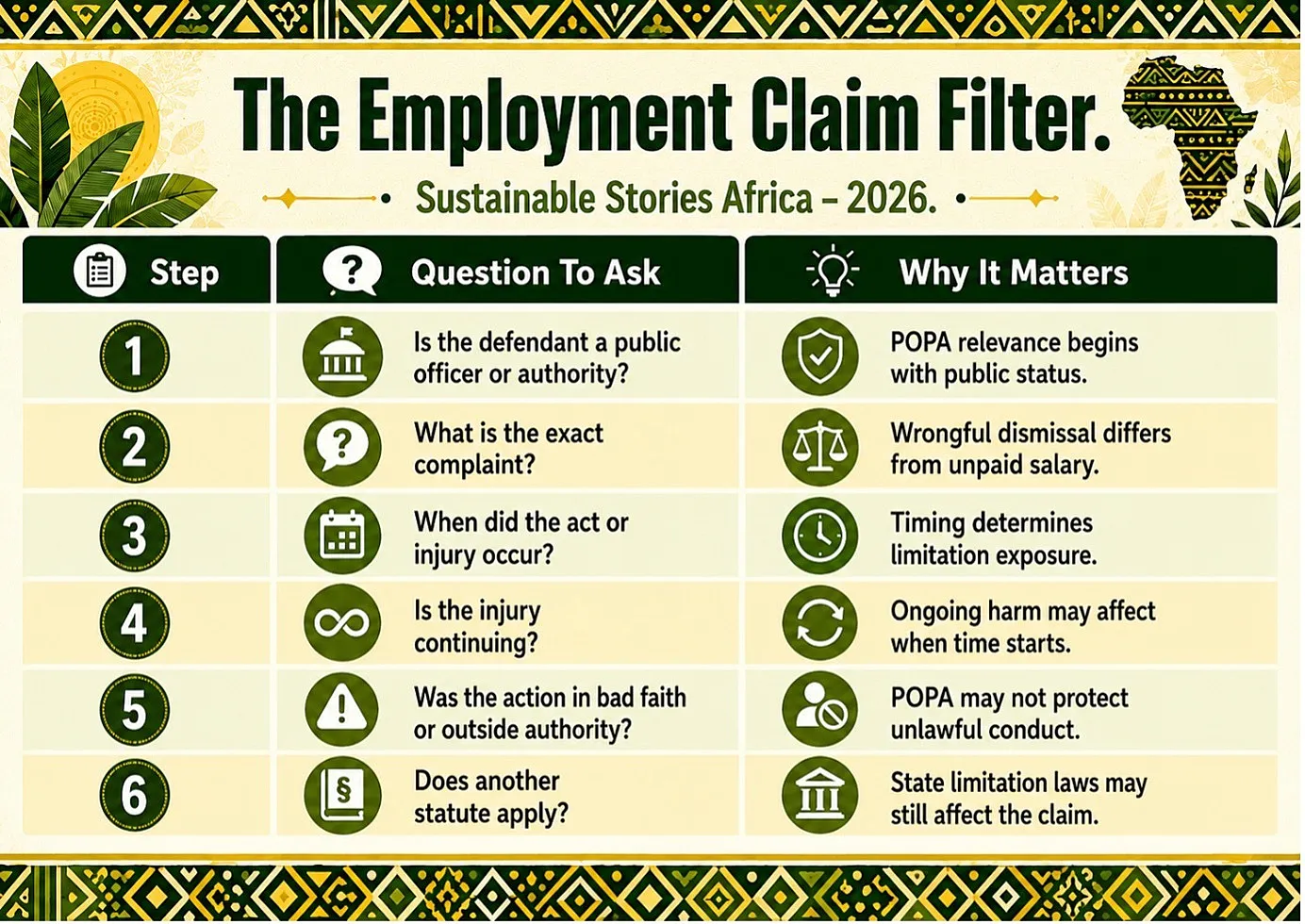
The ruling, therefore, turns employment litigation into a classification exercise. The first question is not simply, “Was this an employment contract?” It is, “What exactly is the employee claiming?”
Why This Matters For Governance
Limitation statutes serve a legitimate purpose, shielding public institutions from indefinite litigation while encouraging timely claims when evidence remains fresh.
However, rigidly applied, the same tool can deny justice to workers who have genuinely earned wages from a public employer.
The Supreme Court's clarification navigates this tension deliberately.
For public bodies, the ruling makes the governance imperative clear. Dismissal letters, suspension notices, disciplinary records, payroll data and internal approvals must be precise and defensible.
Poor documentation is no longer just an administrative weakness; it is a legal liability.
For employees, moral strength alone is insufficient.
A compelling claim filed late remains a failed claim. Acting early, preserving records and understanding filing timelines is now essential workplace knowledge.
For lawyers, precision in pleading is everything. How a claim is framed, wrongful termination versus unpaid wages, can determine whether a client ever gets their day in court.
Clearer Rules Can Strengthen Workplaces
Clearer limitation rules do more than settle legal disputes; they create an incentive for better workplace behaviour before cases ever reach court.
Public employers now have a stronger reason to treat every suspension, dismissal and payroll decision as a governance event, traceable to lawful authority, internal policy and fair process.
The litigation risk is real; so is the reputational one.
For employees, clarity is also protective. Knowing that claims for earned wages carry different legal standing reinforces a fundamental principle: completed work deserves compensation, and that right should not be casually erased.
The sustainability dimension runs deeper still. Decent work encompasses fair treatment, timely remedies and predictable grievance systems, not just job creation or minimum wage.
When employment justice is consistent, workers trust institutions. When institutions manage labour risk transparently, markets stabilise.
For investors and development partners, strong labour governance is not a compliance footnote. It is a long-term value signal.
What Institutions And Workers Must Do
Clarity in law only delivers value when translated into practice. Public-sector employers must urgently review employment dispute protocols, and HR and legal teams need limitation-risk checklists that track the date of disputed acts, claim types, applicable statutes and required evidence.
Employment decisions must be dated, authorised and properly stored. Boards should treat recurring dismissal or pension disputes as governance red flags, rather than isolated HR matters.
Employees and unions must respond faster. The first 90 days after a dismissal or disciplinary decision can be decisive.
Workers should immediately preserve appointment letters, payslips, suspension notices and proof of completed work.
Lawyers must plead with precision, distinguishing unpaid wages from wrongful termination from the outset, not after a limitation defence is raised.
Most urgently, policymakers must close the awareness gap. Limitation rules that only lawyers and institutions understand, but workers do not, quietly undermine access to justice.
Path Forward – Faster Justice Builds Better Labour Markets
Nigeria’s employment justice system now has a clearer signal: rights matter, but timing matters too.
The Okoronkwo v INEC decision reinforces prompt litigation while protecting genuine claims for work already done.
The path forward is better documentation, faster advice, stronger HR governance and wider worker education.
If institutions absorb the lesson, the ruling can support fairer workplaces, reduce stale disputes and strengthen the social and governance pillars of sustainable development.