Sustainability is entering a harder, more practical phase: fewer slogans, more measurable value.
ERM’s 2026 trends report shows companies under pressure from tariffs, energy volatility, AI demand, climate risks and tougher data expectations.
For Africa and other emerging markets, the message is direct: sustainability will matter most where it protects communities, unlocks finance, strengthens infrastructure and improves business performance.
Sustainability Enters Its Harder Performance Era
Corporate sustainability is moving from ambition to execution as companies enter 2026 facing a collision of trade disruption, rising energy demand, climate impacts, AI-driven infrastructure pressure and tougher disclosure expectations.
ERM Sustainability Institute’s 2026 Annual Trends Report: Competing Pressures, New Approaches frames the year as one of contradiction: the 1.5°C climate target is becoming harder to achieve; however, companies continue to invest in renewable energy, resilience, digital tools and operational efficiencies.
For African markets, the stakes are especially real. The shift is not only about compliance.
It is about whether sustainability can reduce project delays, strengthen grids, cut energy costs, improve data credibility, protect workers and help communities benefit from new infrastructure.
Sustainability Pressure Becomes A Business Strategy
The strongest signal from the report is that sustainability has become a performance question.
Companies are no longer being judged only by whether they have targets, but by whether those targets protect value, reduce risk and deliver measurable returns.
Trade tensions have sharpened the test. ERM cites a global analysis of more than 9,000 public companies showing they could face at least $1.2 trillion in additional 2025 expenses because of tariffs and other trade factors, with an estimated $907 billion in lost profit as costs are passed through or absorbed.
At the same time, 66% of sustainability executives at large U.S. firms said tariffs would slow progress on sustainability goals.
However, the corporate response is not to retreat. A global 2025 survey found that 83% of companies increased sustainability spending over the previous year, while 95% viewed sustainability as a commercial opportunity and 99% expected it to deliver competitive advantage within three years.
That is the new terrain for ESG: sustainability must now earn its place inside capital allocation, procurement, infrastructure planning and risk management.
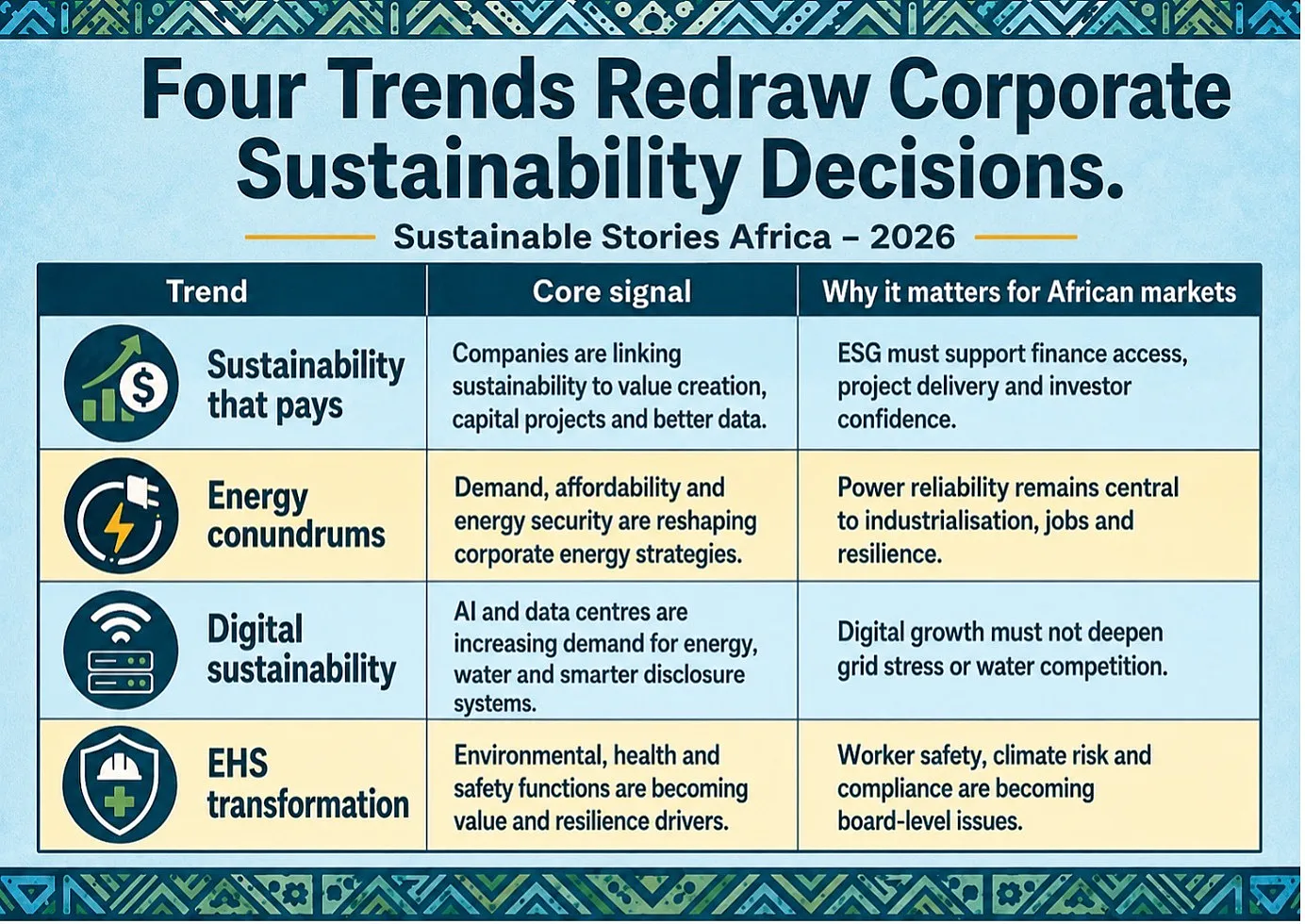
Four Trends Redraw Corporate Sustainability Decisions
ERM organises its 2026 outlook around four trends: sustainability that pays, energy complexity, the digital era, and EHS transformation.
The report’s contents show a clear shift from a broad sustainability strategy toward operational delivery across capital projects, disclosure, grids, data centres, AI, health and safety, and remediation.
The pressure is visible in capital projects. ERM research found that 45% of mining project delays were caused by permitting issues, 26% by stakeholder opposition and 24% by environmental concerns.
For mining projects with capital expenditure between $3 billion and $5 billion, the report says every week of delay can cost about $20 million in net present value.
This is deeply relevant to Africa’s ambitions for renewable energy, mining, transport and industrial corridors.
The report notes that renewable projects in Africa often intersect with the traditional lands and livelihoods of Indigenous Peoples.
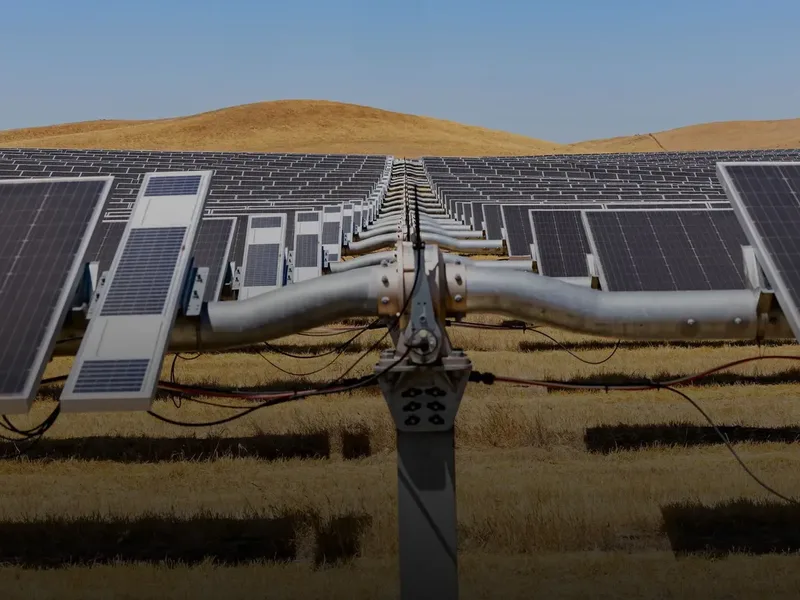
In southern Kenya, a solar developer managed land tenure and displacement concerns by creating a dispute resolution process and helping communities register land titles.
The lesson is practical: community engagement is not a public relations add-on. It is a project delivery tool.
Energy, Data, and EHS Change Execution
Energy demand is emerging as a critical pressure point for sustainable development. Global energy demand grew 2.2% in 2024, faster than the decade average, with developing countries accounting for over 80% of that growth.
Global energy investment was projected to reach a record $3.3 trillion in 2025, with approximately $2.2 trillion directed toward low-carbon options.
However, demand is outpacing infrastructure capacity, with global power demand rising 4% in 2024 and projected to grow nearly 30% by 2035.
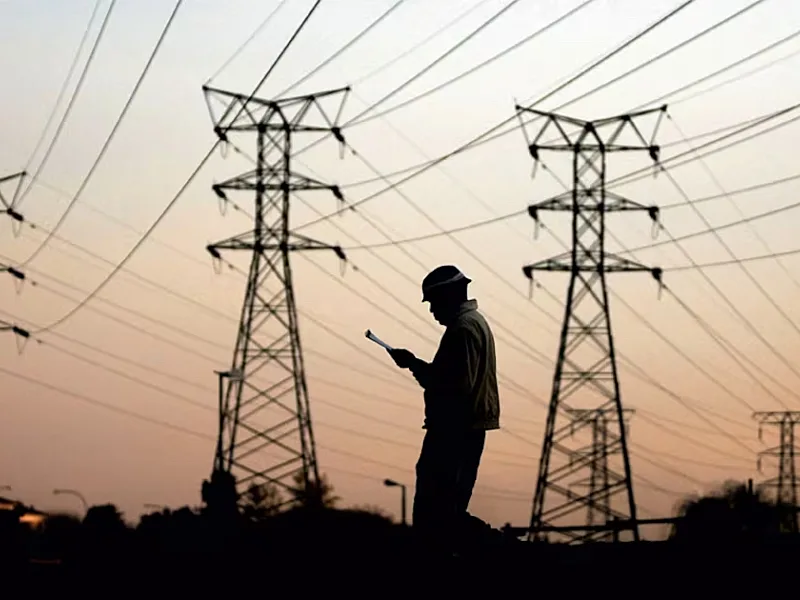
Africa's vulnerability is particularly acute. Climate-linked disruptions, including droughts that triggered hydropower blackouts across Malawi, Zambia and Zimbabwe in 2023 – 24, highlight the continent's infrastructure fragility.
With grid improvements unlikely to arrive quickly enough, ERM argues that on-site storage, standalone mini-grids and smart load management are becoming essential to power continuity.
The digital economy is intensifying these pressures considerably. With 88% of companies reporting AI adoption in 2025 and over 6,100 data centres operational globally, projected to reach 8,300 by 2030, electricity demand from data centres is expected to quintuple by 2040, reaching 5% of global electricity consumption.
Water scarcity compounds the challenge further, as a 100MW data centre consumes approximately 2 million litres of water daily, while 43% of global data centres are located in high water-stress regions.
For African cities pursuing digital infrastructure investment, the central question is unavoidable: can the continent build data centres and AI hubs without deepening electricity shortages, water stress or community opposition?
Resilience Becomes A Market Value Opportunity
The opportunity is that sustainability can now be framed less as defensive compliance and more as value protection.
ERM cites physical climate impacts costing the global economy at least $1.4 trillion in 2024, almost 10 times the 2000 total.
Under current emissions trajectories, climate change could reduce global GDP by $23 trillion by 2050.
However, the adaptation market is also growing. In 2024, about 2,100 companies generated more than $1.2 trillion in revenue from climate adaptation-related products and services, and global adaptation revenue could potentially reach $4 trillion by 2050.
The business case is becoming clearer. A June 2025 study of 320 adaptation and resilience investments across 12 countries found that every $1 spent generated more than $10 in benefits over 10 years.
For Africa, this links directly to food systems, transport networks, ports, housing, health systems and water infrastructure.
Climate resilience is not only about avoiding loss. It can support productivity, protect supply chains, lower insurance exposure, and make infrastructure more financeable.
The same logic applies to sustainability data. Roughly 12,900 companies, representing 91% of global market capitalisation, disclosed sustainability-related information in 2024, up from 86% in 2022.
Among G20 large companies, 73% obtained some form of assurance for sustainability disclosures in 2023, up from 51% in 2019.
Credibility is now an asset. Poor data can become a liability.
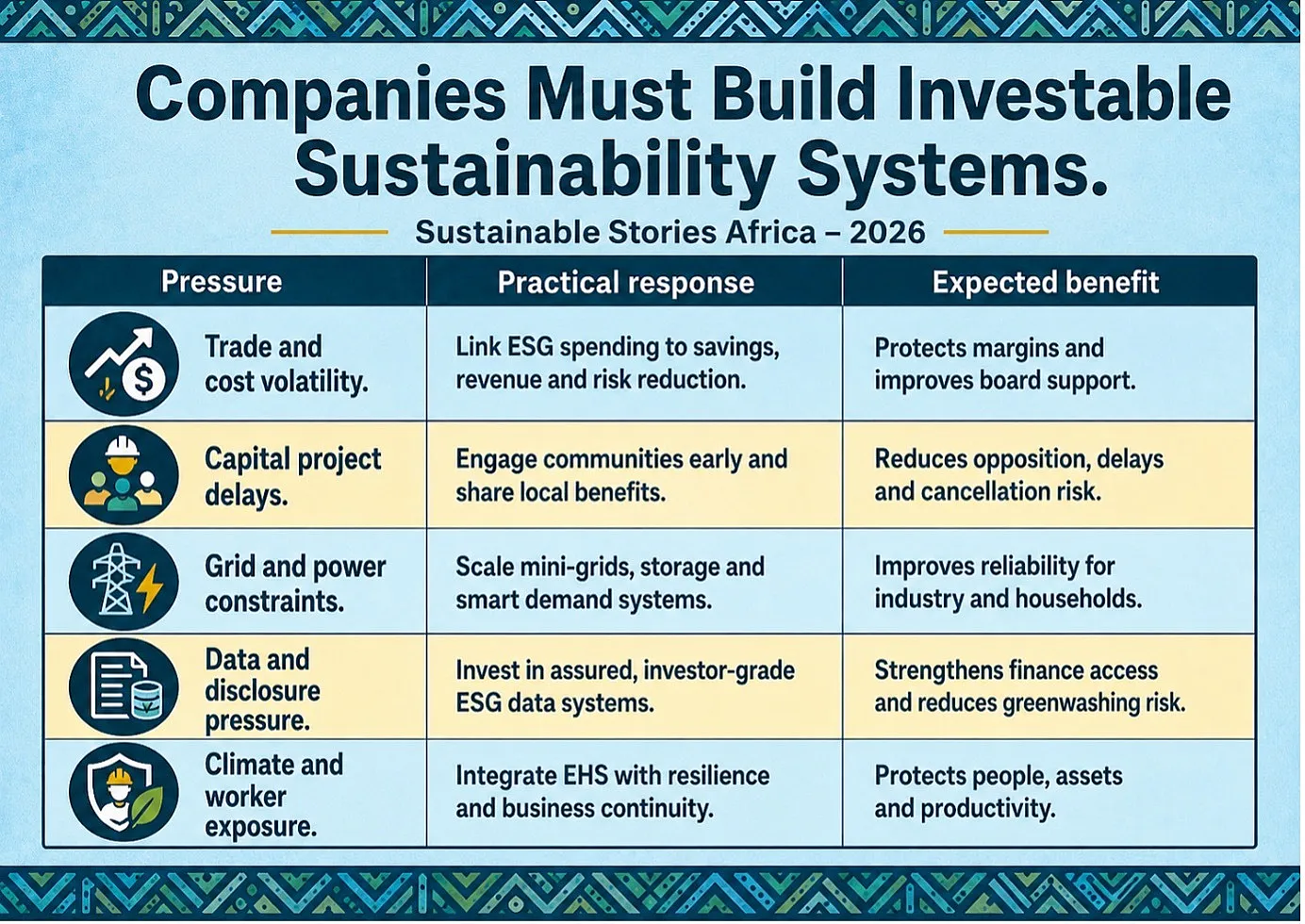
Companies Must Build Investable Sustainability Systems
The action agenda for African companies, regulators and financiers is clear: build systems that make sustainability measurable, investable and operational.
- Governments need to reduce policy uncertainty, accelerate permitting without weakening safeguards, and require credible community engagement for high-impact projects.
- Regulators should also strengthen disclosure rules in ways that improve data quality without overwhelming smaller firms.
- Businesses must move sustainability teams closer to finance, operations, procurement and risk.
If ESG remains separate from capital planning, it will struggle to survive cost pressure. If it is tied to energy savings, resilience, compliance, worker safety and market access, it becomes part of the business strategy.
Financiers also have a role.
- Banks and investors can reward companies that prove sustainability value through reliable data, credible transition planning, stronger EHS systems and community-sensitive project design.
Path Forward – Turn Pressure Into Performance
The next phase of sustainability will be judged by delivery: lower risks, stronger infrastructure, credible data, safer workplaces and measurable community benefit.
For African markets, the priority is to convert ESG from a reporting language into practical systems that protect people, attract capital, improve resilience and support long-term competitiveness.