
A study of 89 Indonesian companies finds sustainability reporting is positively associated with market value, but current profitability does not explain the connection.
The result strengthens the case for transparent ESG disclosure while warning boards and investors against reducing sustainability to a short-term earnings test.
Sustainability Value Arrives Before Profit Evidence
For companies under pressure to prove that sustainability pays, the usual test is immediate: did revenue rise, costs fall or profit margins improve?
New evidence from Indonesia suggests the market may answer a broader question.
Investors can attach value to sustainability reporting even when profitability is not the channel carrying that value.
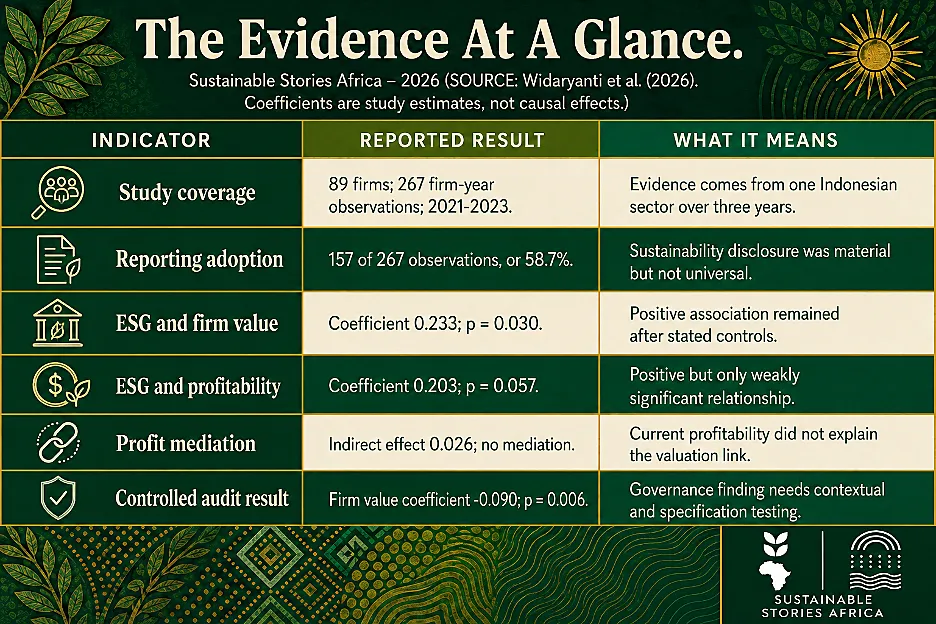
The study examined 89 consumer non-cyclical companies listed on the Indonesia Stock Exchange from 2021 to 2023, creating 267 firm-year observations.
It measured disclosure with a Global Reporting Initiative-based index, profitability with return on assets and market value with Tobin's Q.
For African markets preparing for tighter sustainability disclosure, the finding matters because it reframes reporting as market infrastructure.
Credible disclosure can reduce uncertainty, signal long-term readiness and strengthen stakeholder confidence before those gains appear in current profit.
The Market Signal Outruns Current Earnings
The headline result is a positive association between sustainability reporting and firm value.
- In the study’s controlled model, the sustainability coefficient was 0.233, with a p-value of 0.030.
- The model accounted for firm size, leverage, age and industry effects.
- This does not establish that disclosure caused the valuation increase; however, it indicates that the relationship remained statistically significant after those controls.
Profitability told a more complicated story.
- Sustainability reporting was positively associated with return on assets at the 10% significance level; however, the profitability model explained only 5.3% of the variation in ROA.
- More importantly, the bootstrap mediation test found an indirect ESG-to-value effect of 0.026 and classified it as non-significant. The direct effect, at 0.186, was much larger.
That distinction is commercially important.
- A company may earn a valuation benefit from better information, stronger legitimacy, improved stakeholder relationships or lower perceived risk without being able to point to a same-period profit increase as the explanation.
Sustainability can therefore have financial relevance without fitting a simple "spend today, profit tomorrow" narrative.
What The Indonesian Study Actually Found
The study examined a high-visibility, consumer-facing sector in which 157 of 267 firm-year observations (58.7%) included sustainability reports, compared with 110 that did not.
This adoption rate signals that disclosure had become material, though not yet universal, enabling a meaningful comparison between reporting and non-reporting firms.
The audit committee findings, however, demand caution.
The core model links audit committee strength to lower profitability and firm value, with coefficients of -0.089 and -0.090, both significant at the 1% level.
However, alternative specifications show positive coefficients, and parts of the narrative even describe a positive contribution, inconsistencies that undermine any simple claim about governance destroying or creating value.
Limitations reinforce this caution: three years cannot capture a full business cycle, and one sector cannot represent an entire emerging market.
Tobin's Q is expectation-sensitive, and disclosure indices measure reporting, not performance quality.
The authors call for broader cross-sector, cross-country research.
Value Can Travel Through Wider Channels
For African issuers, the opportunity lies in those wider channels.
- Better disclosure can make risks easier to price, show how boards oversee climate and social exposures, and help lenders or long-term investors distinguish prepared companies from opaque ones.
- The value is not merely reputational. Consistent data can improve capital allocation, procurement decisions and engagement with communities that bear operational impacts.
This matters in markets where many businesses face high financing costs and information gaps.
- A sustainability report that links material risks to strategy, capital expenditure, operating targets and board accountability can become part of the evidence investors use to judge resilience.
The benefit may first appear as confidence, access or reduced uncertainty rather than higher ROA.
However, disclosure creates durable value only when it is credible.
A glossy report not supported by controls, comparable metrics or operational change can widen the trust deficit.
The strongest reading of the Indonesian evidence is therefore not that any ESG report earns a premium. It is that markets may recognise strategically useful sustainability information beyond the narrow lens of current accounting profit.
Boards Must Improve Disclosure And Governance
Boards should begin with materiality and control.
- They need to identify the environmental, social and governance issues most likely to affect enterprise value and stakeholders, assign accountable owners, and connect targets to budgets and risk management.
Finance, internal audit, sustainability, and operations teams should agree definitions so the same metric means the same thing across reports and periods.
Audit committees should avoid copying structures from other markets without testing whether they work locally.
- Independence, expertise and meeting frequency are inputs, not outcomes.
Boards should evaluate whether committee oversight improves data reliability, challenge and decision quality, while regulators should examine whether formal compliance is producing better reporting or simply more process.
Investors should also resist a false binary.
- The absence of immediate profit mediation does not prove that profitability is irrelevant, and a positive valuation association does not prove permanent value creation.
The practical response is to track disclosure quality, operating performance, cost of capital and market valuation over longer horizons, then test which pathways persist through downturns.
Path Forward – Test Value Across Cycles
African markets should treat sustainability reporting as decision infrastructure, supported by comparable metrics, governance controls and assurance proportionate to risk.
The objective is useful information, not reporting volume.
Longer studies across sectors and business cycles must test whether valuation gains endure and which channels carry them.
Until then, boards should build credible systems while investors read the evidence as promising association, not guaranteed return.