Corporate sustainability is moving from ambitious commitments to narrower execution, but companies are demanding more delivery while budgets, leadership support and organisational capacity remain constrained.
The BSR–GlobeScan State of Sustainable Business 2026 finds that regulation is dominating corporate priorities such as climate adaptation, human rights oversight and artificial intelligence governance, which are struggling to keep pace.
For African markets, the findings reveal both a warning and an opportunity.
Sustainability’s Delivery Era Exposes Deeper Faultlines
Corporate sustainability has entered a more demanding phase. Companies are no longer being judged mainly by the promises they announce, but by whether they can translate climate, human rights and governance commitments into operational results.
However, the transition from ambition to implementation is exposing a structural contradiction:
- Businesses are expecting sustainability teams to deliver more with limited investment
- Weaker engagement among important departments and executives who increasingly view ESG as a compliance obligation rather than a source of long-term value.
That is the central finding of the BSR–GlobeScan State of Sustainable Business 2026, based on responses from 124 senior sustainability professionals working at companies with annual revenues of at least $1 billion.
Conducted between April 14 and May 15, the survey describes a corporate agenda becoming more focused and pragmatic, but also more defensive, internally fragmented and vulnerable to underinvestment.
Compliance Is Winning, but Strategy Is Losing
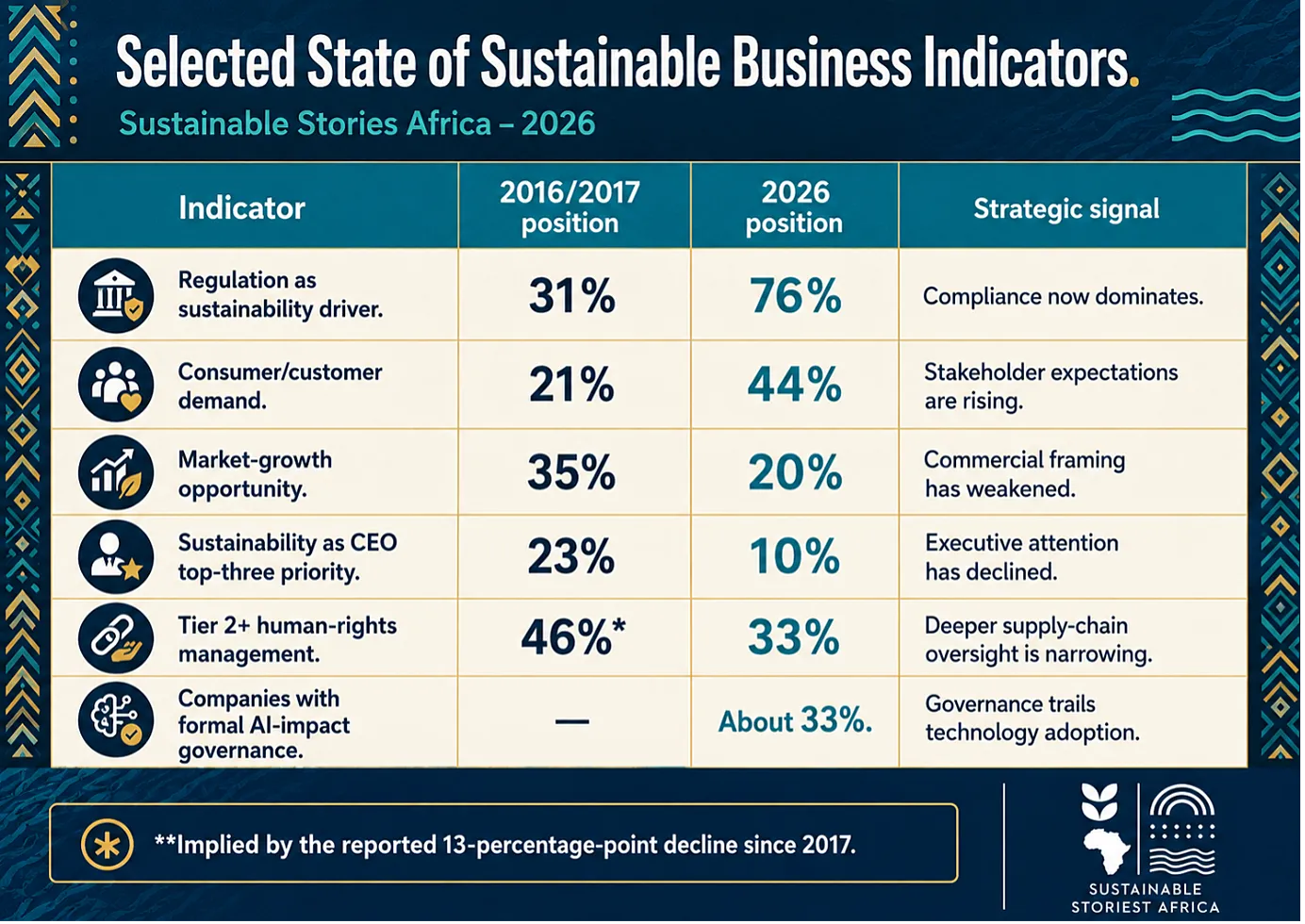
Regulation has become the dominant driver of corporate sustainability, cited by 76% of respondents, up sharply from 31% in 2016, while consumer demand doubled in importance, from 21% to 44%.
Meanwhile, traditional business drivers are fading: market-growth opportunities fell from 35% to 20%, innovation dropped from 21% to 8%, and talent-related motivations declined from 19% to 12%.
This shift suggests companies increasingly ask "what must we disclose?" before "what value can sustainability create?"
- Compliance ranks as a "very significant" priority for 61% of respondents,
- Followed by climate targets (51%), supply-chain engagement (39%)
- Transition planning (35%)
- Human rights (29%).
- Nature and biodiversity trail at just 14%
- Living wages (8%)
- Just transition (5%) barely registering.
For African and emerging markets, this narrowing carries serious weight. Where livelihoods depend heavily on informal employment, natural resources and climate-vulnerable sectors, these deprioritised issues aren't peripheral; they are central to development.
Budgets Shrink as Delivery Expectations Keep Rising
The most consequential figure may be the mismatch between implementation and investment.
While 90% of companies maintain or increase sustainability implementation, 27% report reduced investment, and only 18% expect budgets to rise next cycle, 40% expect no change, and 25% expect further cuts.
Companies are entering the labour-intensive phase of sustainability without consistently funding it.
The barriers are largely internal, not financial. 58% cite tension between sustainability and commercial priorities; 52% cite alignment and governance gaps; 51% cite competing priorities. This is a governance story.
The disconnect starts at the top.
- 77% of sustainability professionals view it as core to long-term strategy
- Versus just 39% of senior leadership, who largely treat it as risk management.
- CEO prioritisation has fallen from 23% to 10% since 2016.
- With CEO-office engagement dropping from 55% to 36%.
Sustainability teams now connect more with finance, legal and IT compliance functions, while weakening ties with operations, HR, product development and R&D.
This gap extends to climate adaptation: nearly 60% assess physical risk, but only 30% have operational adaptation plans and just 15% cover supply chains.
Human-rights oversight is narrowing too. Tier 2 supplier coverage dropped 13 percentage points to 33% since 2017.
AI governance lags similarly, with only a third managing its social and environmental impacts.
A Better Model Connects Risk and Growth
Sustainability isn't disappearing; it's becoming more selective, operational and evidence-driven.
54% of companies have rescoped goals in the past 12 – 18 months, and notably, more report increased ambition (19%) than reduced ambition (13%).
Over 60% say they act more on sustainability than they publicly communicate, suggesting quieter messaging doesn't always signal inactivity.
Still, quieter execution must not become weaker accountability. Without transparent targets and credible reporting, stakeholders may struggle to distinguish real delivery from retreat.
For African markets, the better model integrates compliance with value creation: climate resilience protects factories and supply chains, human-rights diligence strengthens supplier performance, and responsible AI governance builds digital trust.
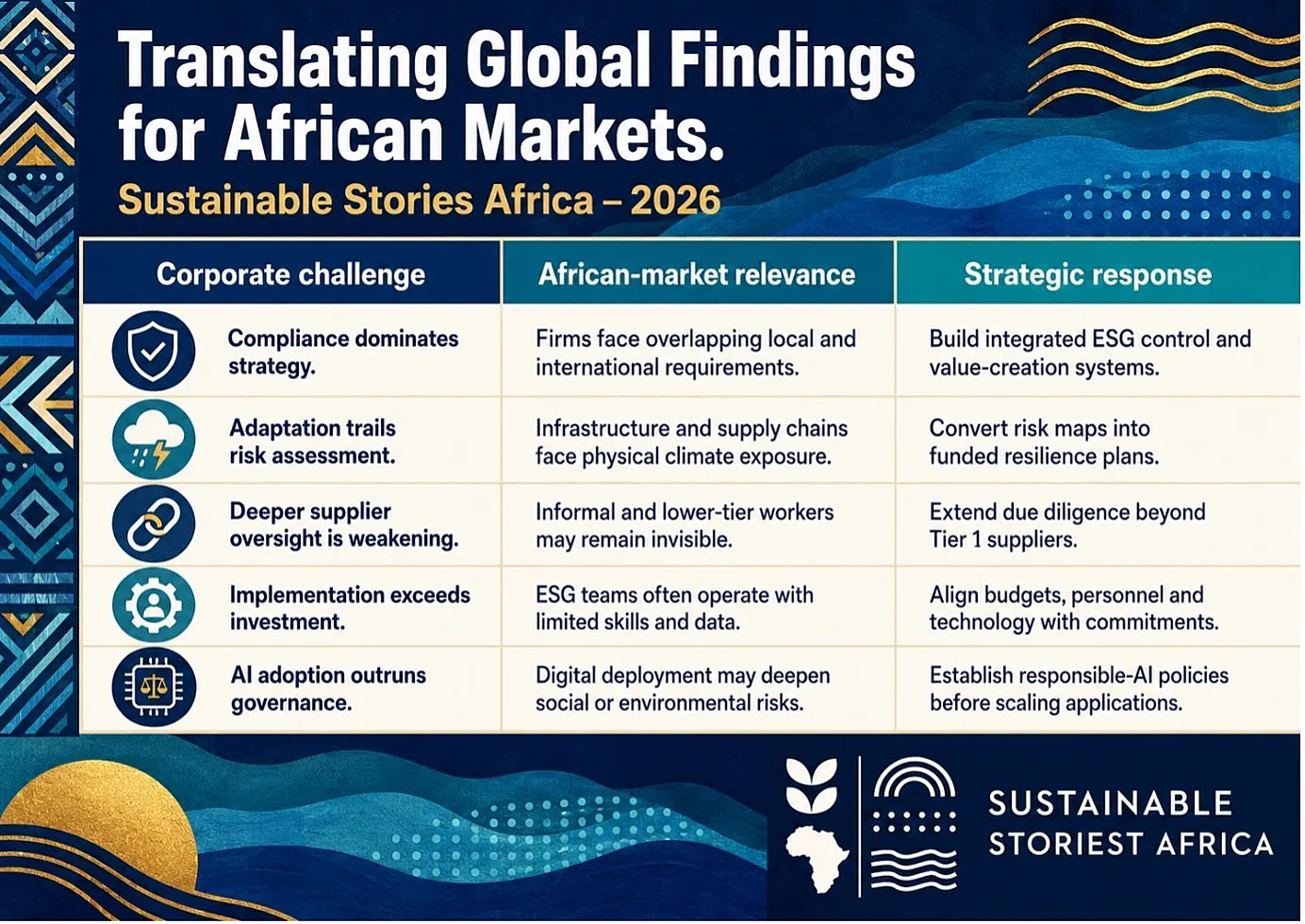
Companies linking sustainability to productivity, resilience and innovation can move beyond defensive compliance into capital allocation and strategic planning.
The alternative is costly, strong policies without capacity, risk assessments without adaptation, and AI adoption without safeguards.
Boards Must Rebuild Capability Around Sustainable Execution
- Boards must first close the strategic alignment gap, framing sustainability around revenue, asset resilience, procurement continuity and capital access—not disclosure alone.
- CFOs should connect commitments to actual budgets, ensuring climate, human-rights and AI objectives have funded systems and personnel behind them.
- Risk teams must convert assessments into real adaptation programmes: facility-level resilience, supplier-continuity plans, insurance analysis and clear accountability.
- Procurement must extend due diligence beyond Tier 1 suppliers, where deeper labour and environmental risks concentrate.
- Companies deploying AI should establish formal governance that covers data rights, discrimination, energy use and human oversight, before harm occurs, not after.
- Regulators, too, have a role: reporting requirements should generate comparable, decision-useful information without draining resources needed for implementation itself.
The report's composition warrants caution: 48% of respondents were headquartered in North America, 39% in Europe, and just 13% elsewhere, making it unrepresentative of African corporate sustainability specifically.
Still, its core challenges, such as resource constraints, leadership misalignment, weak adaptation, supply chain opacity and emerging AI risks, remain highly relevant to African companies operating in global markets.
Path Forward – From Narrow Compliance to Durable Business Value
Sustainability’s next phase must connect regulation with execution, innovation and resilience.
Boards should align targets with budgets, extend responsibility throughout value chains and convert climate-risk assessments into funded adaptation.
African businesses can use this moment to build ESG systems suited to local realities while meeting international expectations.
The objective is not fewer commitments for convenience, but clearer priorities supported by governance, investment, measurable outcomes and accountability.