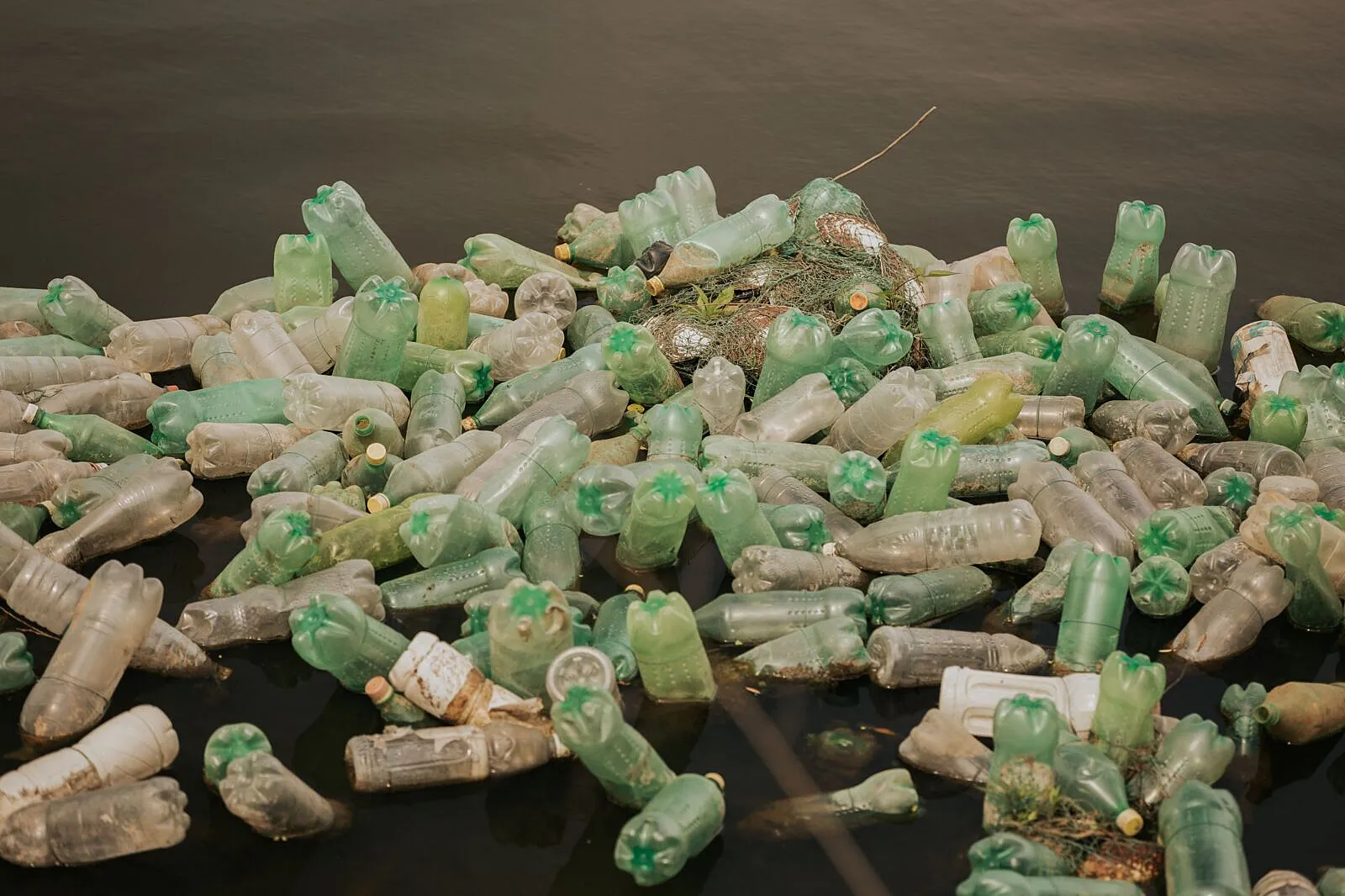
Plastic pollution is measurable, financially material, and accelerating, and the World Economic Forum's June 2026 insight report has produced the most comprehensive data portrait yet of its economic consequences.
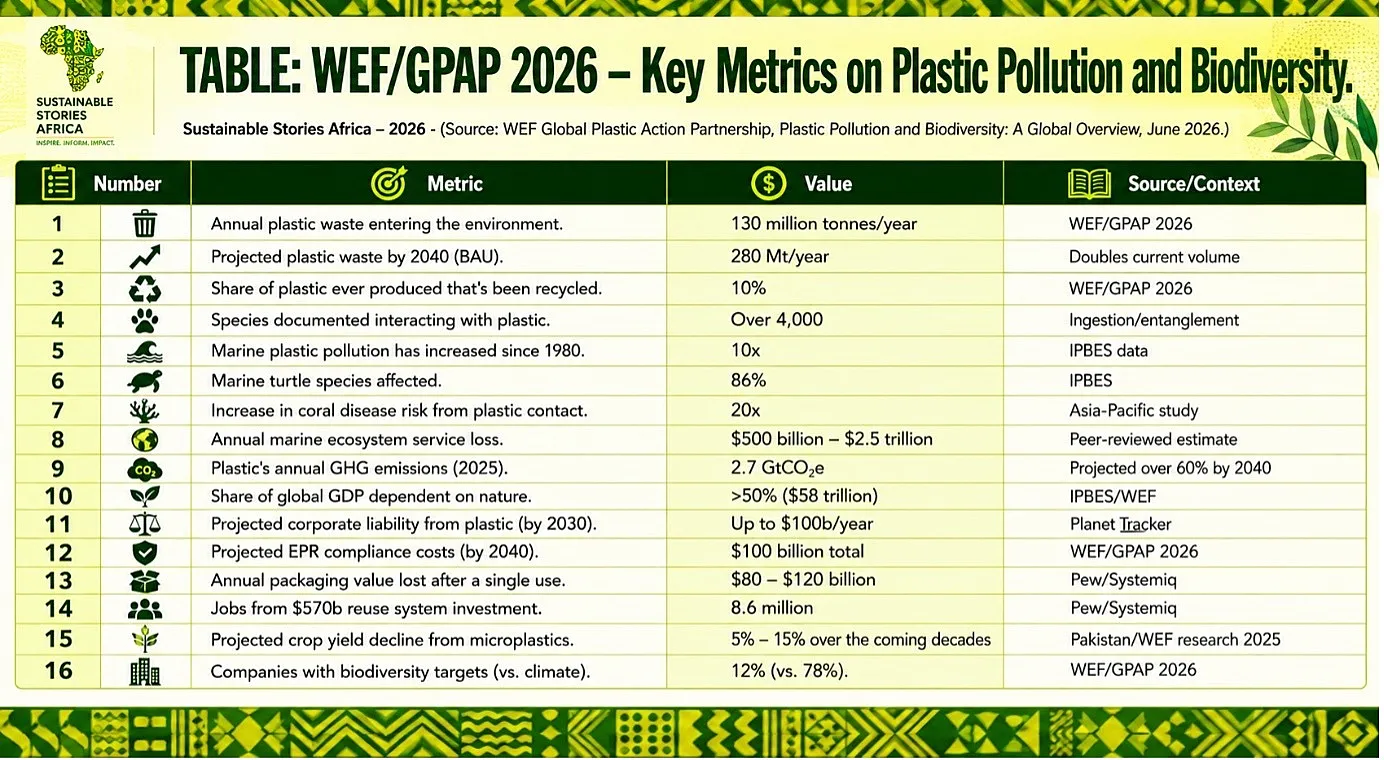
From $500 billion to $2.5 trillion in annual marine ecosystem losses, to $100 billion in projected corporate liability, to a potential 5% – 15% decline in global crop yields, the metrics of this crisis are no longer abstract.
For Africa's businesses, investors, and policymakers, this is not a distant ecological story. It is a data-driven financial risk register, one that demands disclosure, redesign, and systemic reform before the costs become unmanageable.
Counting the Cost of a Plastic Planet
The global plastics economy is burning $80 – $120 billion in value every year, discarding packaging after a single use while simultaneously destroying the ecosystems that underpin agriculture, fisheries, tourism, and communities.
A new WEF data synthesis makes the financial case for change with unprecedented precision.
The WEF's Global Plastic Action Partnership report, Plastic Pollution and Biodiversity: A Global Overview (June 2026), draws on two years of field research in nine countries, augmented by data from OECD, IPBES, Pew/Systemiq, UNEP, the World Bank, and the Asia-Pacific Economic Cooperation organisation.
It delivers a data landscape that transforms what was once framed as an environmental challenge into a measurable ESG crisis with direct financial consequences.
The Core Metric That Changes Everything
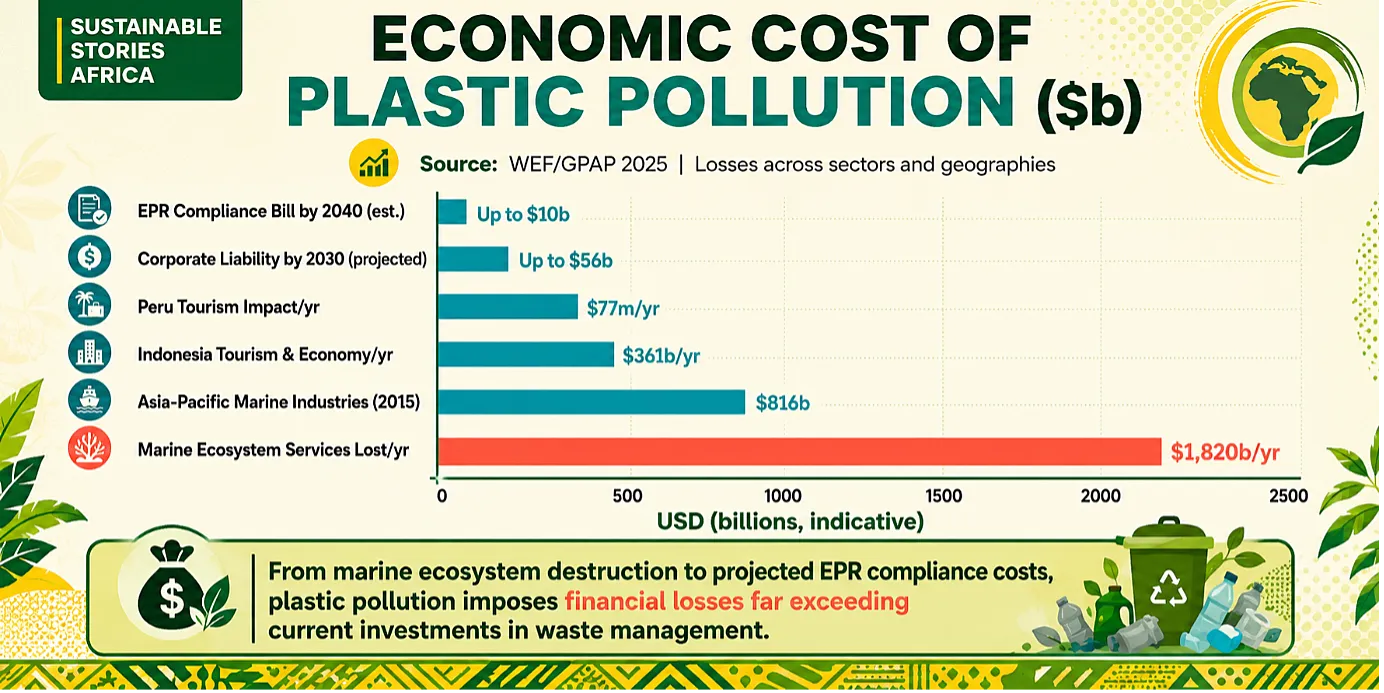
The headline number from the WEF report is one that every C-suite, finance ministry, and investment committee should know: plastic pollution loses $500 billion to $2.5 trillion in marine ecosystem services annually.
This is not a clean-up cost or regulatory exposure; it is the annual destruction of natural capital on which fisheries, coastal tourism, carbon sequestration, and flood protection directly depend.
However, the world currently spends less than $140 billion per year on effective waste management, a fraction of what plastic is costing the planet.
This gap between the costs of action and the cost of inaction is the central financial argument of the report.
 |  |
Unpacking the Key Numbers for African Markets
Metric 3 – Only 10% of plastic is ever recycled:
- Africa's recycling infrastructure is among the weakest globally. Nigeria recycles less than 12% of its 2.5 million tonnes of annual waste.
- However, informal waste pickers, predominantly women, collect and sort nearly two-thirds of all recycled plastic globally, including across African cities, with no formal recognition, stable wages, or legal protection.
Metric 7 – 20x disease risk for corals:
- Africa's coral reef systems, from the Red Sea to the East African coast, face precisely the compound threat the WEF describes: warming oceans and plastic pollution multiplying disease risk 20-fold.
- The value of coral reef tourism globally is estimated at $36 billion per year; across East Africa and island economies, it is a primary revenue driver.
Metric 11 – $100 billion in corporate liability by 2030
- Between 2012 and 2022, 731 plastic pollution policies were introduced worldwide.
- African regulators are following suit; Nigeria's 2021 National Policy on Plastic Waste Management is one example.
- Corporations sourcing from or operating across Africa who have not yet integrated plastic-related biodiversity risk into their ESG frameworks face rising exposure.
Metric 14 – 8.6 million jobs from reuse systems:
- For Africa's largely informal economies and youthful demographics, the reuse economy is not just an environmental opportunity; it is a jobs and livelihoods programme.
- Research in Lagos found that women already repurpose plastic containers as vessels for local beverages and soap, a grassroots circular economy without formal recognition or support.
Metric 16 – Only 12% of companies have biodiversity targets:
- The comparison with climate is stark. While 78% of companies have climate targets, less than 12% have biodiversity targets, and fewer than 1% disclose their biodiversity impacts.
- However, biodiversity loss and ecosystem collapse are now ranked by the WEF Global Risks Report 2026 as the second most severe global risk over the next decade, ahead of AI risks and cyber warfare.
The Business Case Is Quantified
The opportunity is equally concrete. Indonesia offers one of the most compelling national case studies: marine plastic leakage costs the country $8 – $16 billion per year, while building a comprehensive national waste management system through 2040 would cost just $18 billion total, and unlock up to $10 billion per year in the value of the circular economy. The return on investment is clear.
Globally, better product design for recyclability could raise the share of economically recyclable plastic from 22% to 54% by 2040.
Advanced AI-based sorting and sustainable plastic conversion processes have been identified as two business opportunities worth $68 billion by 2030.
Five Metrics That Must Drive Corporate Decisions Now
For Africa's businesses and financial institutions, the WEF report translates into five immediate measurement and action priorities:
- Disclose plastic footprint and biodiversity exposure in line with TNFD and CDP frameworks, particularly for companies in food, beverages, fisheries, agriculture, and manufacturing.
- Include EPR liability and biodiversity-linked corporate risk in risk registers and investor disclosures.
- Set quantified biodiversity targets, not just climate targets, aligned with the Kunming-Montréal Global Biodiversity Framework (GBF) Target 15.
- Map plastic waste pathways in operational geographies to identify hotspots where intervention delivers the highest biodiversity and economic returns.
- Formalise and pay informal waste pickers as strategic ESG partners in extended producer responsibility systems, particularly in high-biodiversity urban and coastal areas.
Path Forward: Metrics Must Translate Into Markets
The numbers are no longer in dispute; plastic pollution is an economic crisis hiding inside an environmental one.
Africa's businesses, investors, and governments cannot afford to wait for the next global policy cycle to begin pricing this risk.
The WEF has drawn the map. The metrics are on the table.
The opportunity for African markets to lead on circular plastics, formalise their waste economies, and protect the biodiversity on which their growth depends, all while meeting the rising ESG expectations of global capital, has never been clearer, or more urgent.