New multi-country evidence links timely pest alerts with stronger farm performance, including greater adoption of integrated pest management, improved crop yields and increased incomes among smallholders in Ghana, Kenya and Malawi.
The findings raise a larger development question: can pest intelligence become essential rural infrastructure as climate change, invasive species and weak extension systems intensify risks across African agriculture?
Early Warnings Are Reshaping African Farming
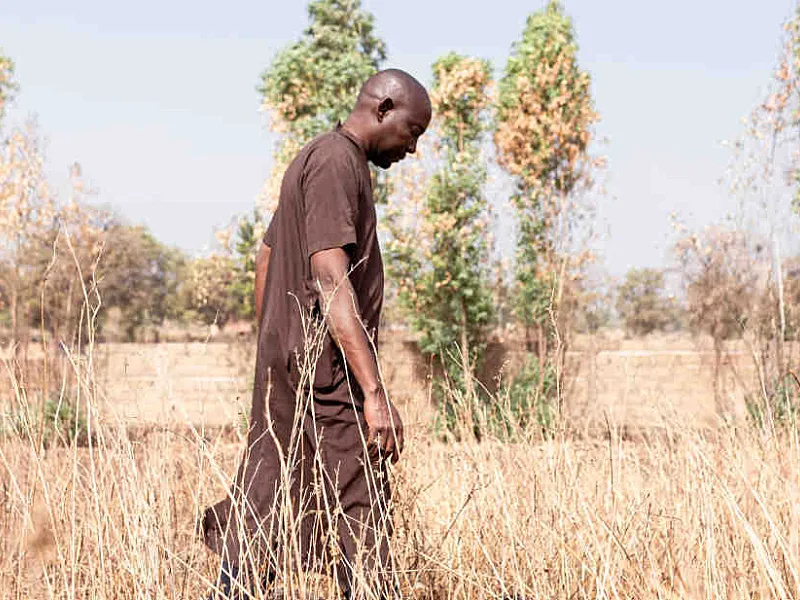
For a smallholder farmer, the difference between receiving a pest warning today and recognising an infestation next week can be the difference between protecting a harvest and losing a season’s income.
New evidence from more than 4,000 farming households suggests that delivering the right information before pests become established may materially improve that equation.
The research, led by Makaiko G. Khonje and colleagues at CABI, examined farmers in Ghana, Kenya, Malawi and Zambia. Published in Pest Management Science, the study found that access to timely pest alerts was associated with greater adoption of integrated pest management (IPM), as part of higher yields and crop incomes in several countries.
The findings matter beyond agricultural technology. They connect food security, climate resilience, rural income, digital inclusion and environmentally safer farming, placing pest information within Africa’s broader environmental, social and governance agenda.
They also show how satellite intelligence and local communication networks can intersect with farmers’ lived realities.
Costly Pest Crisis Meets Data
Crop losses from pests, diseases and weeds account for up to 40% of global agricultural output, with Africa bearing an estimated $66 billion in annual economic damage.
Globally, invasive species have cost economies roughly $1.3 trillion over five decades, losses that translate into reduced household incomes, food insecurity, price volatility and excessive pesticide use.
These risks are intensifying. Climate change is shifting pest behaviour and migration patterns, while expanding trade and agricultural intensification increase the odds of invasive species reaching new farming regions, often faster than farmers can respond.
A recent study explored whether early warning systems could shift farmers from reactive to preventive pest management.
The finding: timing is critical. Alerts signalling optimal intervention windows significantly improved outcomes, raising adoption of integrated pest management practices by 8 to 32 percentage points, and boosting yields and incomes by 18% to 26% across Ghana, Kenya and Malawi.
Four Countries Test Timely Farm Intelligence
The evidence draws on 4,054 smallholder households across Ghana (880), Kenya (1,413), Malawi (819) and Zambia (942), surveyed in areas covered by the Pest Risk Information Service (PRISE) during the 2020/2021 growing season.
Implemented from 2017 to 2022 with support from the UK Space Agency's International Partnerships Programme, PRISE combined earth observations, satellite weather data, pest lifecycle models and field data to forecast optimal intervention windows.
Recognising Africa's connectivity and literacy gaps, alerts were delivered not only via smartphones but through text, voice messages, radio, community centres and plant clinics, channelled through agricultural ministries, research agencies and meteorological services.
This mixed approach reflects a key development principle: a sophisticated forecast holds little value if farmers cannot access or trust it.
The project targeted fall armyworm, bean fly and tomato leaf miner across maize, beans and tomatoes, with fall armyworm covered in all four countries.
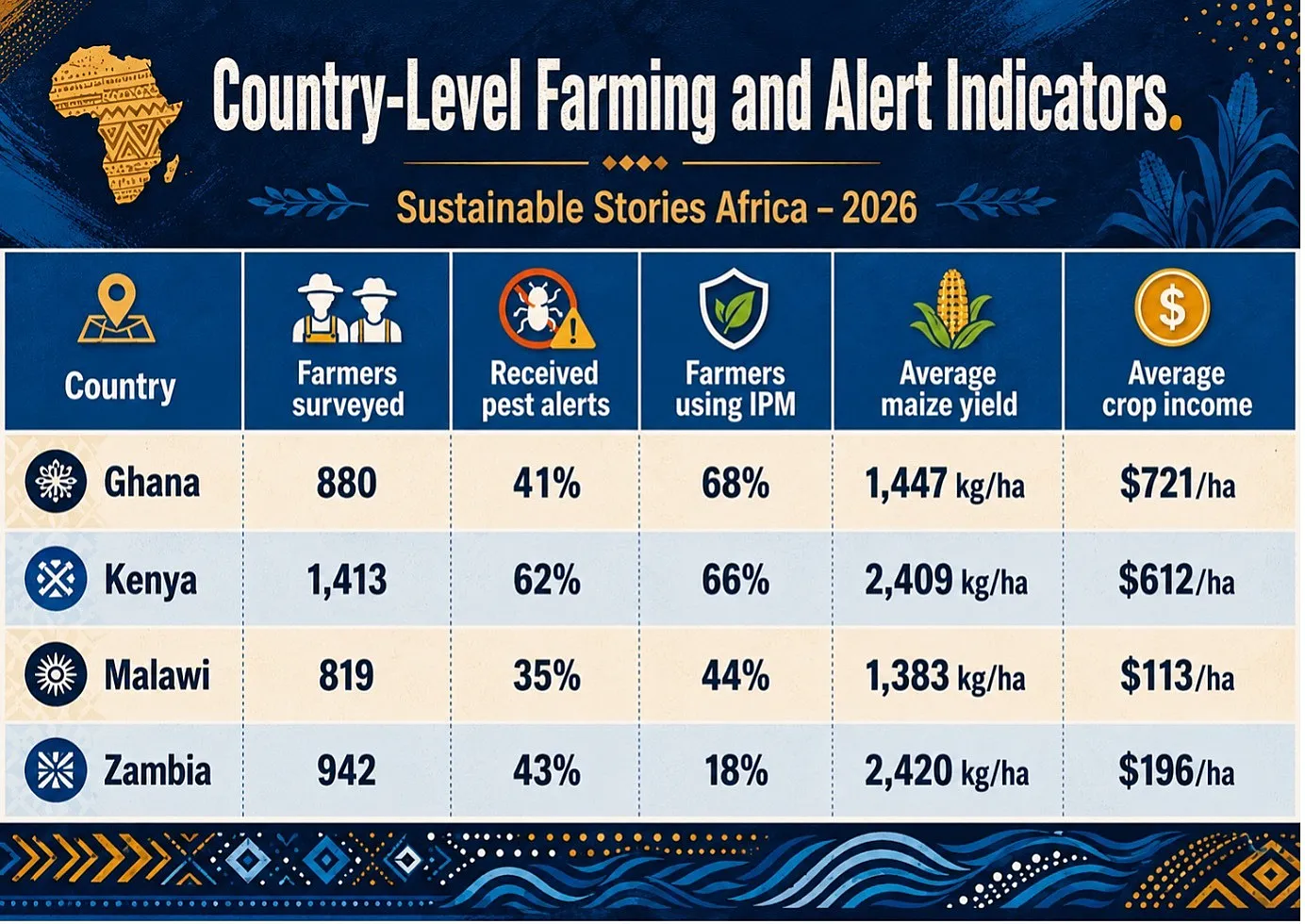
Results reveal both promise and disparity. Kenya recorded the highest alert access (62%) against Malawi's lowest (35%), while IPM adoption ranged from 68% in Ghana to just 18% in Zambia, underscoring how local institutions and market access shape outcomes.
After controlling for household and farm characteristics, pest alerts were linked to maize-yield gains of roughly 23% (Ghana), 20% (Kenya) and 19% (Malawi), with bean and tomato improvements reaching 24% to 43% in Kenya and Malawi.
Income gains ranged from 18% to 26% across three countries; Zambia's results, while positive, were statistically insignificant.
Researchers caution against causal claims, noting the cross-sectional data reflects strong associations rather than definitive proof.
Better Alerts Can Unlock Safer Growth
The immediate opportunity is higher productivity. Precise knowledge of pest emergence, such as fall armyworm larvae timing, allows farmers to intervene more accurately, reducing crop damage, protecting input investments and improving market access.
The development value runs deeper. Alerts promoted a range of IPM practices, including field scouting, removing affected plants, conserving natural predators, pheromone traps, biopesticides, and repellent cropping, reducing reliance on indiscriminate chemical spraying.
This creates a clear ESG case. Environmentally, precision pest management cuts unnecessary chemical use and protects beneficial insects.
Socially, higher yields and incomes strengthen food security and resilience. Governance-wise, trusted information systems make extension services more responsive and accountable.
There's also a climate-adaptation dimension: as pest pressures grow more complex with shifting weather patterns, systems that translate data into timely local advice help farmers adapt before losses become irreversible.
For governments and financiers, pest alerts offer high leverage, rather than replacing irrigation, credit or inputs, but protecting the returns on those investments.
The alternative is costly: past outbreaks have driven yield and income losses of 22% to 72% across sub-Saharan Africa.
Scaling Alerts Requires More Than Technology
These findings make a case for treating pest intelligence as public agricultural infrastructure, rather than a short-term digital pilot.
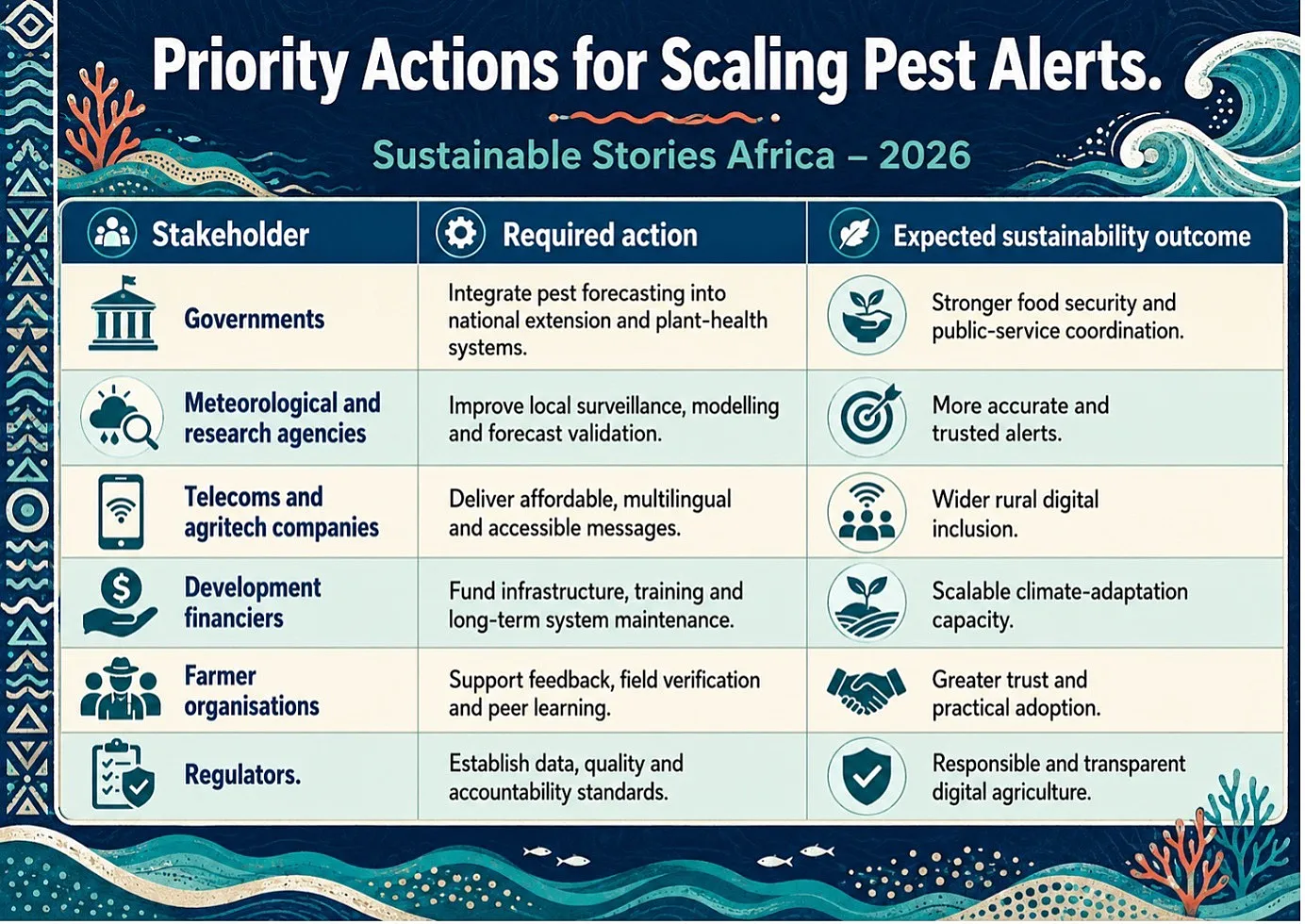
- Governments should embed pest forecasting within national extension systems, with agricultural ministries, meteorological agencies, universities and plant-health authorities sharing protocols for surveillance, forecast validation and rapid advisory distribution.
- Design must centre farmers, not devices. SMS suits areas with strong phone access and literacy, but voice messages, radio, plant clinics and community centres remain essential where connectivity, electricity, cost or language limit digital participation.
- Telecommunications firms can support subsidised messaging, agritech companies can personalise alerts using location and weather data, while financial institutions could integrate verified alerts into credit and insurance products.
- Development financiers should fund underlying infrastructure, such as rural connectivity, weather stations, surveillance networks and extension capacity prioritising long-term maintenance over one-off launches.
Rigorous measurement matters too. Future programmes should use randomised or longitudinal designs, track actual message receipt and action, and assess variation by gender, farm size, crop and channel.
The study's limitations, potential information spillover, mixed telephone and in-person interview due to COVID-19, and recall-dependent yield estimates don't undermine its conclusions.
Instead, they sharpen the next research priority: identifying when alerts work best and how forecasting can scale without excluding farmers on the wrong side of Africa's digital divide.
Path Forward: From Pilot Evidence To Public Infrastructure
African governments should connect pest surveillance, climate information and agricultural extension through affordable, multilingual delivery channels.
Investment must include local institutions, farmer feedback, rural connectivity and transparent performance measurement, rather than technology alone.
The objective is a dependable early-warning system that protects harvests, incomes and ecosystems.
Properly scaled, pest intelligence can become practical climate-adaptation infrastructure, advancing food security, poverty reduction and responsible agricultural production across African markets.