A new disclosure framework is seeking to make people-related risks as visible to markets as climate and nature risks have become.
The Taskforce on Inequality and Social-related Financial Disclosures has released Beta Version 0.1 of its framework, setting out how businesses and financial institutions can report impacts, dependencies, risks and opportunities linked to workers, communities, consumers and inequality.
People Risks Enter Financial Reporting
A new global framework is pushing businesses and financial institutions to treat people-related issues not as corporate social responsibility add-ons, but as material drivers of risk, resilience and long-term value.
The Taskforce on Inequality and Social-related Financial Disclosures, known as TISFD, has published Beta Version 0.1 of its disclosure framework, designed to help companies and financial institutions report how they affect and depend on people.
The draft arrives at a moment when inequality, affordability pressures, AI disruption, informal work, climate stress and weak social protection are shaping market stability.
For African and emerging-market economies, where labour informality, youth unemployment and climate vulnerability intersect, the framework could become an important tool for connecting financial disclosure with lived realities.
Inequality Is Becoming Market Risk
More than one billion working people globally cannot afford a decent living, while 2.1 billion labour in informal employment, a figure that surges to 85% – 90% across sub-Saharan Africa.
This reality reframes people-related risk as a core economic and business issue, not a peripheral ESG concern.
Enter the Taskforce on Inequality and Social-related Financial Disclosures (TISFD), launched in September 2024 by a global coalition of businesses, financial institutions, civil society and labour organisations.
Modelled on the TCFD and TNFD architecture, TISFD structures disclosure around governance, strategy, impact and risk management, and metrics and targets; however, it centres on people: workers in operations and value chains, consumers, end-users and affected communities.
For African companies, banks, insurers, pension funds and regulators, the framework arrives at a critical juncture.
Local enterprises already navigate fragile social systems: under-skilled labour markets, depressed household purchasing power, climate-vulnerable communities, weak infrastructure and policy volatility.
TISFD equips boards, investors and lenders with a common language to price these risks and steer capital toward long-term value creation.
Framework Connects People, Value And Risk
Businesses depend on people to operate, grow, innovate and remain competitive. Workers supply labour and skills; consumers sustain demand; communities grant trust, legitimacy and social licence; public institutions underpin stability.
However, many firms still exclude people-related issues from strategic decisions, a gap growing costlier as value shifts toward intangible assets such as human and social capital.
Strengthening rights, well-being and capabilities drives productivity, innovation, resilience and market depth; weakening them amplifies risk.
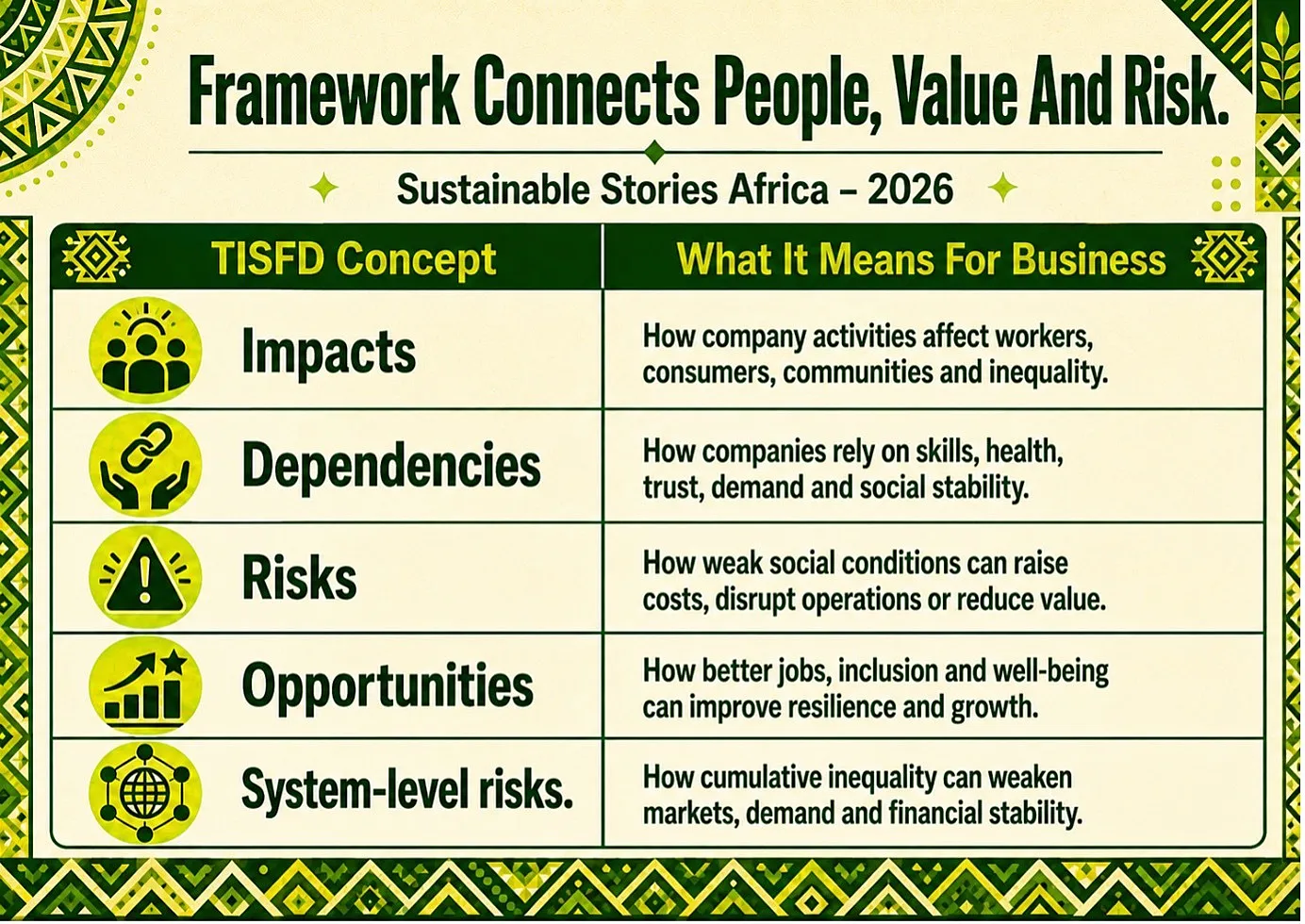
TISFD anchors its logic in four concepts:
- Impacts (how business affects people and inequalities).
- Dependencies (how it relies on human and social resources).
- Risks and Opportunities (when impacts and dependencies move revenue, costs, assets, capital access, reputation, operations or market stability).
The framework insists people, climate and nature are inseparable: climate harm deepens inequality; poorly managed green transitions spark opposition; AI and automation can widen job insecurity and digital exclusion.
In African markets, where energy transition, digitalisation and industrial policy advance amid high informality and social vulnerability, this framing is decisive.
A renewable energy project is never only a climate investment; it reshapes land access, benefit-sharing, local skills, electricity affordability and institutional trust.
Better Disclosure Can Improve Decisions
TISFD’s promise is not disclosure for disclosure’s sake; it is better decision-making. For companies, the framework surfaces emerging risks before they crystallise as disputes, disruptions or financial losses.
A model built on low-paid contract labour may look efficient today but breeds turnover, reputational damage, regulatory pressure and service instability tomorrow. Investing in worker safety, training and fair pay builds a more resilient operating model.
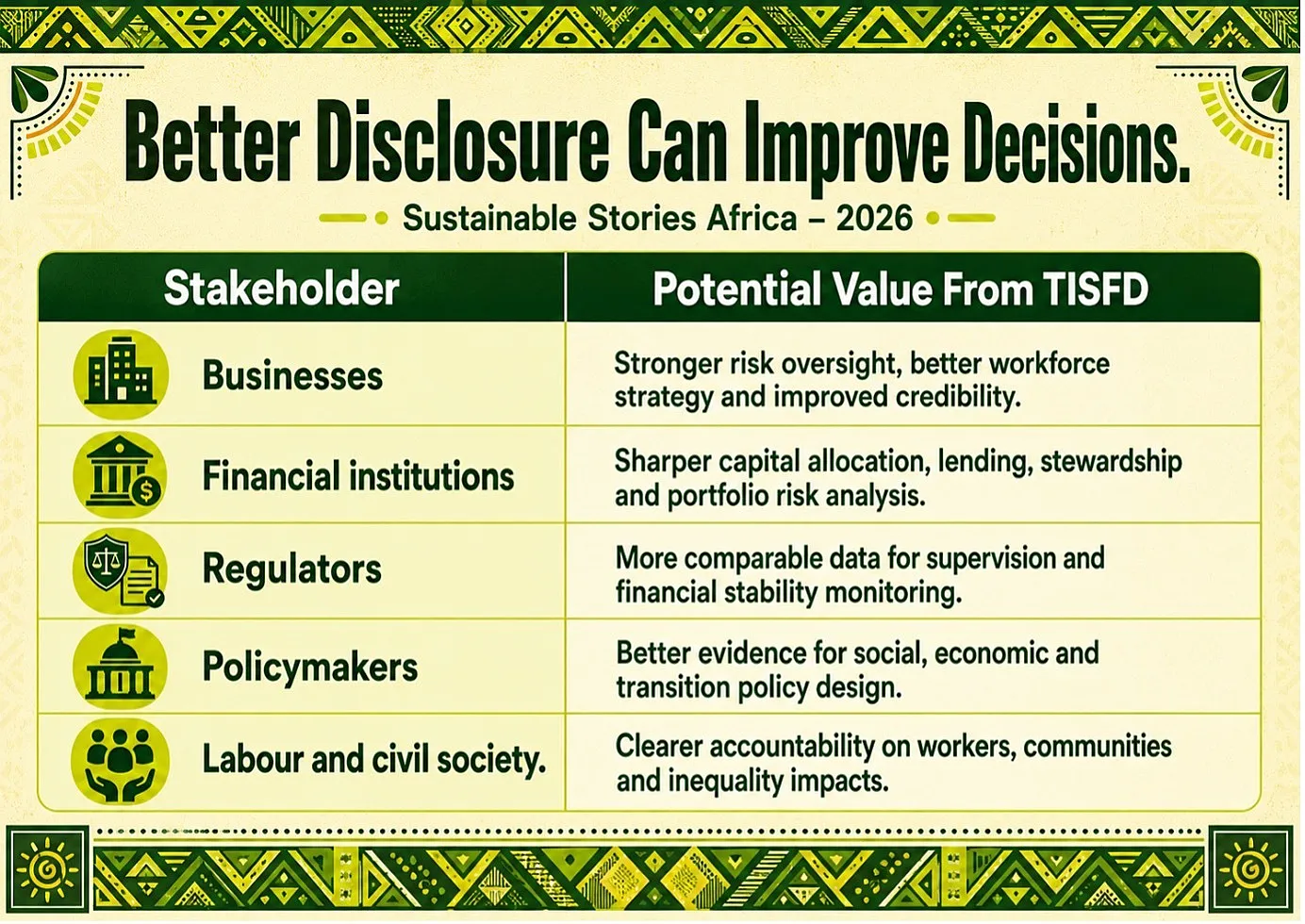
For investors and lenders, people-related disclosure sharpens capital allocation.
- Banks can trace how labour practices affect credit quality; asset managers can embed workforce and community risks into portfolio construction; insurers can price how social pressures shape claims and long-term liabilities; pension funds can test whether beneficiaries’ returns are exposed to inequality-driven market instability.
For policymakers and regulators, TISFD supplies a stronger evidence base.
- Revealing where business practices deepen social vulnerability, where regulation is fragmented, and where policy must align social priorities with climate, nature and transition agendas.
For Sustainable Stories Africa’s audience, the development imperative is clear.
- Climate disclosure that ignores the people bearing transition costs is incomplete.
Finance that overlooks labour informality, community vulnerability and inequality exposure misprices credit risk.
Transition policies designed without people-related data invite the social backlash that weakens reform.
Businesses Must Prepare For Disclosure
TISFD’s Beta Version 0.1 signals the direction of travel: people-related information must be governed, assessed, disclosed and linked to strategy.
The draft rests on four pillars.
- Governance (board and management oversight of impacts, dependencies, risks and opportunities).
- Strategy (how these issues interact with the business model and financial prospects).
- Impact and Risk Management (identification, assessment, prioritisation and monitoring across operations and value chains).
- Metrics and Targets (to be developed in later iterations).
Five general requirements; materiality, system-relevant information, stakeholder engagement, scope and time horizons, push disclosure beyond a narrow internal risk view toward affected stakeholders, system-level risks and short-, medium- and long-term horizons.
For African companies, the starting point is practical.
- Boards must map where people-related risks sit in the business model.
- Finance teams must trace how labour, community, consumer and value-chain issues move cash flow, costs and capital access.
- Sustainability teams must connect human rights, workforce data and social impact with financial reporting.
- Procurement needs supplier visibility. Investors need to ask sharper questions.
Public consultation on Beta 0.1 runs until 31 July 2026; iterative versions follow through 2026 – 2027, with a final framework targeted for end-2027.
African private-sector engagement is essential. Global frameworks often crystallise before emerging-market realities, informality, youth employment, gendered economic exclusion, climate migration, community consent, SME value chains, access to basic services, are fully reflected.
Those realities must be visible in the final architecture.
Path Forward – Put People Inside Market Decisions
The TISFD Framework makes a strong case for treating people-related issues as financially relevant, systemically important and central to sustainable development.
For African markets, the priority is early adoption, local evidence and active participation in consultation.
Businesses, regulators and investors should use the framework to improve governance, protect rights, strengthen resilience and ensure that climate, nature and digital transitions deliver value for people as well as markets.