The first TNFD status report shows rapid adoption alongside uneven disclosure, data and regional participation.
Nature-related reporting has moved quickly from specialist discussion to a market practice backed by organisations representing more than $20 trillion in assets under management.
TNFD’s first status report records strong momentum, but Africa and the Middle East account for only 6% of survey responses, highlighting the capacity and representation gap behind global disclosure progress.
Nature Risk Enters Mainstream Financial Reporting
Two years after the Taskforce on Nature-related Financial Disclosures released its recommendations in September 2023, companies and capital providers are beginning to treat ecosystem resilience as a business issue.
TNFD’s inaugural 2025 Status Report captures that shift while warning that nature assessment remains new, complex and uneven.
As of 31 July 2025, more than 1,800 organisations had joined the TNFD Forum.
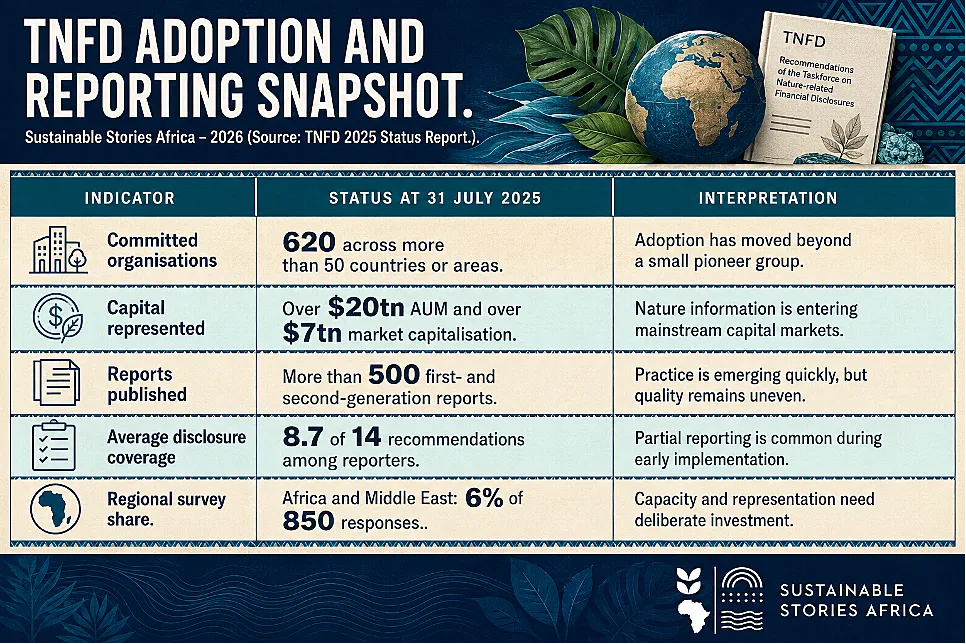
About 620 organisations across more than 50 countries or areas, representing over $20 trillion in assets under management and more than $7 trillion in market capitalisation, had committed to begin TNFD-aligned disclosure.
More than 500 first- and second-generation reports have already been published.
Those numbers matter because nature loss can affect water, soil, pollination, disease regulation, coastal protection and resource availability.
The financial effects appear through production, asset values, permits, insurance, supply chains and community conflict.
For African economies with high dependence on agriculture, minerals, forests, fisheries and tourism, the issue is not remote from development; it is embedded in it.
Early Adoption Outpaces Complete Disclosure Practice
The report triangulates a TNFD survey with market scans and reporting data. Among companies reporting at least one recommended disclosure, the average coverage was 8.7 of the 14 recommendations.
- Depending on the dataset, 75% to 87% reported at least five disclosures, while only 11% to 36% reported all 14.
That pattern is consistent with a young framework.
- Governance, strategy and risk-management narratives can often build on existing climate processes.
- Metrics are harder because nature is location-specific, value-chain data may be missing, and companies must assess both dependencies and impacts.
- Financial institutions face an added constraint: their analysis depends on data from customers and investees.
The report also found that 78% of survey respondents who had published nature-related disclosures integrated them with climate reporting.
Integration can reduce duplication, and help boards see climate and nature as connected systems.
It should not collapse nature into a carbon metric. However, a project can reduce emissions while increasing water stress, habitat loss or community exposure.
Investors Want Standards And Comparability Next
63% of TNFD survey respondents considered nature-related risks and opportunities as significant as, or more significant than, climate-related issues for future financial prospects.
Separately, 77% of asset managers and owners surveyed by Responsible Investor wanted a dedicated nature standard based on TNFD.
The signal is clear: voluntary uptake is creating demand for consistency.
- Investors need to compare exposure, governance, actions and performance across companies. Standards can improve comparability.
- They must preserve the location-specific information that makes nature assessment decision-useful.
The danger is a compliance race focused on the number of disclosures rather than the quality of decisions.
- A company can mention each recommendation and still fail to identify its most material sites or value-chain dependencies.
- Boards should ask whether the assessment changed capital allocation, sourcing, product design or stakeholder engagement.
Assurance expectations will likely rise as reporting matures.
- Companies should preserve source data, methodologies, geospatial boundaries and review evidence from the start.
- Reconstructing the basis of a nature claim after publication is costly and can weaken market confidence.
Africa Needs Data, Voice And Capacity
Only 6% of the status report’s 850 survey responses came from Africa and the Middle East, compared with 42% from Asia and the Pacific and 32% from Europe.
The combined regional category also hides important differences between African ecosystems, economies and regulatory capacity.
Underrepresentation can shape standards in subtle ways. If data, tools and examples are built mainly around mature markets, African organisations may face higher implementation costs or metrics that do not reflect informal supply chains, community land rights and limited geospatial data.
Nature reporting must include Indigenous Peoples and local communities as knowledge holders and rights holders, not only as stakeholder categories.
There are practical foundations. Companies can begin with material locations, water and land dependencies, existing environmental permits, incident records, supplier maps and community concerns.
Sector associations, banks, exchanges and universities can share data and methodologies. Kenya and South Africa are represented in TNFD’s regional consultation network, but broader continental capability remains necessary.
Public data investment is part of market infrastructure. Governments and research institutions can improve land-cover, water, ecosystem and climate datasets while protecting sensitive community information.
Shared baselines reduce duplication and help smaller companies participate without purchasing expensive proprietary tools.
Companies Should Start Narrow, Then Deepen
A credible first year need not assess every location at equal depth.
- Organisations should identify priority sectors and sites, apply the TNFD LEAP approach, document assumptions and build a staged data plan.
- Climate teams, enterprise risk, procurement, finance and operational managers should work from one materiality process.
Targets should follow evidence.
- Before announcing nature-positive ambitions, companies need baselines, boundaries and a clear explanation of avoided harm, restoration and residual impacts.
- Assurance should test data lineage and whether disclosures reflect actual decisions.
Boards can use a maturity roadmap: start with governance and material locations, deepen dependency and impact assessment, introduce core metrics, then connect targets and transition plans to budgets.
Each stage should improve decisions rather than add disclosure volume.
Path Forward – Expand Adoption, Improve Decisions
TNFD adoption should now move from partial disclosure toward location-specific assessment, credible metrics and funded action.
Regulators and standard setters must support comparability without erasing ecological context.
Africa needs stronger data infrastructure, local expertise and representation in rulemaking.
The test of nature reporting is not how many boxes companies complete, but whether capital decisions protect the ecosystems and communities on which business depends.