The world has expanded access to essential health services since 2000, but progress has slowed sharply in the Sustainable Development Goals era.
A WHO and World Bank global monitoring report shows 4.6 billion people still lacked essential health service coverage in 2023, while 2.1 billion faced financial hardship from out-of-pocket health spending in 2022.
Health Coverage Gains Are Losing Pace
Universal health coverage was meant to be one of the clearest promises of the Sustainable Development Goals: people should receive the health services they need without being pushed into financial hardship.
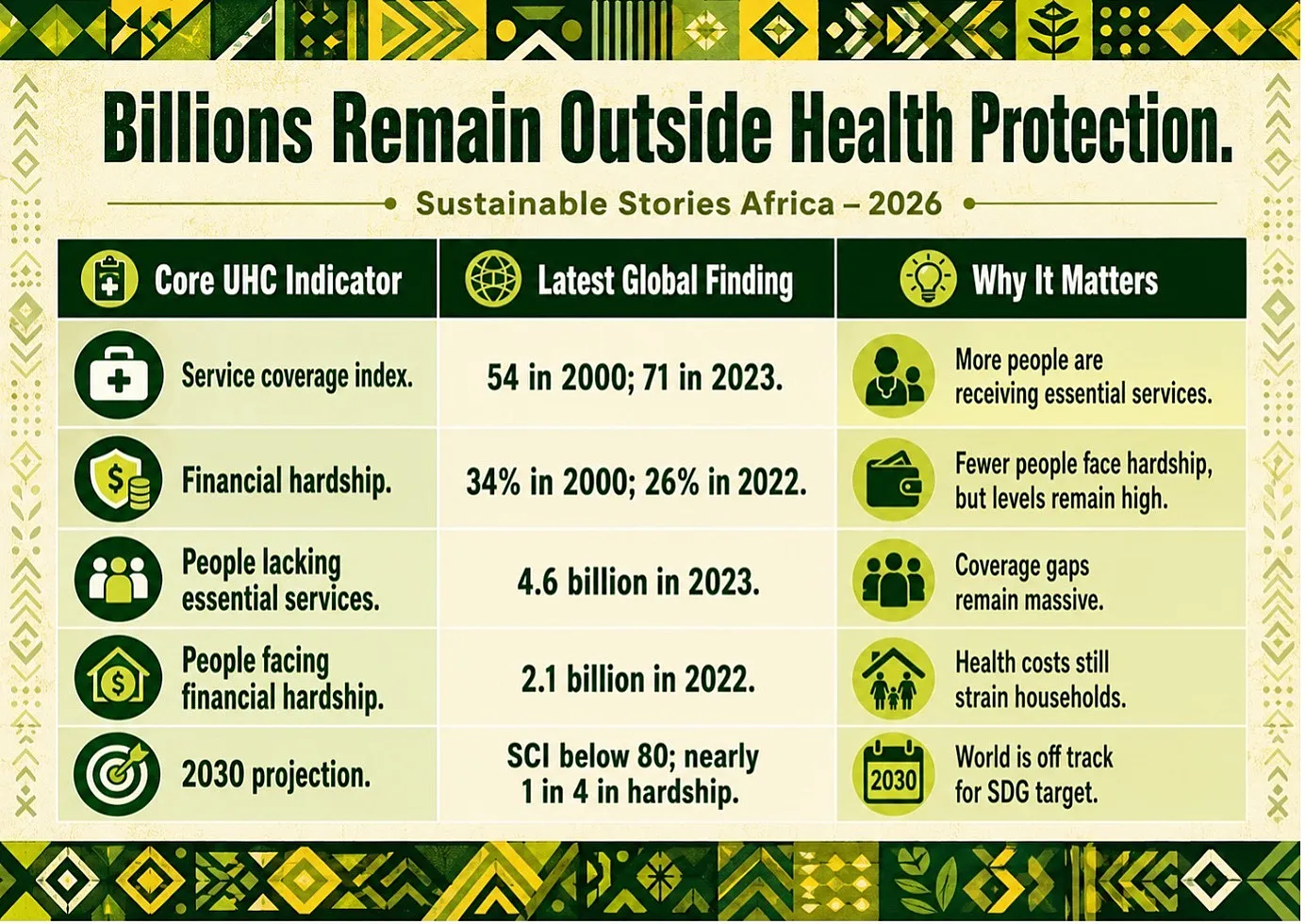
A decade after that commitment, the world has made measurable progress. The global UHC service coverage index rose from 54 in 2000 to 71 in 2023, while the share of people facing financial hardship due to out-of-pocket health spending fell from 34% in 2000 to 26% in 2022.
However, the 2025 global monitoring report by the World Health Organisation and the World Bank shows that the pace is no longer enough.
For African and emerging-market economies, the warning is direct: health systems cannot deliver inclusive development if households still delay care, sell assets, borrow money or fall deeper into poverty to pay for treatment.
Billions Remain Outside Health Protection
Midway through the SDG era, 4.6 billion people still lacked access to essential health services in 2023, while 2.1 billion faced financial hardship from out-of-pocket health spending in 2022.
At current pace, the 2030 target will be missed: the global service coverage index is projected to remain below 80, with nearly one in four people still facing health-related financial hardship by decade’s end.
This is not only a health story. It is a governance, poverty, productivity and social protection story.
Universal health coverage determines whether a market woman treats hypertension before it becomes a crisis, whether a child receives immunisation on time, whether a pregnant woman reaches skilled care, and whether a family loses income because medicines must be paid for at the point of need.
The 2025 report introduces a revised monitoring framework, the first global UHC round to use updated metrics approved by the UN Statistical Commission.
Two SDG indicators now anchor tracking: service coverage (SDG 3.8.1) and financial protection (SDG 3.8.2), with a revised financial hardship indicator that better captures the impact of health spending on poorer households.
Progress Improved, Then Slowed Sharply
Progress since 2000 has expanded service coverage and reduced financial hardship, but momentum fractured after 2015.
The annual rate of service coverage improvement dropped to one-third of its pre-2015 pace; reductions in financial hardship slowed by 23%.
The slowdown reveals a policy disconnect: expanding services and shielding households from costs must advance together.
A country can widen treatment access yet leave patients exposed if medicines, diagnostics or chronic care remain out-of-pocket; it can subsidise care without fixing quality, staffing or infrastructure.
Gains have been lopsided. Infectious disease control drove 52% of the increase in the global service coverage index (2000–2023); three tracers, basic sanitation, insecticide-treated nets and tobacco reduction, accounted for 78% of the change.
Non-communicable diseases finished the period with the lowest sub-index score. For Africa, where infectious burdens persist alongside rising NCD pressures, systems built for episodic care struggle with long-term monitoring, affordable medicines and regular follow-up.
Between-country inequality has narrowed; countries with low or very low coverage fell from 55 (2000) to eight (2023); however, within-country gaps endure.
Data from 38 low- and middle-income countries show persistent barriers for women aged 15 – 49 shaped by economic status, education and urban-rural divides.
Better Health Financing Can Protect Families
Global poverty reduction lowered impoverishing out-of-pocket health spending from 29% (2000) to 20% (2022); however, 1.6 billion people still faced impoverishing payments in 2022.
The sharper signal: among those remaining in poverty, the share spending out-of-pocket on health rose from 64% to 76%. Fewer people are poor globally, but for those who are, health payments cut deeper into basic needs.
- For households, this means choosing between food, rent, school fees and medicine.
- For governments, health financing is inseparable from poverty reduction.
- For employers, it drives productivity loss and absenteeism.
- For insurers and financiers, it signals weak risk pooling and underdeveloped prepaid coverage.
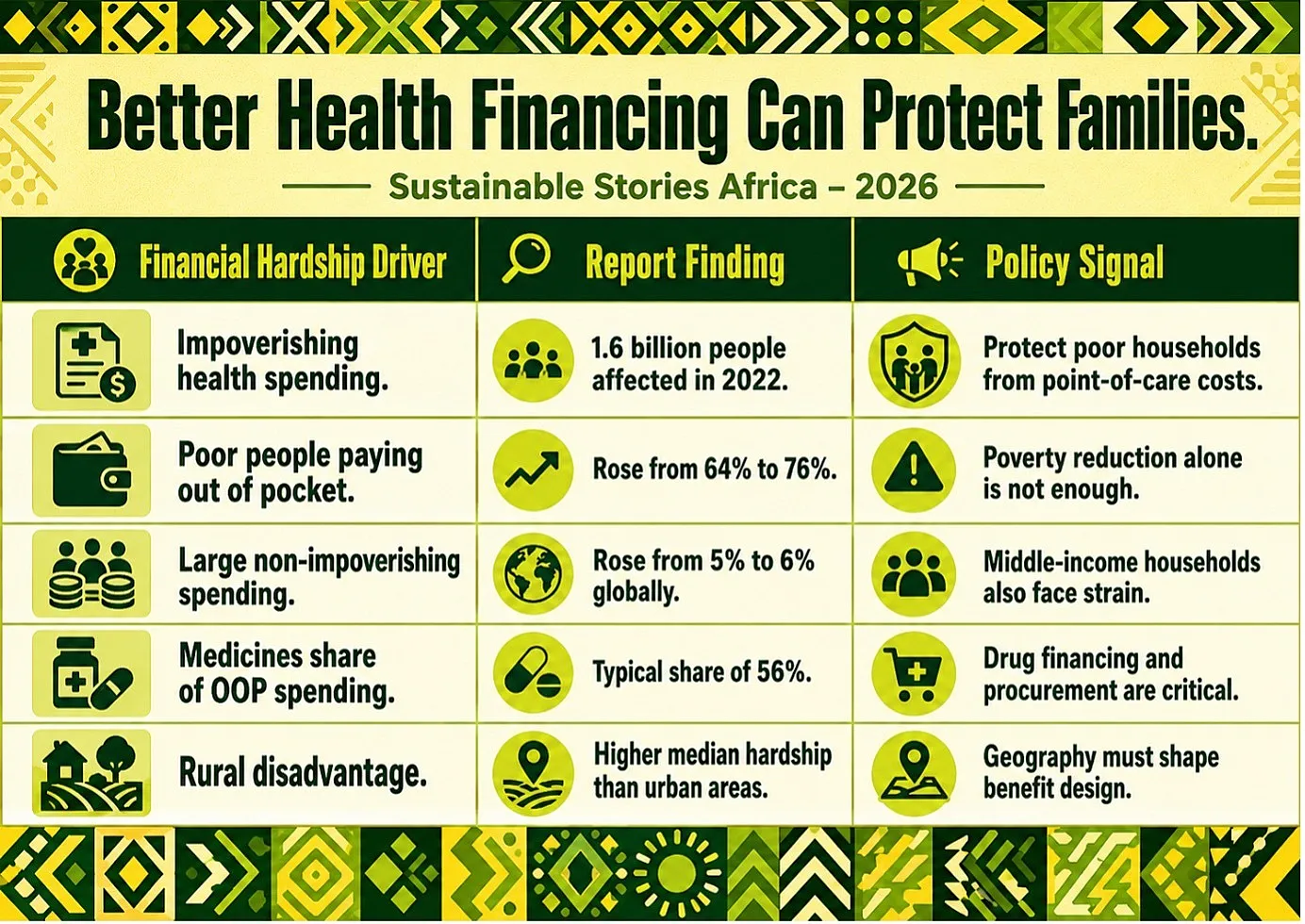
Medicines are a pressure point: they typically absorb 56% of out-of-pocket spending, rising to 60% among the poorest quintiles.
The opportunity is clear. Strengthening pooled public financing, reducing medicine costs, expanding primary health care and prioritising essential services for the poor can turn UHC into a development accelerator.
Families stay healthier. Children remain in school. Workers remain productive. Governments build trust.
Countries Must Fund Essential Care
The report’s policy direction is practical: essential care must be free at the point of access for the poor; publicly funded, compulsory prepaid coverage must expand to shield populations; high out-of-pocket medicine costs must be addressed.
NCD services must grow; primary health care must deepen across prevention, detection and treatment; and multisectoral action, sanitation, poverty reduction, and social policy must anchor UHC outcomes.
For African governments, UHC cannot be limited to insurance enrolment. It demands fiscal choices, procurement reform, workforce investment, digital health systems, reliable primary care and targeted protection for informal workers and poor households.
Nigeria’s challenge mirrors the broader reality: citizens judge progress at the clinic counter.
- Are medicines available?
- Is the nurse present?
- Is the diagnostic affordable?
- Does insurance cover actual needs?
- Is care close enough to reach before complications worsen?
Private sector participation matters; however, only under strategic governance.
Pharmacies, clinics, health-tech firms, diagnostic providers and insurers can extend access; public policy must ensure affordability, quality and equity, or expansion deepens inequality.
The revised SDG monitoring framework sharpens the dashboard.
By tracking not only catastrophic spending but also impoverishing spending and the discretionary household budgets, the new indicator better reflects poorer households’ experience, critical for “leave no one behind” commitments and for African countries where large informal populations pay directly for care.
Path Forward – Make Health Coverage Financially Real
Universal health coverage must now move from promise to protection: essential care, affordable medicines, stronger primary health systems, and public financing that first shields poor households.
For African markets, the priority is clear. Governments, financiers and health providers must align UHC with poverty reduction, workforce productivity and social resilience. Health for all becomes real only when care is available, trusted and financially safe.