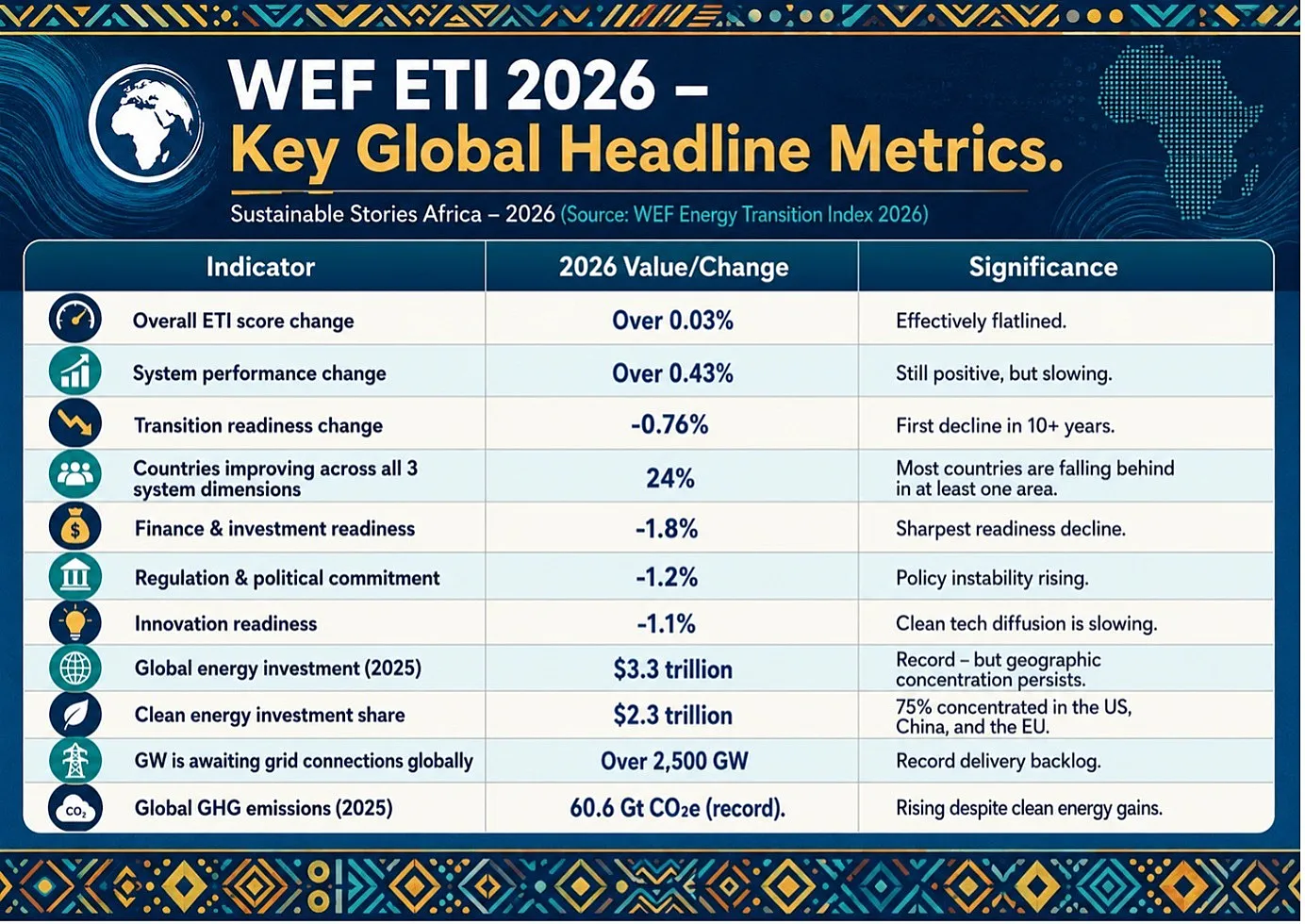
Despite record global energy investment of $3.3 trillion in 2025, with renewables and nuclear generating 42% of electricity and nearly 800 gigawatts of new capacity, the WEF's Energy Transition Index 2026 reveals a stalled transition.
Progress has flatlined, readiness is declining for the first time in over a decade, and enabling conditions across finance, regulation, innovation, and infrastructure are eroding simultaneously.
For Africa, these findings aren't abstract: geopolitical shocks, capital concentration, and volatile commodity prices shape daily energy realities.
Record Investment, Flatlining Progress
Something is broken in the architecture of the global energy transition, and the WEF's 2026 Energy Transition Index has just documented exactly what.
The sixteenth annual edition of the ETI, which tracks energy systems across 120 countries using 44 indicators, delivers an assessment that is both alarming and precise.
Overall progress has flatlined, with global average ETI scores advancing by just 0.03% in 2026. The enabling conditions that have powered a decade of progress - stable policies, accessible finance, innovation momentum and infrastructure investment have weakened simultaneously and in tandem.
The result is a global transition that is, in the WEF's own characterisation, "not reversing, but fracturing and becoming more uneven."
For African nations, including Kenya, Namibia, Ghana, Nigeria, South Africa, and others, the ETI data tells a story of early momentum, rising potential and, above all, a continent at the mercy of global financial and geopolitical dynamics it did not create and cannot fully control.
Three Defining Signals From the 2026 ETI
The WEF frames 2026's ETI findings around three decisive signals:
First: A pause.
- Overall transition progress has flatlined. Transition readiness, the measure of whether countries have the policy, financial, infrastructure and innovation conditions to sustain progress, declined for the first time in over a decade.
- Four of five readiness sub-dimensions deteriorated.
Second: Rising pressure.
- The transition is shaped by compounding stresses that went beyond any single event.
- By late 2025 and early 2026, trade restrictions had affected $2.6 trillion of global commerce, three times 2024 levels.
- Export controls now cover more than half of critical transition minerals.
- The 2026 disruption to energy flows through the Strait of Hormuz, which carries approximately a quarter of global seaborne oil and 20% of global LNG, triggered one of the most acute energy price shocks since 2022.
Third: A shifting priority.
- Energy security is emerging as the defining lens through which governments, investors and businesses assess the transition.
- Countries that integrate resilience into system design are better positioned to attract investment and sustain deployment.
- However, this shift risks deepening regional divergence, as the countries least able to build resilience face the most acute consequences.
The Numbers That Define 2026
Against these global headwinds, Sub-Saharan Africa recorded the largest regional ETI improvement in 2026, with scores rising by 1.2%, the strongest performance of any world region.
This is a signal worth understanding in depth: at a time when the global system is under strain, Africa's transition trajectory is pointing in the right direction.
The question is whether the global enabling environment will support or undermine that momentum.
What a Reinvigorated Global Transition Architecture Could Deliver
The three priorities the WEF identifies to restore momentum are simultaneously a policy agenda and a financing blueprint:
- Strengthen security, affordability and resilience – embedding these as core design principles rather than reactive responses to shocks.
- Unblock delivery by expanding infrastructure – streamlining permitting, fast-tracking grid connections and building the workforce needed to execute at scale.
- Increase investability – through stable policy, credible regulation and better risk-sharing to direct capital where it is most needed.
Each of these priorities is particularly resonant for Africa.
- The continent's energy security is acutely vulnerable to commodity price shocks.
- Infrastructure delivery bottlenecks constrain every aspect of economic development.
- The financing costs facing African clean energy projects, two to three times higher than those in advanced economies, represent one of the most acute injustices in the global transition architecture.
A global transition framework that genuinely addresses these three priorities does not merely accelerate progress in Europe and North America.
It creates the conditions for African nations to leapfrog legacy infrastructure, attract long-term capital and build resilient, affordable energy systems for the hundreds of millions currently without adequate access.
What Africa Must Demand From the Global Transition Architecture
The WEF ETI 2026 is not merely an analytical document. It is a call to action that Africa must engage with on its own terms:
- African finance ministers and central bank governors must press multilateral development banks and international climate funds to restructure the risk-sharing frameworks that currently price African clean energy investment at two to three times the cost of equivalent projects in advanced economies.
- African heads of state must leverage the COP30 $1.3 trillion climate finance pledge, announced without fossil fuel phase-out language, to demand concessional capital for African just transition programmes with structural conditionalities that protect economic growth.
- African energy regulators and utilities must use the ETI's country-level data to build evidence-based advocacy for regulatory reform, grid investment and domestic resource mobilisation in their national transition strategies.
Path Forward – Sub-Saharan Africa's Moment Must Be Seized
Africa's Rise Deserves the World's Full Attention
The WEF Energy Transition Index 2026 exposes a fracturing global transition, splitting along economic and geopolitical fault lines. Sub-Saharan Africa's 1.2% ETI improvement, the highest of any region, marks an underreported story of resilience.
However, sustaining it demands more than domestic effort: reformed climate finance architecture, fairer governance of mineral supply chains, and international coordination that treats Africa's transition as a strategic priority, rather than charity.
The data makes Africa's case eloquently. What remains is the will to act on it.