
Local economic plans are often treated as paperwork. A Brookings report suggests they may be more powerful than that when they are detailed, quantitative and connected to real growth sectors.
The evidence is U.S.-based, but the lesson travels: African cities seeking jobs, investment and inclusion need planning systems that can turn ambition into measurable delivery.
Local Plans Can Shape Shared Prosperity
Economic development planning is supposed to do more than describe a region’s problems. At its best, it gives policymakers a roadmap for growth, jobs, investment and quality of life.
A September 2024 Brookings report by Ian Seyal and Greg Wright, Planning for Prosperity: Analysing the Effectiveness of Local Economic Planning, examines whether local economic plans are merely backwards-looking documents or whether they help identify future growth opportunities.
Using natural language processing to analyse hundreds of planning documents, the authors find that more detailed and quantitative planning is associated with faster economic growth.
For African and emerging-market cities, the insight is urgent.
As governments pursue industrialisation, climate resilience, infrastructure investment and inclusive job creation, the quality of local planning may determine whether public spending becomes broad-based prosperity or another round of fragmented projects.
Planning Quality Now Matters For Growth
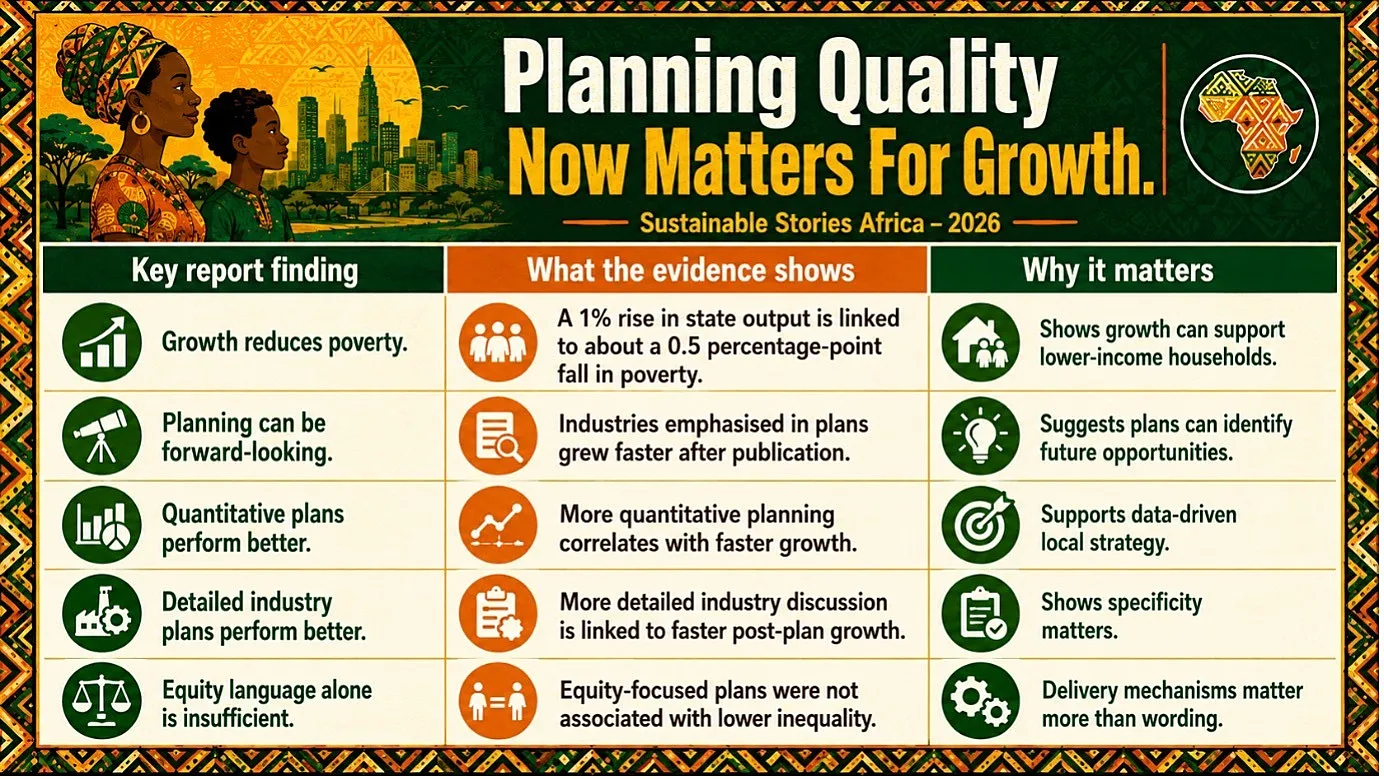
One of the report’s strongest findings is simple but consequential: economic growth raises incomes across the distribution, but the largest gains are concentrated among families at the bottom.
Using U.S. state-level data from the Current Population Survey between 1984 and 2013, the authors find that increases in gross state output were associated with income gains across the income distribution, with stronger effects for lower-income families.
For every 1% increase in state output, the poverty rate falls by approximately half a percentage point, with especially large income gains for young people without a high school degree and single mothers.
That finding matters because it reframes growth planning as a social policy tool.
Economic growth is not the only measure of development, and the report is careful not to present it as a cure-all.
However, when growth lifts low-income households, planning becomes central to poverty reduction, workforce inclusion and regional resilience.
The second finding is more institutional: planning documents appear to do two things at once.
They describe where growth has happened recently, and anticipate where it could occur.
Industries that were given priority emphasis in local plans grew faster after the plans were published, suggesting that planners are accurately identifying growth opportunities, helping create conditions for growth, or both.
What The Brookings Planning Evidence Shows
A study analysing 363 Comprehensive Economic Development Strategies produced by U.S. Economic Development Districts between 1998 and 2021 offers measured but meaningful evidence that quality economic planning is associated with stronger regional growth.
Using natural language processing rather than manual review, the researchers measured how often specific industries were meaningfully discussed in each plan relative to all plans in the sample, then asked whether sectors receiving greater emphasis subsequently grew faster.
The answer was cautiously affirmative. Industries highlighted in plans were already growing before publication, indicating planners were responding to observable trends.
Crucially, those industries also grew faster in the four years after publication, suggesting planners may be identifying emerging opportunities, sustaining momentum, or improving coordination and investment readiness.
Plan quality also mattered. More quantitative documents, deploying data, numbers, and statistical measures more intensively, were associated with faster post-publication growth, as were plans that referenced industries with greater specificity rather than broad sector labels.
These findings held after controlling for population density, income levels, and document length.
The study stops short of claiming causation, acknowledging that stronger regions may produce better plans.
Nevertheless, the evidence is robust enough to make one conclusion unavoidable: the rigour and detail of economic planning deserve far greater institutional attention.
Better Plans Can Deliver Wider Gains
For African cities, the report's development logic is more instructive than its U.S. institutional context.
Local governments across the continent are managing fast population growth, infrastructure deficits, climate shocks, youth unemployment, and constrained fiscal space.
In that environment, vague planning carries a real cost, duplicated projects, weak prioritisation, poor investment sequencing, and missed opportunities in sectors where regions already hold comparative advantages.
A stronger plan moves beyond broad aspirations for jobs, growth, or inclusion to identify which sectors are expanding, where infrastructure gaps exist, what skills are needed, which communities are excluded, and how progress will be measured.
The Brookings evidence is directly applicable: planning documents with greater detail and quantitative grounding are linked to better economic outcomes.
For African markets, this means local economic plans must function as practical investment documents.
- A district targeting agro-processing should map crop clusters, logistics corridors, storage gaps, and financing constraints.
- A coastal city pursuing blue economy growth should distinguish ports, aquaculture, cold-chain logistics, and coastal resilience.
Done well, planning becomes less a reporting exercise and more an operating system for development.
What Cities And Regions Should Do
The report's most sobering finding is on equity. Equity language in planning documents rose sharply during the COVID period, but plans that emphasised equity were not associated with more equitable outcomes.
No statistically significant difference were found in income shares for the bottom 20% or 40%, nor for people with a high school education or less, or Black and Hispanic individuals.
The lesson is not that equity is unimportant; it is that equity language alone is insufficient.
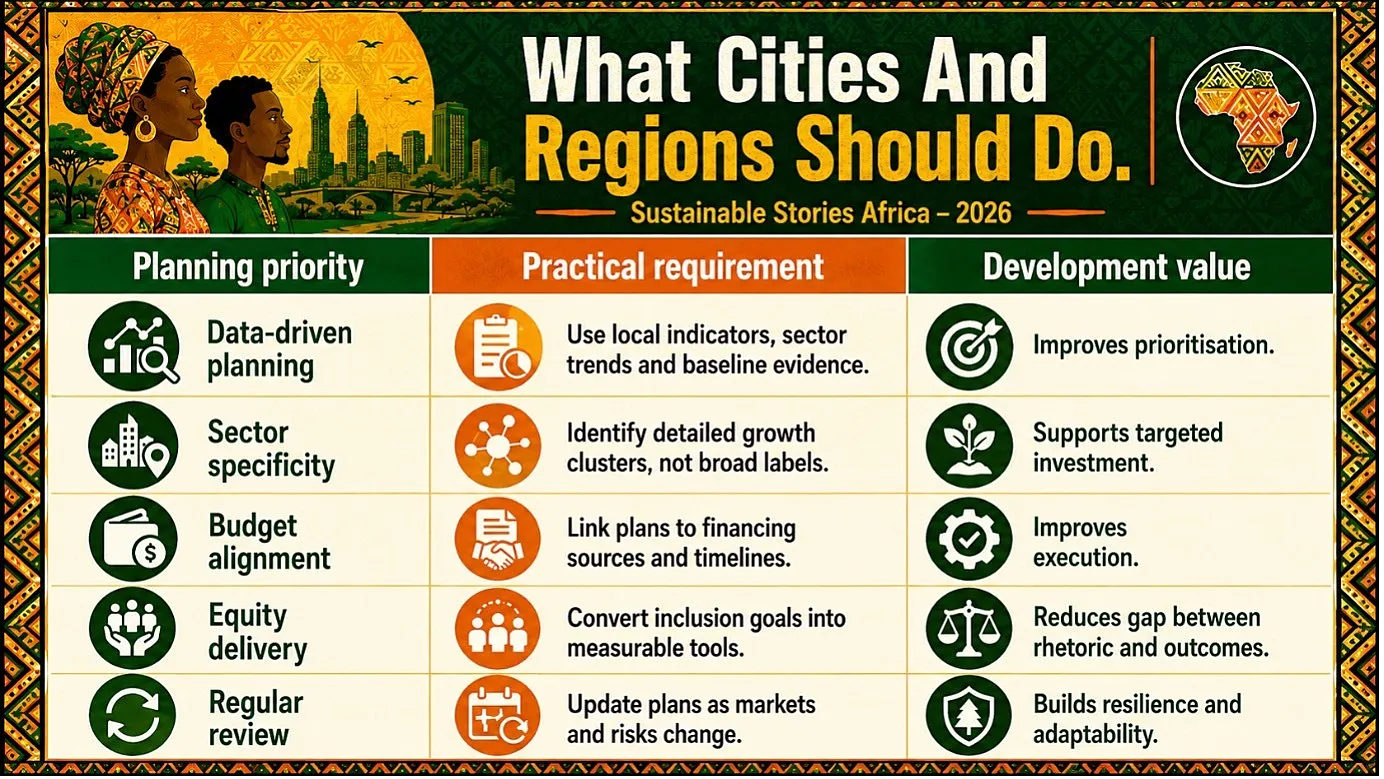
Inclusion must be engineered into planning through concrete mechanisms: procurement access for small firms, training pathways for youth, childcare support for women workers, transport links to low-income communities, and metrics tracking who actually benefits.
The report identifies five priorities for stronger planning systems.
- First, plans must be data-rich, grounding ambitions in baseline indicators, sector trends, and investment gaps.
- Second, plans must be sector-specific, distinguishing food processing from pharmaceuticals, or ports from aquaculture, rather than relying on broad labels.
- Third, plans must connect to budgets, clarifying what can be funded immediately versus what requires private capital or development finance.
- Fourth, equity commitments must translate into measurable implementation targets.
- Fifth, plans must be updated regularly, reflecting shifts in technology, climate risk, trade patterns, and demographics.
For African cities, these are not procedural refinements; they are the difference between planning as documentation and planning as development strategy.
Path Forward – Turn Growth Plans Into Shared Prosperity
The Brookings report points to a practical truth: regions do not grow by aspiration alone.
They need plans that are detailed, quantitative, forward-looking and honest about delivery.
For African cities, the next step is clear. Build planning systems that connect data, budgets, sectors and equity mechanisms.
Growth can reduce poverty, but only when strategy becomes execution and execution reaches the households, workers and firms that need it most.