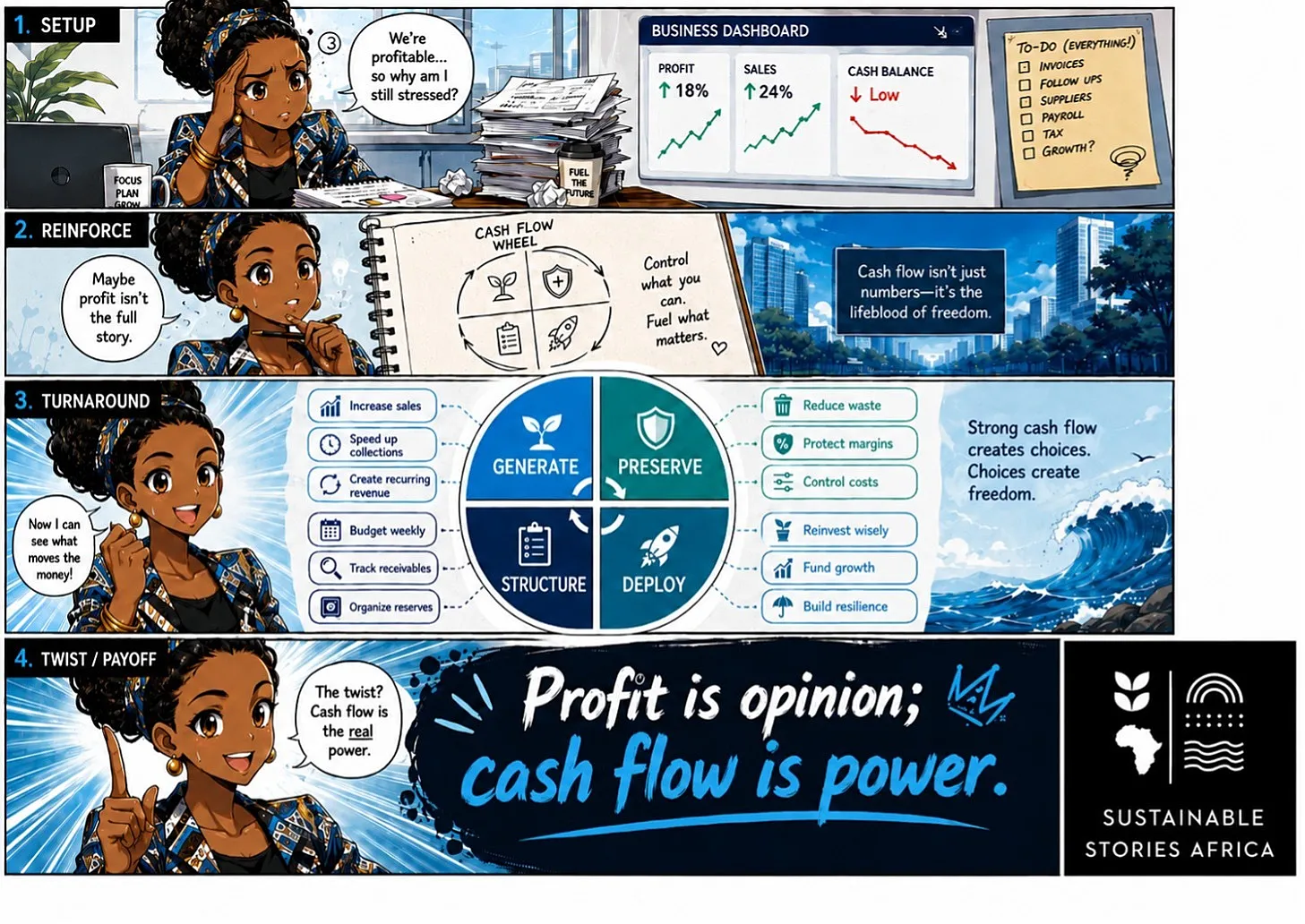
Profitable companies still collapse when they cannot pay suppliers or service debt. FinPolNomics' new framework argues that cash flow is not luck; it is a deliberate wheel of four levers: generate, preserve, structure and deploy.
For African businesses squeezed by high borrowing costs, delayed receivables and currency pressure, mastering that wheel is fast becoming survival infrastructure, not a finance department slogan.
Cash Discipline Beats Profit Talk
Cash flow stress ranks among the most common pressures facing businesses across emerging markets, where companies routinely report profits on paper while struggling to pay suppliers, service debt or fund growth.
FinPolNomics' latest explainer argues that this gap exists because leaders treat cash as a treasury afterthought rather than a designed system spanning pricing, collections, inventory, debt terms and investment decisions.
The stakes are immediate for African firms. Payment delays, inflation and foreign-exchange constraints routinely squeeze liquidity even when income statements look healthy, making cash discipline a matter of operational survival rather than accounting preference.
This framework matters now because finance leaders across the continent are simultaneously facing tightening credit conditions and currency volatility, raising the cost of getting cash management wrong at precisely the moment margins are thinnest.
When Profit Becomes A Trap
FinPolNomics' sharpest line cuts through the theory: "profit is opinion; cash flow is power".
That single contrast exposes why so many companies that look successful on paper still miss payroll, delay suppliers, and scramble for emergency credit.
What is happening is a rethink of how finance teams are trained to think about liquidity.
Instead of one metric, FinPolNomics presents cash flow as a wheel with four interlocking levers:
- Operations generate cash
- Working capital preserves it.
- Financing structures it
- Investments deploy it.
Each lever failing independently can still bankrupt an otherwise profitable business, which is precisely why the framework insists that cash flow be managed as a single connected system rather than four separate finance tasks.
The Four Levers, Broken Down
FinPolNomics grounds its wheel in specific, actionable disciplines rather than abstract principles.
The framework moves cash flow management out of the treasury silo and into commercial, operational and investment decision-making across the business.
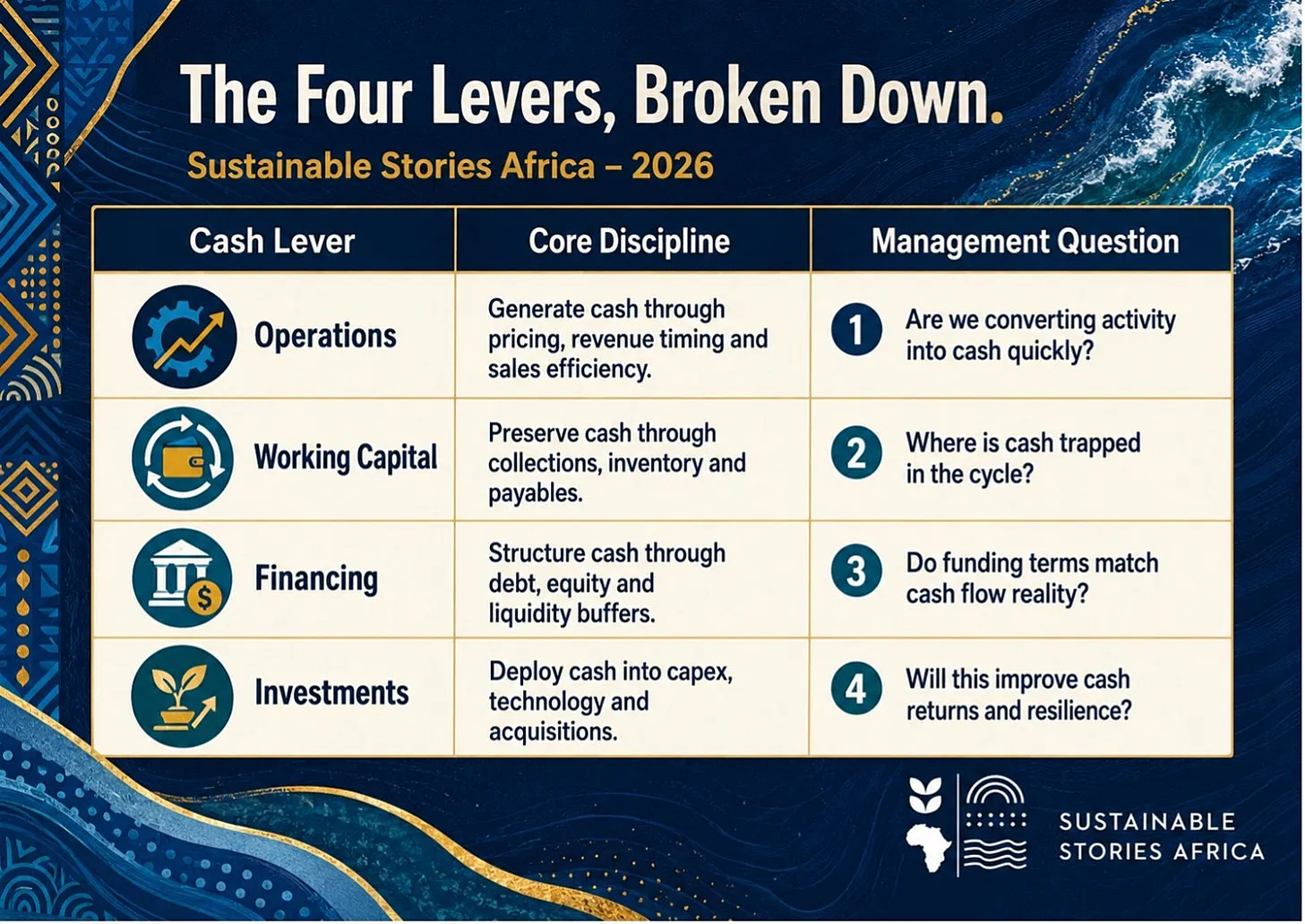
On operations, the framework insists that pricing decisions cannot happen without cash visibility, warning that "revenue without collections discipline can become working capital pressure".
On working capital, it points directly to African market realities: receivables stretch, suppliers demand faster payment, and inventory buffers rise "because logistics are uncertain," making live visibility into debtors, stock and payables essential rather than optional.
Financing discipline gets equally specific treatment.
FinPolNomics warns that "short-term borrowing for long-term assets can create refinancing pressure," a mismatch that has burned African companies caught between rising rates and long-cycle assets.
Equity, the framework advises, should be raised "from strength where possible, not desperation".
What Disciplined Cash Flow Unlocks
Get the wheel turning correctly, and the payoff compounds across the business. FinPolNomics identifies four concrete gains: better liquidity resilience, stronger decision-making, lower funding pressure, and higher enterprise value.
For African companies, that translates into tangible relief. Firms that master collections and inventory velocity free up cash otherwise trapped in the operating cycle, while those that match financing terms to asset life avoid the refinancing scrambles that force fire-sale asset disposals or emergency borrowing.
The alternative is stark: companies that ignore the wheel keep reporting profit as liquidity quietly erodes, until a single missed payment or currency shock exposes the fragility beneath healthy-looking numbers.
Who Must Move And How
FinPolNomics' framework assigns clear responsibilities across finance, commercial and leadership functions rather than leaving cash discipline to the treasury desk alone.
- Finance and commercial teams must align pricing decisions with cash visibility, not just revenue targets
- Operations leaders should accelerate revenue timing and optimise product mix toward faster-converting offers
- Finance teams need live dashboards tracking debtors, stock, payables and cash forecasts
- CFOs must match debt terms to asset life and raise equity from strength, not distress
- Investment committees should judge capex, technology spend and acquisitions by cash impact and strategic fit, "not hype"
Path Forward: Manage The Full Wheel
FinPolNomics advocates treating cash flow as a complete enterprise system rather than four disconnected finance tasks.
Strong operations, disciplined working capital, appropriately structured financing and careful investment deployment together reduce funding pressure and raise enterprise value.
For African businesses navigating high borrowing costs and currency volatility, this shift advances resilience and governance objectives simultaneously: the winners, as FinPolNomics puts it, "are not just profitable; they are liquid, disciplined and intentional".