Electric mobility is no longer only a climate ambition. A new World Bank report says it is becoming an economic, public health and energy-security opportunity for developing countries.
The strongest early case is not private cars, but electric two-wheelers, three-wheelers and buses, the vehicles that move workers, traders, students and commuters through crowded cities every day.
Electric Mobility Becomes A Development Test
Electric vehicles are moving from the edges of climate policy into the centre of development planning, as the World Bank argues that cleaner transport can reduce lifetime mobility costs, cut urban air pollution, strengthen energy security and reshape jobs across developing economies.
Its 2026 report, “Electric Mobility in Developing Countries: Cost-Benefit Analysis and Policy Guidance,” assesses the economics of battery electric vehicles across 40 developing countries and six vehicle segments.
The report was prepared by Wenxin Qiao, with significant contributions from Binyam Reja, under the World Bank Group’s Transport and Logistics Department.
It was developed under the project “Accelerating Electric Mobility Transition in LMICs: A WBG Approach for Coordinated and Scaled Up Support,” led by Ana Waksberg Guerrini, with supervision from Nicolas Peltier-Thiberge and Said Dahdah, and overall guidance from Bertrand de la Borde.
For Africa and other emerging markets, the message is practical: electrification should not begin everywhere at once.
It should start where the economics are strongest, the health gains are largest, and the policy systems can deliver.
Clean Transport Is Now Economic Policy
The economics of electric mobility are improving rapidly across developing countries, but success hinges on sequencing, financing and institutional coordination.
That is the headline finding from World Bank modelling comparing battery-electric vehicles against internal combustion engines across six vehicle categories in 40 countries.
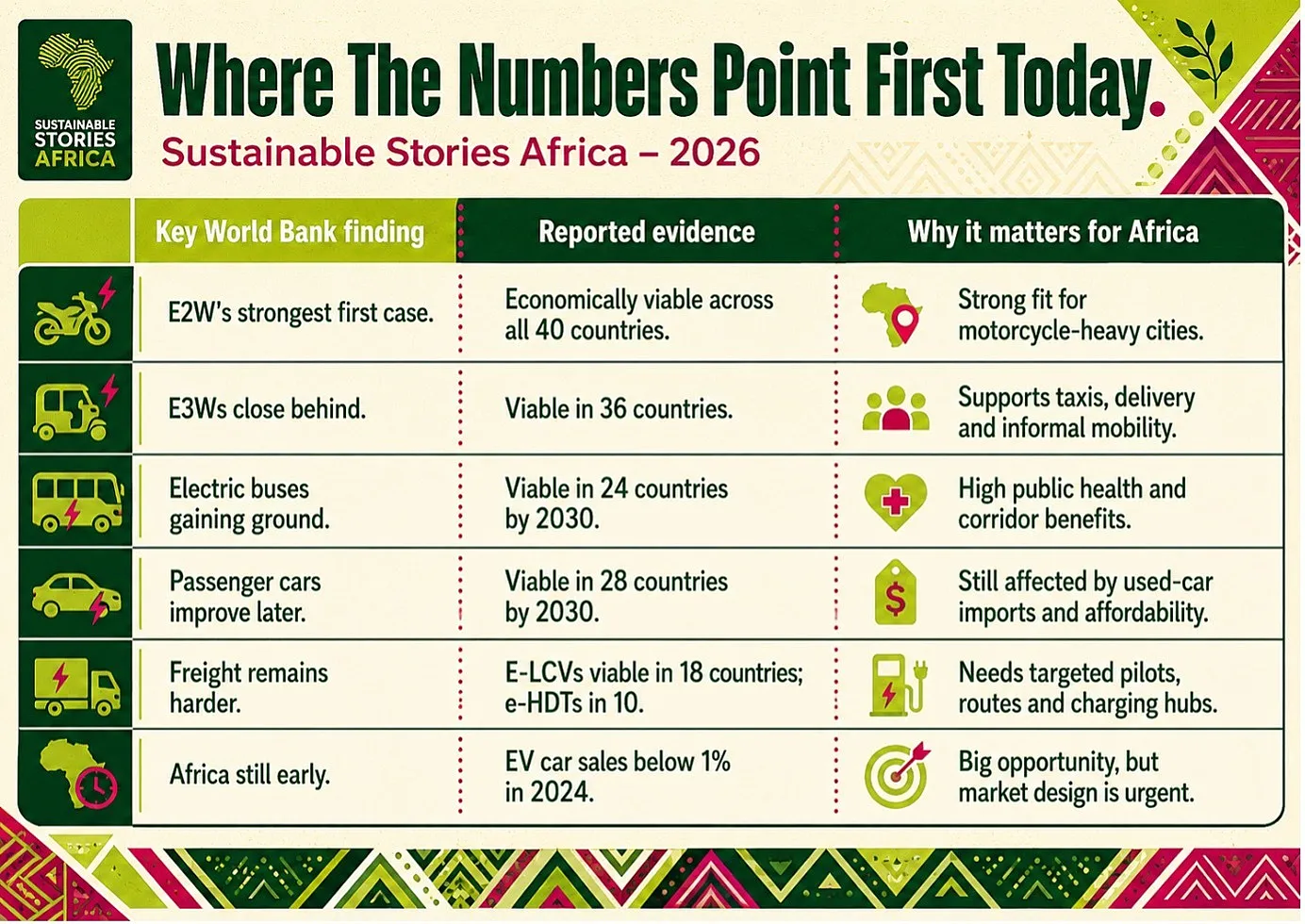
The strongest economic case lies in high-intensity vehicles. Electric two-wheelers are viable across all 40 countries studied, three-wheelers in 36.
By 2030, electric passenger cars are projected to be economically competitive in 28 countries and electric buses in 24. Electric freight lags, including light commercial vehicles, show cost advantages in 18 countries, heavy-duty trucks in just 10.
The stakes extend beyond vehicles. Road transport accounts for 25% to 60% of final energy consumption across the analysed countries, while petroleum imports absorb 2% to 6% of GDP in oil-importing economies.
In African, South Asian and Southeast Asian cities, road transport contributes 30% to 50% of urban PM2.5 concentrations.
- For a motorcycle taxi rider in Lagos, Cotonou, Kigali or Nairobi, the question is not abstract decarbonisation. It is whether daily fuel spending falls.
- For a city transport agency in Dakar or Accra. The question is whether buses can move more people while gathering lower pollution and lower lifetime operating costs.
- For finance ministries, it is whether electricity can replace imported fuel without blowing holes in fiscal revenue.
Where The Numbers Point First Today
For developing countries navigating electric mobility transitions, the World Bank's answer is clear: start with segment-led electrification.
Two-wheelers, three-wheelers and buses should precede broad private-car mandates because they travel more intensively, operate in dense urban environments and generate faster fuel and maintenance savings.
The rationale is compelling across African and Asian markets. Two-wheelers account for 70% to 90% of vehicle fleets in countries including Nigeria, Rwanda, Burkina Faso and Bangladesh, and approximately 50% of vehicle shares across several African countries.
Electric two-wheelers consume just 13 megajoules per 100 kilometres, compared with 78 megajoules for conventional equivalents, reflecting BEVs' 90% energy conversion efficiency against roughly 20% for internal combustion engines.
The economics follow usage intensity.
- A private car parked most of the day slowly recovers the purchase premium.
- A motorcycle taxi, delivery tricycle or city bus operating all day accelerates those savings significantly.
The barrier, however, is affordability.
- A rider may know an electric motorcycle is cheaper over its lifetime and still be unable to buy one.
- A bus operator may accept that electric buses save money over the years and still struggle to finance the fleet.
This is where the report distinguishes economic viability from financial affordability, a crucial point for African policy design.
Cleaner Fleets Can Protect Urban Livelihoods
Electric mobility promises more than cheaper transport; it offers cleaner air, healthier cities and greater energy resilience.
World Bank findings show that internal combustion vehicles emit three to four times more carbon dioxide than BEVs across 40 countries studied, with nitrogen oxide emissions five to seven times higher, and local air pollution costs two to five times greater.
For African cities, the public health case is as urgent as the climate case:
- Market women, schoolchildren, minibus drivers and street vendors face daily exposure to traffic pollution along congested corridors
- Petroleum-importing countries, including Senegal and Mali, can strengthen energy security and reduce fuel import dependence through EV scaling
- Sahelian countries, including Mali and Burkina Faso, hold strong solar potential to power clean mobility transitions
The industrial opportunity is equally significant. EV manufacturing demands new skills in mechatronics, battery assembly, power electronics and charging infrastructure.
While Africa's EV manufacturing remains early-stage, concentrated in two-wheelers across Ethiopia, Kenya and Rwanda, domestic assembly represents a viable job-creation pathway.
The risk is treating EVs as imported consumer goods. The opportunity is to embed e-mobility within industrial policy, renewable energy planning and technical skills development.
What Governments Must Build Next Quickly
The World Bank's guidance is not a call for blanket subsidies; it is a call for targeted, sequenced delivery built around six practical policy directions:
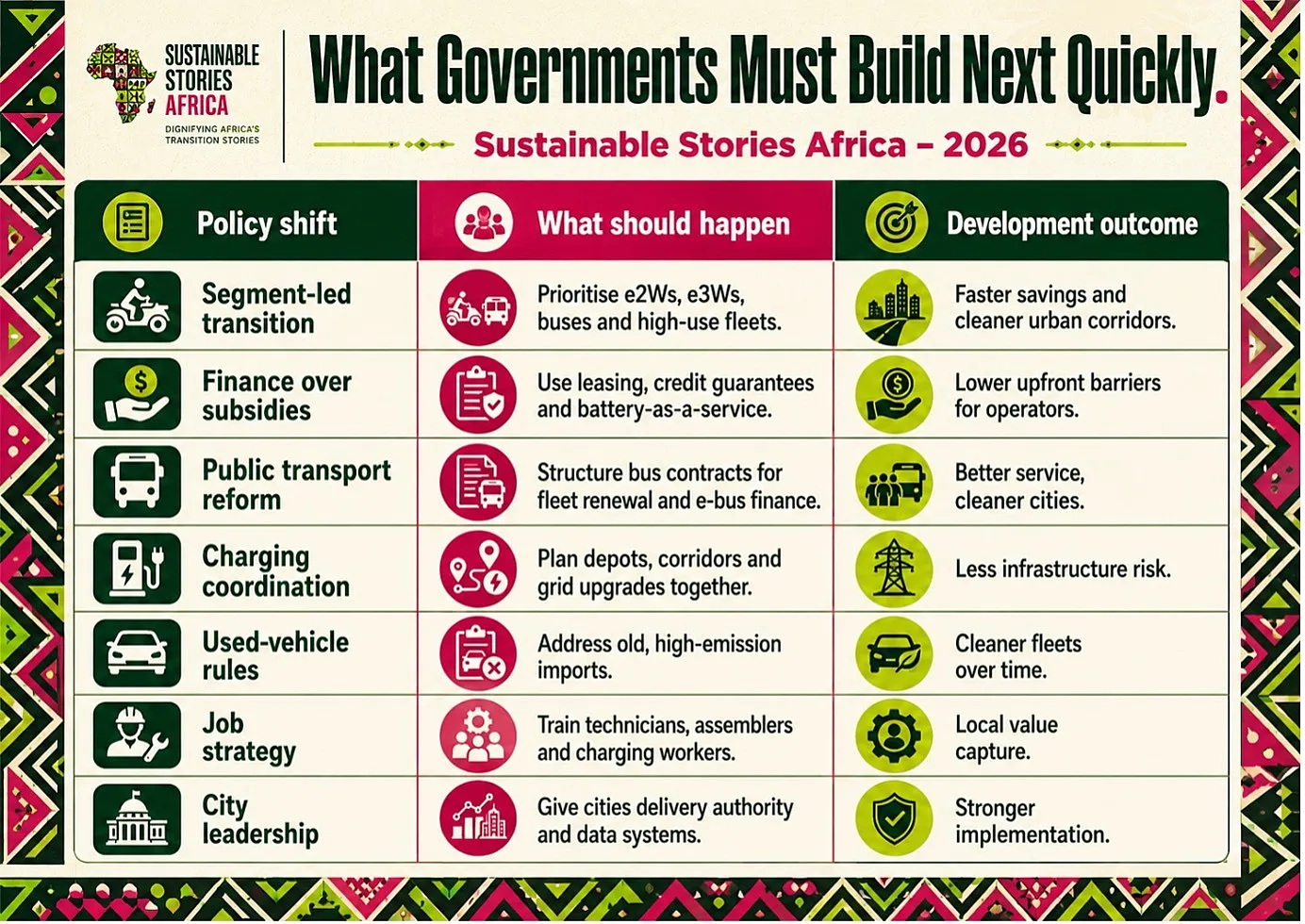
- Segment-specific national EV strategies: Nigeria, Kenya, Uganda and Rwanda should prioritise two-wheelers and commercial motorcycles; Ghana and Ethiopia should examine e-bus corridors where buses dominate fleets
- Financing over subsidies: Informal operators need daily affordability, not lifetime cost spreadsheets, leasing, battery swapping, pay-as-you-go models, and credit guarantees can align repayments with fuel savings
- Public transport reform before e-bus scaling: Electric buses require predictable routes, contracts, depots and fare systems; without bankable operating models, cities risk acquiring buses they cannot maintain or deploy
- Integrated power-sector planning: Charging infrastructure must coordinate with grid capacity, electricity pricing, renewable energy growth and off-peak demand management
- Early fiscal management: Delaying electrification to protect fuel tax revenue carries higher hidden costs through pollution, fuel subsidies and import bills
- Realistic industrial policy: Not every country will manufacture batteries, but most can create jobs in assembly, maintenance, diagnostics, charging installation and battery recycling
Path Forward – For Cleaner African Mobility
Electric mobility should start where it works first: two-wheelers, three-wheelers, buses and high-use urban fleets.
That is where costs fall faster, health gains are clearer, and public benefits justify concessional finance.
For African markets, the priority is practical delivery: finance models, charging systems, skills, public transport reform and cleaner power.
Well done, EVs can cut costs, protect health, reduce fuel-import pressure and support a more inclusive transport transition.