The African Development Bank has approved a $34 million loan for Seychelles under the final phase of its Economic Resilience and Green Recovery Support Programme.
Approved on 22 September, the financing supports public financial management, the business environment and climate resilience.
For an island economy exposed to external and environmental shocks, results will depend on how reforms affect services and firms.
A final phase gets new financing
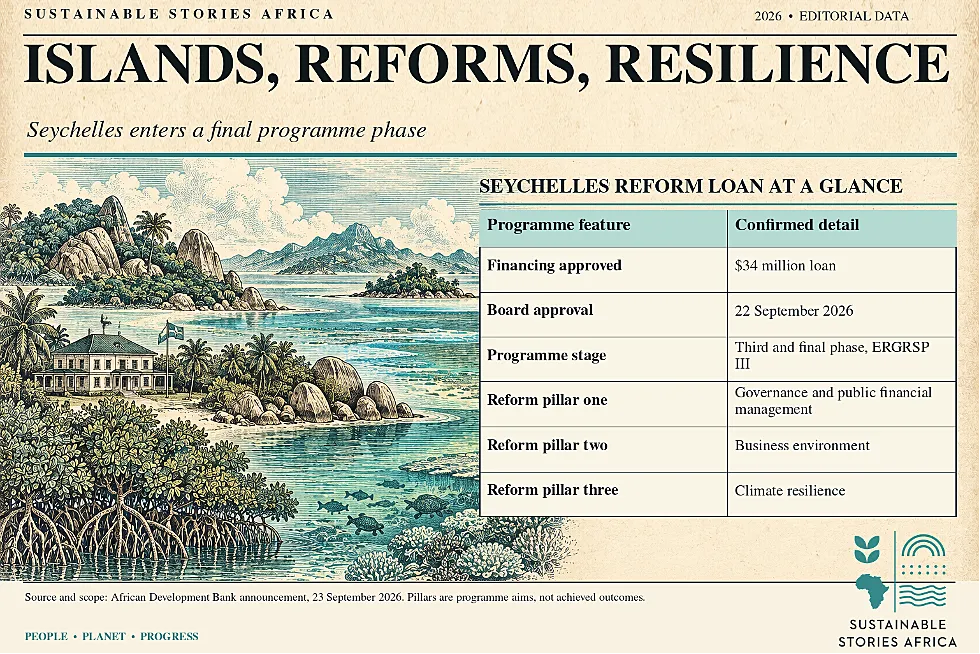
The African Development Bank Group's board approved a $34 million loan to Seychelles on 22 September 2026 for the third and final phase of the Economic Resilience and Green Recovery Support Programme, known as ERGRSP III.
The bank says the operation seeks stronger public services, more private sector opportunity and greater climate resilience.
It identifies three connected reform areas:
- Economic governance and public financial management;
- The business environment;
- Climate resilience.
The approval is financing for a reform programme, not evidence that the intended outcomes have already been achieved.
For a small island economy, the distinction matters: residents and businesses will experience the value of the loan through services and implementation, rather than through the announcement itself.
Reforms link institutions and livelihoods
Public financial management may sound remote from everyday life, but how a state budgets, procures and reports spending shapes the reliability of services.
- A small enterprise applying for a permit, a resident using a government portal or a coastal business facing storm disruption all depend on institutions working together.
- These are examples of the programme's possible relevance, not documented beneficiaries of this particular phase.
The bank's stated package connects economic management with the conditions for enterprise and adaptation.
- That integration can be useful in Seychelles, where economic activity and environmental exposure are closely linked.
The loan also closes a three phase programme begun in 2024, making continuity and evidence from earlier reforms important to assessing what this final stage adds.
Delivery will decide the public value
Reform loans generally support government policy and budgets; they should therefore be judged by verifiable institutional changes and their effects, not treated as a dedicated construction budget unless a project document says so.
The bank's accessible announcement confirms the $34 million amount and the three broad reform themes.
- It does not, in the information verified for this article, establish a numerical outcome for service users, private investment or avoided climate losses.
- That leaves a clear accountability task.
Authorities and the bank should explain the policy conditions, the timetable, responsible agencies and the indicators by which residents can judge success.
- Digital processes, for example, only improve services if they remain accessible to people with limited connectivity or difficulty navigating forms.
The reform programme's final phase also invites a question of sequencing.
- Improved financial controls can make spending more credible, while business reforms may expand the tax base and climate planning can reduce future emergency costs.
However, these benefits will depend on administrative capacity and public trust.
- A performance framework should distinguish an enacted policy from a service that works consistently in practice.
- If a licensing process moves online, for example, authorities can report processing times and how many applications are completed without in-person assistance.
- If climate considerations enter the budget, they can explain which decisions changed and how exposure was assessed.
Such indicators would help citizens see whether the three pillars reinforce one another.
- The published $34 million is a loan, so fiscal transparency also requires disclosure of borrowing terms and repayment obligations.
- None of these proposed measures should be presented as already achieved by this approval.
Publish the reform scoreboard
Seychelles should report progress across the programme's three pillars in a way the public can inspect: service delivery times, transparent fiscal reporting, practical steps for firms and climate risk measures.
- Independent scrutiny from civil society and businesses can identify who benefits and who is excluded.
Climate resilience also needs to enter routine budget decisions so that maintenance, preparedness and coastal exposure are considered before losses occur.
- The bank and government should publish evaluation findings from earlier phases alongside the commitments of the final one.
The credibility of green recovery finance will turn on measured changes in public institutions and in people's capacity to withstand shocks.
- As the programme ends, a public review should compare original targets with achieved outcomes and explain any gaps.
The loan can then be evaluated for value alongside the longer-term cost of servicing it.
That discipline is particularly useful where climate shocks may put sudden pressure on both budgets and public services.
Path Forward – Make Reform Outcomes Visible
The next step is a public timetable for the final reform phase, with responsible agencies and measurable service, business and resilience outcomes.
Seychelles and the bank should publish progress and evaluation results.
Clear reporting can show whether an approved loan becomes stronger institutions and practical climate protection.