A Climate Impact Lab projection puts Nigeria at the top of the estimated national heat death toll from the current strong El Niño.
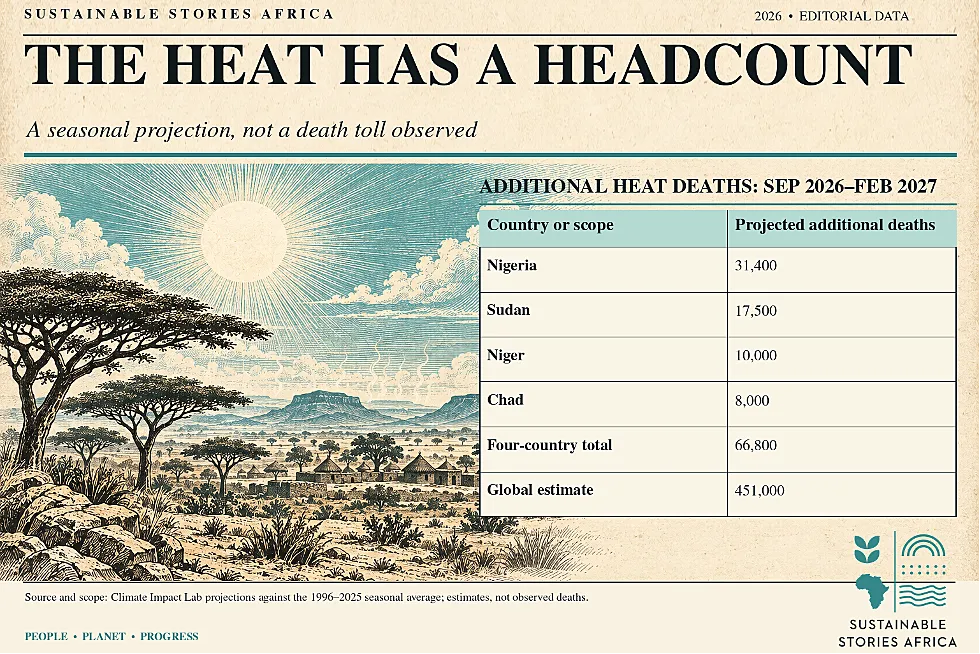
Researchers estimate 31,400 additional heat-related deaths in Nigeria between September 2026 and February 2027, relative to a normal year.
The forecast gives health authorities a limited window to protect outdoor workers, older people and households without reliable cooling.
Nigeria leads the projected Sahel toll
Nigeria could record an estimated 31,400 additional heat-related deaths from September 2026 to February 2027 under a strong El Niño, the highest projected national total worldwide, according to researchers at the University of Chicago’s Climate Impact Lab.
Their estimate compares with average conditions for the same months in 1996 – 2025, not a count of deaths that have already occurred.
- Across Nigeria, Sudan, Niger and Chad, the projected excess toll reaches 66,800.
- The researchers estimate 451,000 additional heat-related deaths globally.
The immediate issue for Nigerian authorities is whether a seasonal warning can become practical protection before the hottest periods arrive.
Forecasts meet unequal access to cooling
The team combined European seasonal temperature forecasts with peer-reviewed evidence on temperature and mortality across 24,378 regions.
- Its model accounts for local climates and differences in vulnerability and capacity to cope.
- The Sahel is expected to see some of the largest temperature departures from normal during the forecast period.
- Nigeria's large population helps explain its high total; high exposure and limited cooling make that number more troubling.
- Sudden heat can mean an outdoor trader losing hours of income, a farmer working through midday conditions or a crowded clinic treating dehydration.
These are plausible pathways of harm, rather than individual cases documented by this projection.
- A resident with an electric fan is also vulnerable when the power fails.
Heat therefore connects public health planning to dependable electricity, water and labour protections.
A warning can still save lives
The projection is uncertain: seasonal forecasts change, and the final toll will depend partly on the response.
- The underlying analysis estimates mortality in comparison with a historical baseline;
- It does not imply that every death in a hot period results from El Niño.
- It also does not independently estimate the risks to particular Nigerian age or occupational groups.
- Existing health research, cited by the researchers, nonetheless identifies older adults, young children and people with chronic conditions as especially vulnerable.
The practical advantage of acting on a forecast is time.
- Heat alerts tied to clear advice, accessible water, cooling spaces and outreach through primary care can reduce exposure before hospitals face an influx.
- Local governments can map markets, farms and dense neighbourhoods where people have few options to leave the heat.
- Employers can shift the most strenuous tasks away from peak hours without waiting for a national emergency declaration.
The burden may also be uneven within a state:
- A weather forecast issued for a broad area cannot identify every street or household at risk.
- Public communication therefore needs channels beyond smartphone alerts, including local radio and trusted community networks.
Heat planning must consider people unable to stop work without losing income.
- The measures can be modest, such as shaded rest, drinking water and a clear route to a clinic, but they require funding and named responsibility.
- Researchers caution that heat mortality can be reduced by adaptation, which is precisely why their projected figure should trigger action rather than fatalism.
Authorities can compare expected temperatures with past admission patterns and prepare response capacity before a surge.
They can then publish what happened, including missed areas, and revise the response.
Without that feedback loop, a national total may attract attention while the places facing the sharpest exposure remain invisible.
Turn the forecast into local readiness
Health ministries and state authorities should publish heat alert thresholds, specify who sends warnings, where residents can cool down and how clinics will obtain supplies and additional staff.
Worker organisations, schools and market associations can make alerts useful in the languages and routines of people at risk.
The research team specifically points to heat action plans, targeted outreach, hydration stations, worker protections and hospital readiness.
- Governments should also record heat illness and mortality consistently, so they can assess whether the interventions reach those most exposed.
A forecast of 31,400 measures potential loss under modelled conditions.
- The public test will be whether preparation changes that outcome.
- Public agencies should also explain the limits of a forecast without diluting the warning.
A single national estimate does not specify which town will face the next dangerous spell.
- Regional alerts, prepared facilities and a record of heat outcomes are the means by which a broad scientific projection becomes a useful local service.
Path Forward – Heat Protection Reaches Everyone
Nigeria can use the months ahead to connect seasonal forecasts with state health services, public warnings and protected working hours.
Prioritise communities with limited electricity, water and access to care.
Measuring who receives alerts and who reaches treatment will show whether climate adaptation is reducing avoidable harm, rather than simply producing another warning.