Guarantees are moving higher on Africa’s energy finance agenda as development institutions seek to share project risk with private investors.
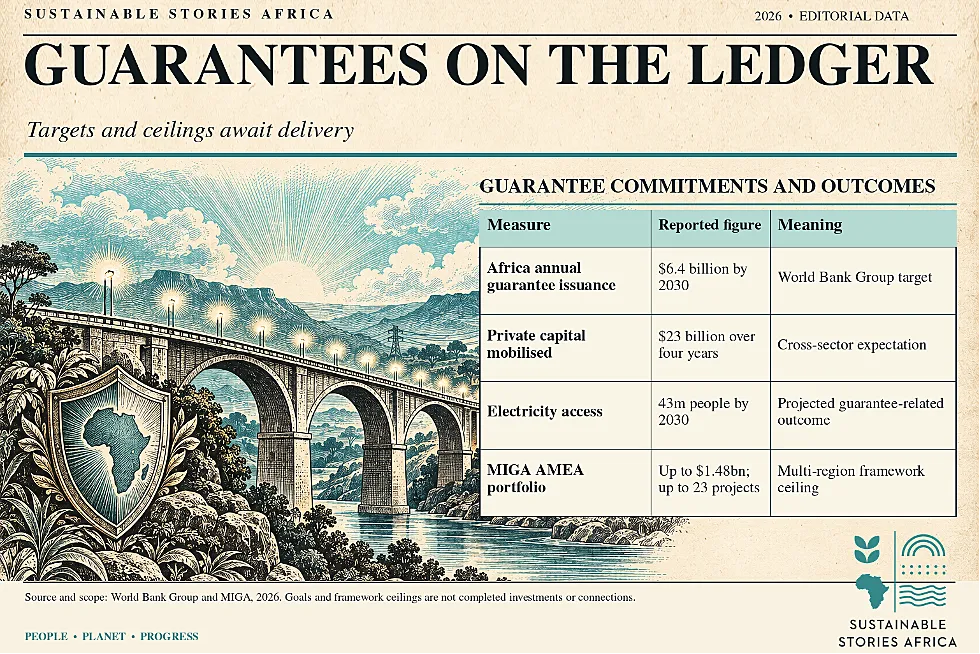
The World Bank Group aims to raise annual African guarantee issuance to $6.4 billion by 2030 and says new guarantees could mobilise $23 billion over four years.
For communities awaiting power, the decisive measures are completed connections, affordability and reliable supply.
Risk protection moves into the foreground
Africa's energy finance discussion is increasingly focused on guarantees, which can protect investors against specified risks and help projects secure capital.
Renewables Rising describes a continental turn toward such instruments. A concrete benchmark comes from the World Bank Group:
- Its guarantee platform aims to more than double annual issuance in Africa to $6.4 billion by 2030.
- The bank expects guarantees issued over four years to mobilise $23 billion in private capital across several sectors, not energy alone.
These figures are targets and expectations, not cash already invested in power plants or households connected to electricity.
The shift matters because many technically viable projects struggle to reach financial close when lenders are uncertain about payment, currency or political risk.
Portfolio deals show how cover can work
The World Bank Group says its Mission 300 partnership with the African Development Bank seeks to connect 300 million Africans to electricity by 2030.
- It estimates that its planned guarantee expansion could support electricity access for 43 million people by that date, alongside other development outcomes.
- In April, the Multilateral Investment Guarantee Agency, or MIGA, announced a framework with AMEA Power that could provide guarantees of up to $1.48 billion for up to 23 renewable generation and storage projects across Africa, the Middle East and Central Asia.
That portfolio's geography matters: neither the full guarantee amount nor its projected generation can be attributed solely to Africa.
- The first phase includes several African countries; individual guarantees for two Egyptian projects were signed at the time of the release.
Framework ceilings and signed project coverage are different stages of finance.
A guarantee cannot build a grid alone
A guarantee shifts a defined risk; it does not make a weak project technically sound or pay every bill after construction.
- Developers still need credible offtake agreements, permits, land arrangements, grid connections and equipment procurement.
- Public authorities must understand potential contingent liabilities if a guarantee is called.
A lender may finance a solar project once political risk is covered, but a household will see no gain if the distribution network cannot carry the power or tariffs are unaffordable.
- The policy opportunity is to pair targeted risk sharing with better project preparation and transparent regulation.
- When structured well, a limited amount of public risk capacity can support more private investment; its effectiveness has to be measured against the additional capital and actual access it produces.
Different guarantees address different problems.
- Political risk cover may reassure a foreign investor about expropriation or currency transfer
- A credit guarantee may help a local bank lend against an uncertain revenue stream.
Neither should obscure the underlying economics of an electricity project.
The AMEA framework illustrates the scale a portfolio approach may achieve, but its figures represent ceilings and its countries span three regions.
- It would be misleading to report the whole portfolio as delivered African generation.
- To test additionality, independent reviewers could compare projects with similar deals that received no guarantee, while acknowledging that such comparisons are difficult. They should also inspect the public cost of claims and fees.
An instrument that attracts capital but leaves utilities with unpayable obligations will not support durable access.
Financial closure, completed construction and service quality are separate milestones, each deserving a separate public measure.
Measure connections and fiscal exposure
Governments, development banks and guarantors should disclose what each instrument covers, its fee and duration, which obligations remain with the public sector and whether it helped bring a project to financial close.
- Project reports should separate approved frameworks, issued guarantees, construction starts and electricity delivered.
Local lenders can develop domestic currency options where feasible, reducing mismatches between revenues and debt service.
Communities should be able to see whether investments expand reliable, affordable supply and create local jobs.
The World Bank targets are ambitious;
- The evidence of success will be built project by project, especially where transmission and distribution remain binding constraints.
This reporting should also make clear who ultimately pays if a covered risk materialises.
- Guarantees are valuable when their expected public benefit exceeds their cost, and they address a genuine obstacle.
Independent assessment can show whether capital would have flowed anyway and whether access gains endure beyond the guarantee period.
Path Forward – Tie Guarantees To Power
Guarantee providers should connect risk cover to prepared projects, viable utilities and grid investment.
Transparent disclosure can show how much private capital is genuinely additional and what liabilities governments retain.
Energy access targets must be checked against completed connections, reliability and affordability.
That is how finance innovation becomes a measurable public benefit.
Culled from: Africa turns to guarantees to unlock energy finance