The UN Global Compact has launched a Sustainable Procurement Implementation Framework to turn corporate commitments into purchasing practice.
The voluntary resource covers governance, supplier engagement and performance measurement rather than replacing regulation.
For African suppliers, implementation will matter as much as ambition: requirements must be clear, proportionate and commercially workable.
ESG moves to the purchasing desk
The UN Global Compact launched its Sustainable Procurement Implementation Framework on 21 September during a high-level forum alongside the UN General Assembly.
The resource is intended to help companies bring sustainability into everyday sourcing and supplier decisions.
- It is voluntary guidance, not a new law or replacement for existing standards.
Timing matters because a company’s public commitments can lose force when price, delivery and compliance teams make purchases using different priorities.
Procurement is where those choices reach factories, farms, logistics providers and smaller contractors.
From policy to supplier choices
The framework assesses current capabilities, governance, sourcing priorities, supplier engagement and measurement.
- The UN Global Compact says the coalition behind it was established in 2025 and aims to help 100,000 companies integrate sustainability into procurement by 2030.
That is an ambition, not a verified count of adopters.
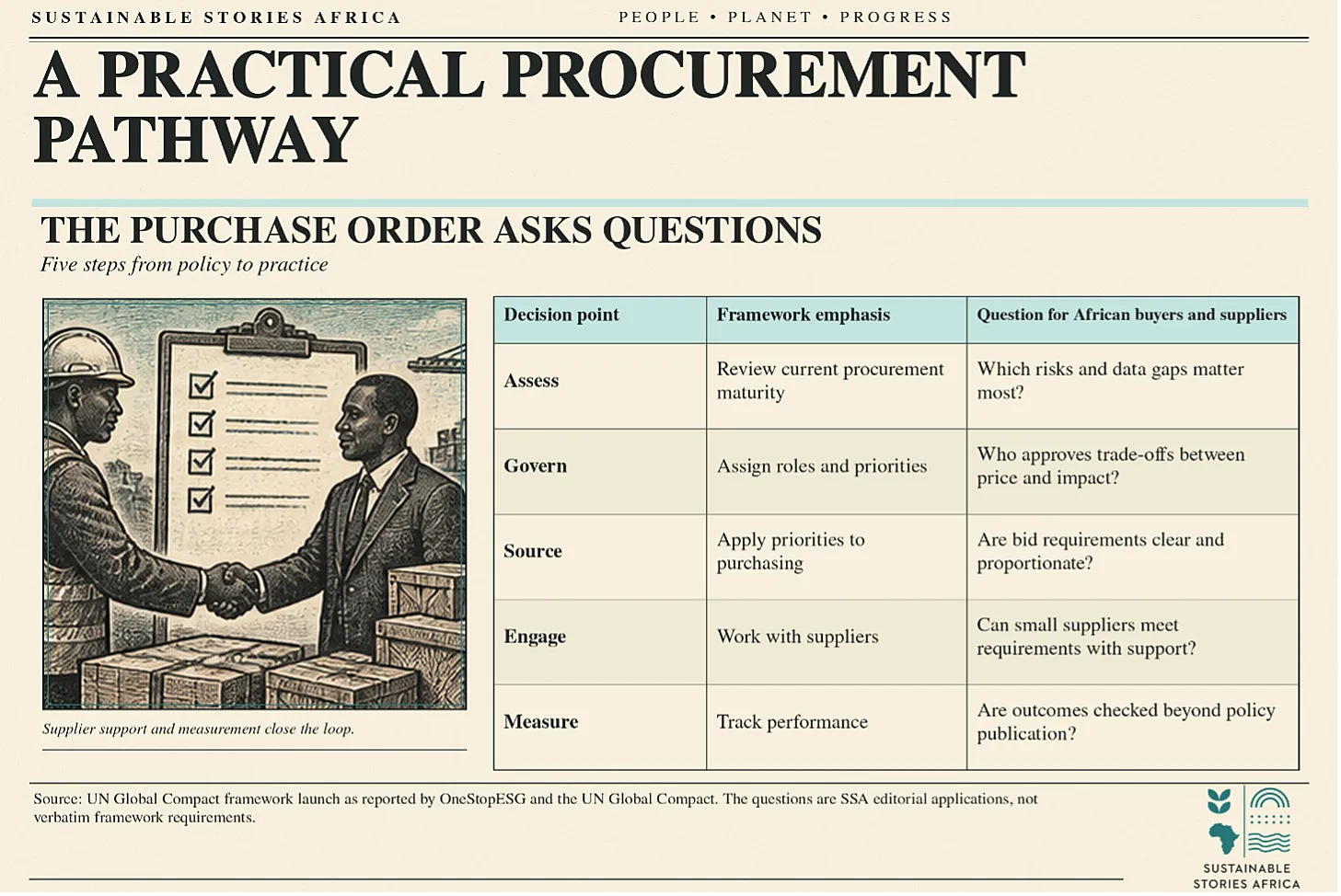
For a large buyer sourcing food, construction inputs or packaging in Africa, a supplier questionnaire alone may not improve working conditions or resource efficiency.
- Buyers need to know whether specifications, payment terms and contract length give suppliers room to invest.
- Smaller firms also need to understand requirements and time to adapt, rather than a series of incompatible forms.
UN Global Compact chief executive Sanda Ojiambo described the ambition as making sustainable procurement “the global norm” and providing companies with a practical route from ambition to action.
The framework’s value will depend on whether procurement teams actually change decisions, not merely download another guide.
Stronger supply chains, fairer access
Better purchasing practices could reward suppliers that manage environmental and labour risks, improve traceability and make supply chains more resilient.
- In African markets, they could also help local firms compete on verified performance rather than marketing claims alone.
However, rigid demands imposed without training, prompt payment or realistic timelines could shut smaller suppliers out of contracts.
Put buyers on the hook
Companies should select a small set of material risks, establish baselines, update sourcing criteria and track whether supplier conditions improve.
Procurement leaders should explain decisions when a cheaper bid carries greater social or environmental exposure.
Buyers can also offer practical supplier support, disclosing their own purchasing behaviour and what is genuinely possible.
Path Forward – Make Responsible Purchasing Commercially Workable Everywhere
The framework offers a method, but companies retain responsibility for changing contracts and supplier relationships.
Progress in African markets will be most credible when buyers measure outcomes and give smaller suppliers a realistic path into sustainable value chains.
Culled from: UN Global Compact Launches Sustainable Procurement Implementation Framework