
A new GlobeScan survey finds that 83% of respondents in China believe artificial intelligence’s benefits outweigh its risks, compared with 48% in the United States.
The divide matters as governments and businesses decide how quickly to deploy AI, and what safeguards the public will expect.
Nigeria, Kenya and Egypt are among the more optimistic markets. For Africa, the question is how to turn that confidence into useful, affordable and accountable technology.
A global divide in trust
The two countries at the centre of AI development have reached sharply different public verdicts on it.
In a GlobeScan analysis published on September 23, 83% of respondents in China agreed that AI’s benefits outweigh its risks.
In the United States, 48% agreed, and 52% disagreed, a 35-percentage-point gap between the two countries.
For African policymakers, the striking finding is not simply the superpowers disagreeing.
It is the optimism in surveyed African markets:
- 82% agreement in Nigeria
- 79% in both Kenya and Egypt.
GlobeScan reported 76% agreement across its Africa and Middle East grouping.
These findings signal an opening for AI-led development, but they don’t prove that people will accept every use of the technology.
Optimism meets local realities
GlobeScan surveyed 32,106 people online across 33 markets in July and August 2026.
- Respondents were asked whether they strongly or somewhat agreed, or disagreed, that AI’s benefits outweigh its risks.
- Globally, 66% agreed, but only 20% agreed strongly.
The difference matters: much of the apparent support is qualified rather than firm.
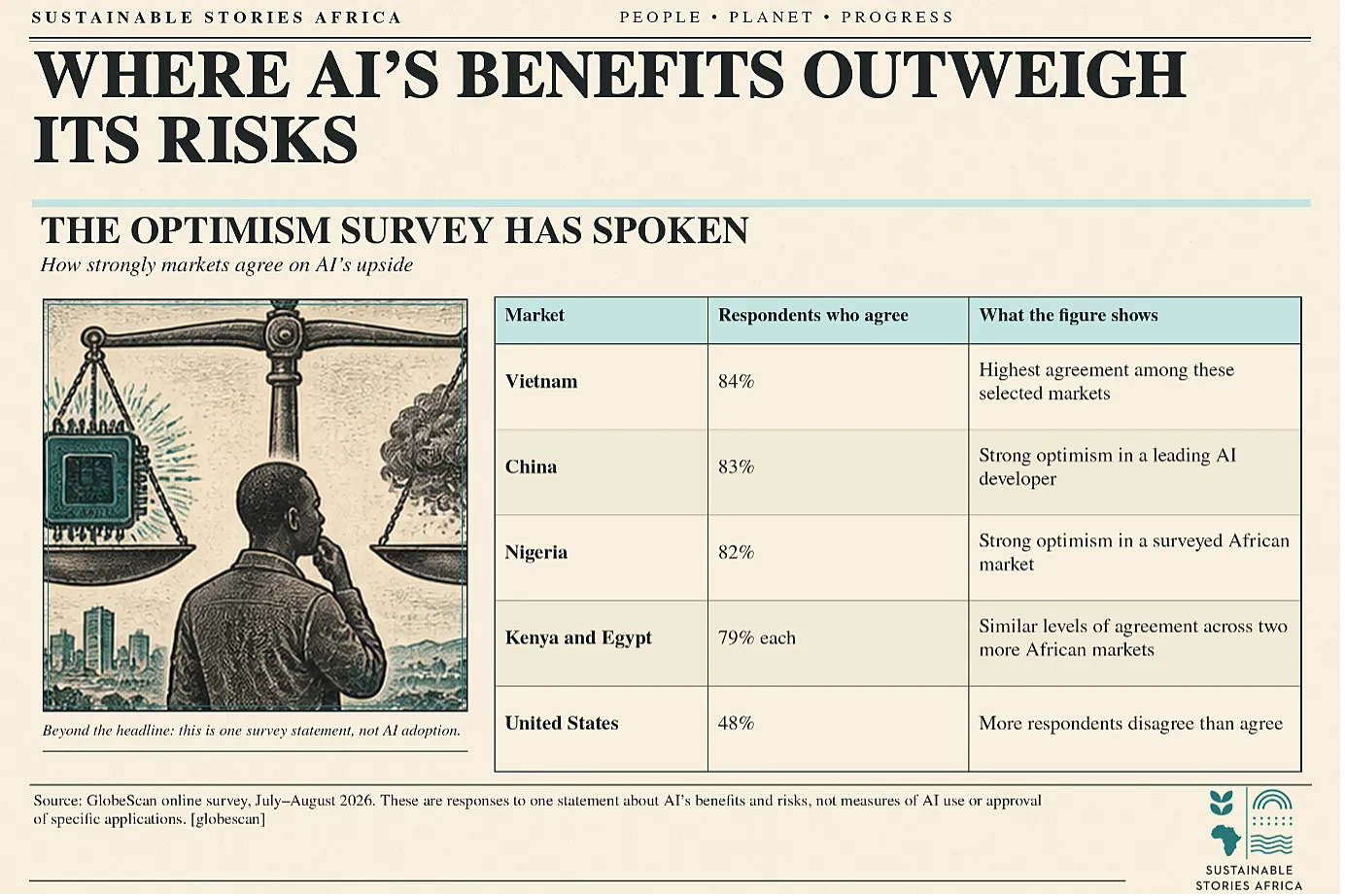
The table puts Africa’s opportunity in perspective.
- A farmer seeking more timely advice, a clinician reviewing information or a small business handling customer enquiries could find AI valuable; however, that is a potential use, not an outcome established by this survey.
Whether such tools help depends on their accuracy, accessibility and fit with local needs.
GlobeScan argues that public confidence will also depend on how organisations respond to concerns about jobs, privacy, misinformation, energy use and accountability.
- Its results show attitudes, not why each respondent holds them; they should not be read as evidence that Africans are unconcerned about those risks.
Turning confidence into public value
The African Union has a policy framework for acting on both opportunity and risk.
- Its Continental AI Strategy, endorsed in July 2024, calls for an Africa-centred approach that develops capability while promoting ethical, responsible and equitable use.
The AU identifies potential applications in healthcare, agriculture, finance and education.
- If AI systems work reliably in local contexts, businesses and public services could use them to reach more people or make better-informed decisions.
- If they fail, the costs could fall on people least able to challenge an incorrect decision, a privacy breach or a service designed without them in mind.
Optimism therefore creates a responsibility to test claims of benefit, not a reason to relax scrutiny.
That responsibility extends to infrastructure.
- The AU’s strategy identifies electricity, broadband, computing capacity, quality data and skills as foundations for AI development, while also pointing to the power demands of data centres.
For investors, the sustainability question is not only whether a tool can scale, but what it takes to run, and who gains access when it does.
Make deployment earn trust
Governments should translate broad AI strategies into safeguards that people can use:
- clear rules for data protection, ways to contest consequential decisions and public reporting on how systems perform.
Businesses should test tools against local languages and conditions, explain where human oversight remains in place, and disclose material resource demands.
- These are editorial recommendations informed by the risks identified in the GlobeScan findings and the AU strategy, not measures announced in the survey.
The AU has already set out a five-year implementation plan that prioritises national strategies, talent, investment, infrastructure, datasets, computing capacity and protection against bias and misuse.
The immediate task is to make those priorities visible in procurement, funding and deployment.
Public enthusiasm offers a starting point; demonstrable benefit and accountability will determine whether it lasts.
The path forward for trustworthy African AI
African institutions can build on the AU strategy by pairing investment in skills and infrastructure with safeguards against bias, misuse and exclusion.
That would make optimism a foundation for responsible adoption rather than a substitute for evidence.
For businesses and financiers, the test is practical: show who benefits, measure the resources used and give affected people a meaningful route to challenge harm.
Culled from: Two Superpowers, Two Verdicts on AI