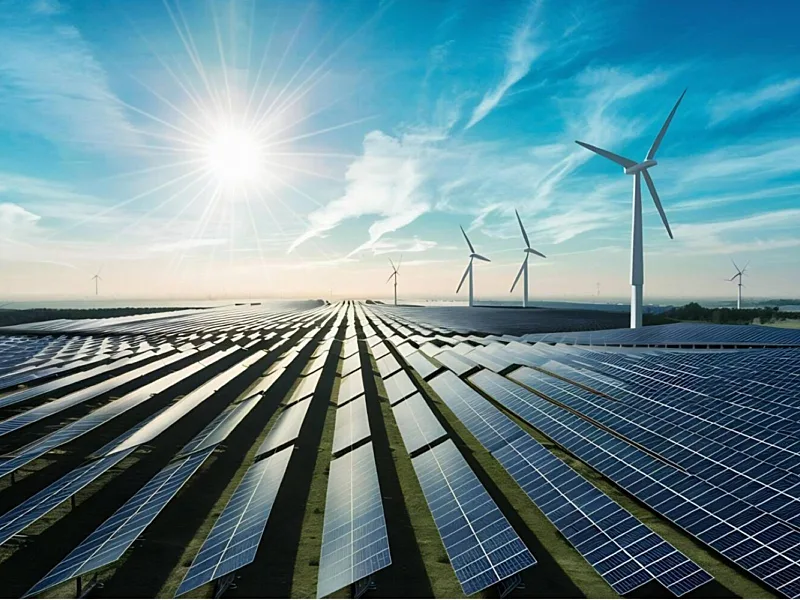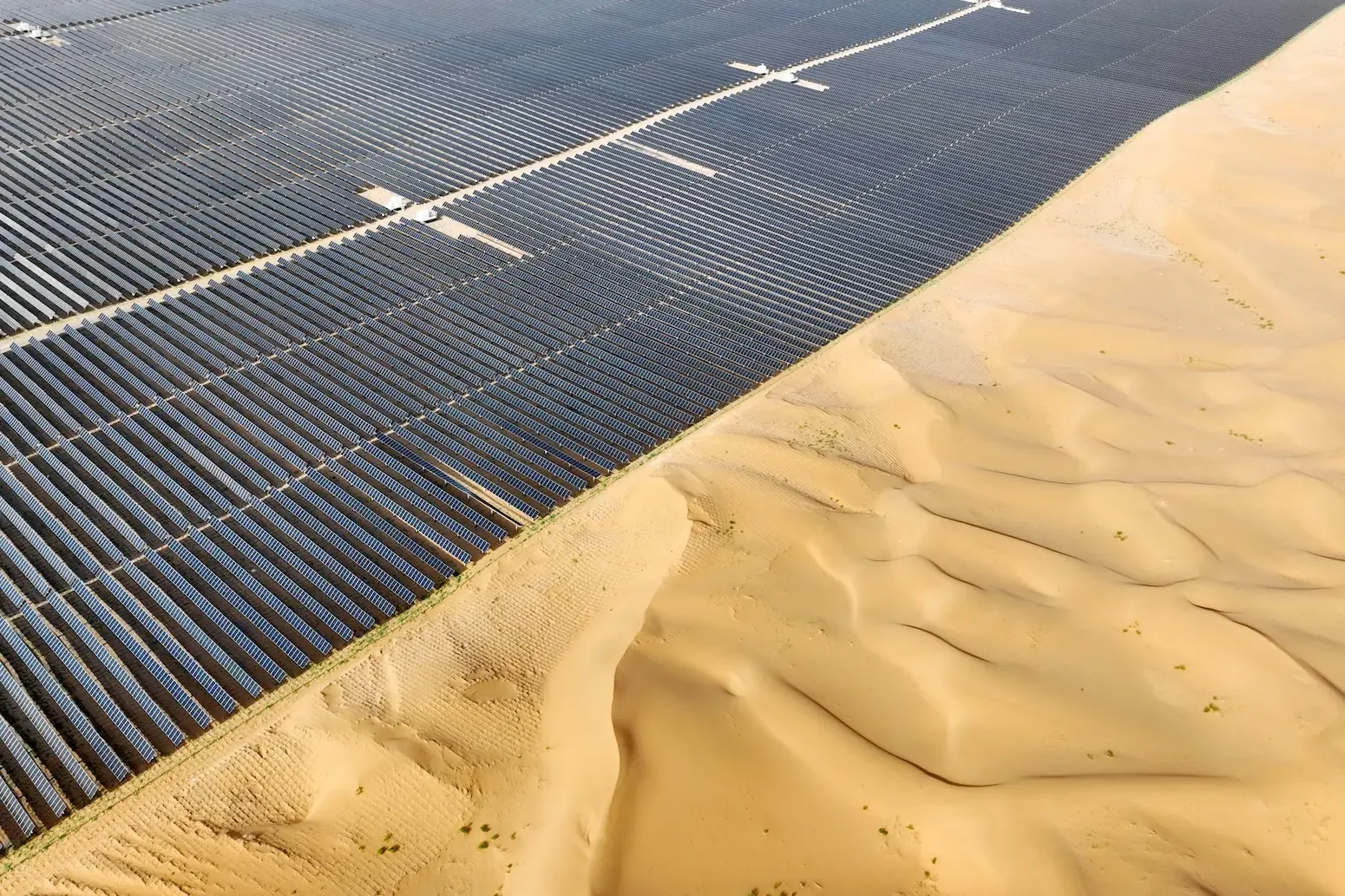
A study of solar farms near China’s Gobi Desert suggests panels can slow ground-level winds and reduce dust emissions.
Its projections show larger benefits if installations expand substantially by 2060.
For dry regions elsewhere, including parts of Africa, the finding is a research prompt, not proof that every solar project will improve air quality.
Power plants with another effect
Large solar farms near the Gobi Desert may do more than generate low-carbon electricity: by altering wind flow and ground conditions, they may also suppress dust.
Research reported by Phys.org on 24 September says a modelled expansion consistent with China’s 2060 carbon-neutrality plans could lower average springtime PM10 concentrations across northern China by nearly 14%.
The figure is a scenario estimate, not an observed air-quality improvement already delivered.
That distinction matters for cities downwind of dusty landscapes, where a new energy project may extend beyond its electricity output.
It is equally important for developers: a plausible co-benefit should be measured, not promised in advance.
How panels change the ground
Researchers led by Yueting Hao of Nanjing University combined satellite observations with modelling to examine solar arrays, wind and soil around the Gobi.
In the study areas, spring vegetation cover increased by about 17% relative to pre-installation conditions, while estimated soil erodibility fell by about 17%.
The arrays also increased surface roughness, slowing winds close to the ground where dust is lifted.
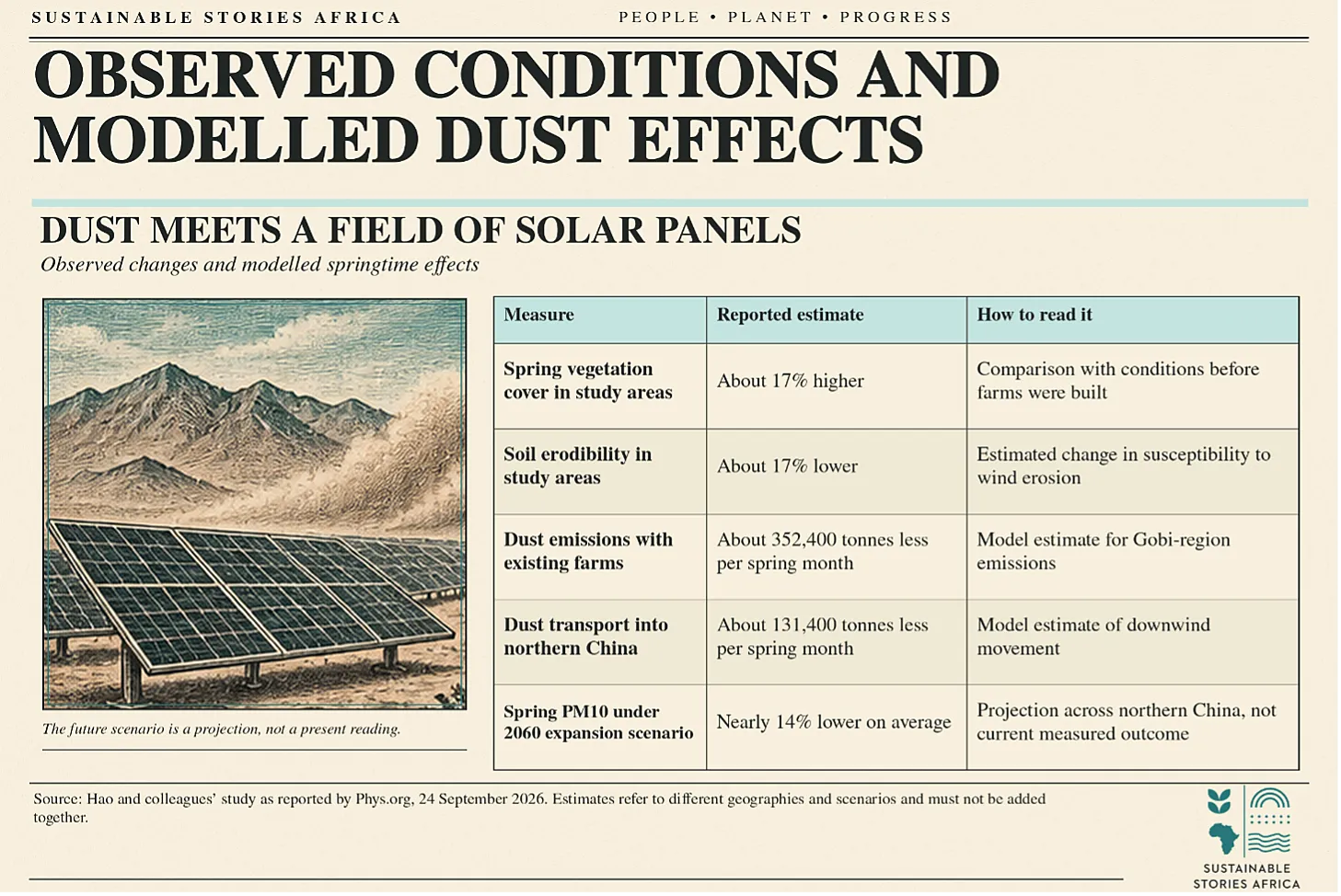
The researchers modelled solar-covered area growing to almost 11 times the area of existing farms by 2060.
Under that scenario, they estimated Gobi dust emissions could fall about 12% and dust transport about 21%.
The figures depend on assumptions about expansion, climate and land response; they do not make an equivalent forecast for African deserts.
Design for several benefits
For African solar developers in dry regions, the useful lesson is to assess local effects alongside generation: vegetation management, soil stability, access roads and neighbouring communities can shape a project’s footprint.
- If project-specific evidence confirms lower dust, that could strengthen the public-health and environmental case for thoughtful siting.
- If it does not, the electricity benefit must stand on its own merits.
The risk is overgeneralisation.
- Water needs, habitat disturbance, land rights and construction impacts could outweigh any dust benefit at a poorly chosen site
- A Chinese modelling result should guide questions for environmental assessments, not substitute for them.
Measure before making claims
Developers and regulators should establish baseline dust and vegetation conditions before construction, monitor changes after commissioning and share findings with affected communities.
Researchers should test whether similar mechanisms hold under different soils, panel spacing and local weather.
That is how an intriguing co-benefit becomes evidence that planners can use responsibly.
Path Forward – Test Local Benefits Before Scaling Claims
The Gobi findings add a new question to solar planning: can well-designed projects protect air quality as they produce electricity?
African projects should answer it with local measurements, community engagement and transparent environmental safeguards, rather than copying the 2060 China projection as it is.