Currency stability depends on external earnings
Afreximbank projects Zimbabwe’s real growth at 5% in 2026 and 3.9% in 2027.
Gold earnings and agriculture support the outlook, while softer gold prices and fuel costs pose risks.
External arrears continue to constrain access to concessional finance.
Gold and agriculture support a slower expansion
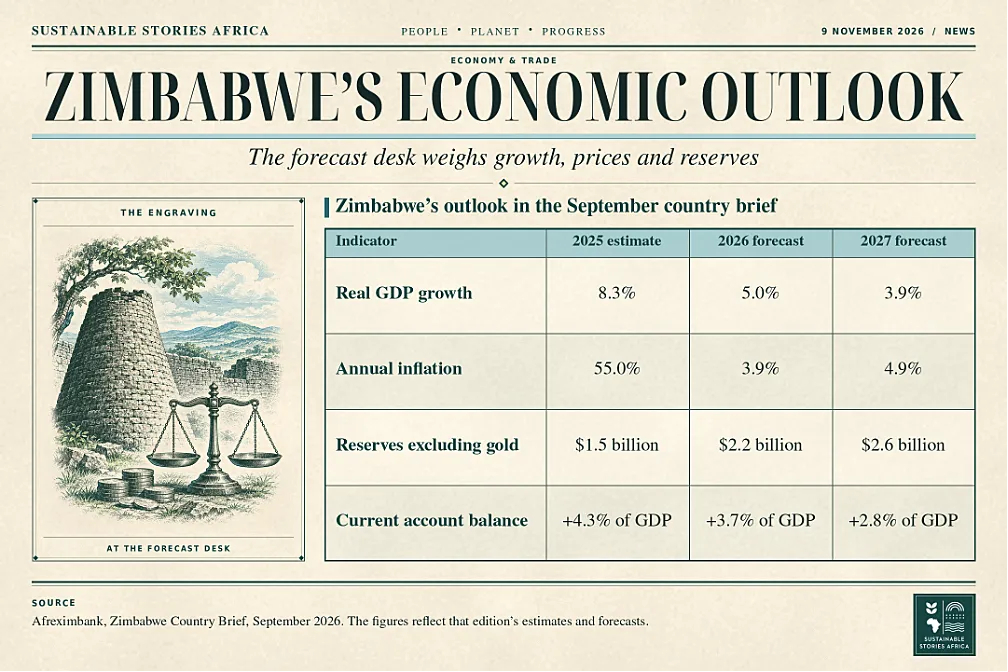
Zimbabwe’s economy is forecast to grow 5% in 2026 before slowing to 3.9% in 2027, according to Afreximbank’s September 2026 country brief.
Improved agricultural yields and gold mining support the near-term outlook.
- The bank expects momentum to ease as the post-drought farm recovery fades and softer gold prices reduce foreign-currency inflows.
The forecast follows estimated growth of 8.3% in 2025, when rainfall improved and agriculture rebounded after the previous year’s drought.
- Strong gold exports supported foreign exchange supply and government receipts.
The same factors that lifted growth also explain some of the economy’s exposure.
- Another weather shock can affect harvests and rural incomes, and changes in gold prices can reach the budget and currency through export earnings.
Lower inflation and a wider trade deficit
The bank forecasts annual inflation of 3.9% in 2026, down from its 55% in 2025, as stronger gold receipts, tighter monetary conditions and greater currency stability ease price pressures.
- It projects inflation of 4.9% in 2027.
- Lower inflation means prices rise more slowly.
- Households that absorbed earlier increases may still face high prices for transport, food and other essentials.
Zimbabwe introduced its Zimbabwe Gold currency, known as ZiG, in April 2024.
- The brief links its greater stability to stronger foreign-currency inflows, with reserve accumulation providing additional support.
It expects exports of $12.6 billion and imports of $13.5 billion in 2026, leaving a goods trade deficit of roughly $900 million.
- The current account is forecast to stay in surplus because it also captures transactions outside merchandise trade, including remittance flows.
The bank’s fiscal forecast shows how quickly conditions could change.
- It projects a small surplus of about 0.3% of GDP in 2026 followed by a deficit of about 0.8% in 2027.
- This is because lower gold prices reduce royalty revenues and profits.
- That shift would occur as the government faces wage commitments and works on clearing arrears.
The numbers show another measure of the budget’s exposure to gold.
Why more reserves matter to businesses
A manufacturer importing machinery or parts needs access to foreign currency at a predictable cost.
- Strong export receipts can ease that pressure, although Zimbabwe’s reliance on imported fuel leaves firms exposed to higher global oil prices.
A fuel shock can raise transport and production costs, while a weaker currency raises the price of imported inputs.
- The brief projects reserves excluding gold to reach $2.2 billion in 2026 and puts import cover at 1.5 months.
Greater local processing could help diversify export earnings over time.
The brief identifies value addition in mining and investment in power and transport as priorities under Zimbabwe’s National Development Strategy 2.
- Processing projects depend on reliable electricity, affordable financing and the ability to reach customers.
These conditions influence whether higher mineral production generates durable employment and more diversified trade.
Arrears remain a financing constraint
The bank projects external debt of 34.5% of GDP in 2026.
- It also stresses that arrears and the need for creditor agreement limit access to concessional finance.
- A stable debt ratio can therefore coexist with difficulties borrowing on affordable terms.
The brief identifies the IMF staff-monitored programme approved in April as a framework for fiscal control, currency stability and arrears clearance.
In a separate October update, the IMF also projected 5% growth for 2026 and 3.5% for 2027, citing the expected effect of El Niño-related drought on agricultural production.
- The table retains the September country brief’s figures.
For businesses and public agencies, the practical measures to watch include foreign exchange access, budget performance as gold prices change and progress with creditors.
- Tracking them alongside GDP would show whether short-term stability translates into more predictable conditions for investment.
- It would also help identify where drought, fuel prices or weaker export receipts start to put pressure on households and firms.
For firms that sell into the domestic market, lower inflation can make pricing and stock decisions easier.
- Its benefits depend in part on whether importers can obtain foreign currency when payments fall due.
Watching both currency conditions and purchasing power would give a fuller picture of the recovery than either annual inflation or export earnings alone.
Watch reserves arrears and export earnings
Afreximbank’s forecasts point to continued growth at a slower pace.
The durability of that outlook depends on export earnings, agricultural conditions and the ability to manage imported fuel costs.
Progress on arrears and more reliable access to finance would determine how much room Zimbabwe has to invest in infrastructure and broaden its export base.