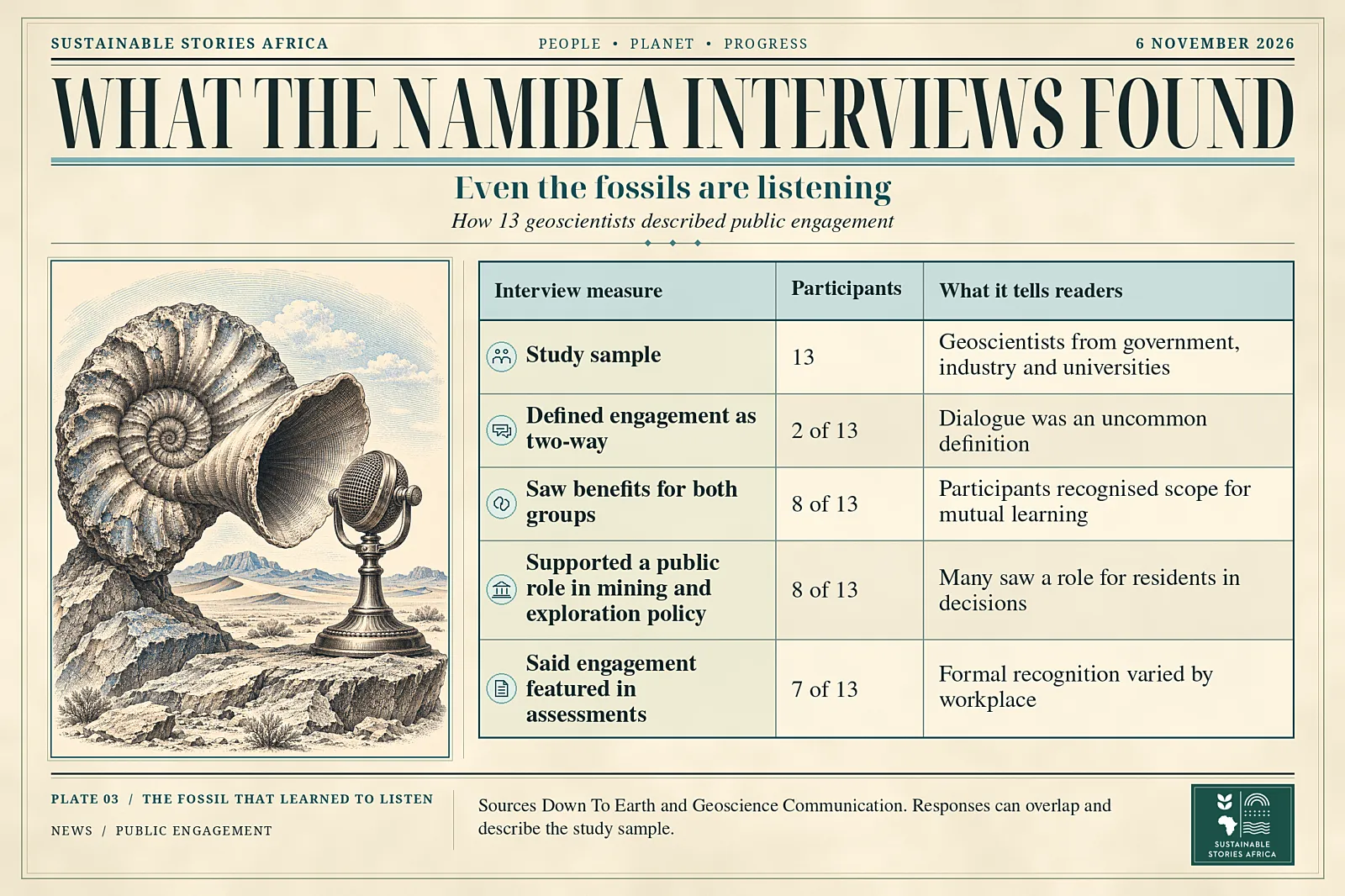
Interviews with 13 Namibian geoscientists found that only two defined public engagement as a two-way exchange.
Several participants recognised that communities could inform their work and should have a voice in mining policy.
The findings matter where exploration decisions intersect with access to groundwater and trust in the institutions overseeing it.
A gap between explaining and listening
Namibian geoscientists interviewed for a study largely described public engagement as explaining their work, even though many saw value in hearing from communities.
The finding, highlighted by researchers Josephine Naambo Uushona and Marina Joubert in Down To Earth on November 4, points to a gap in how specialists approach public participation in decisions about mining and water.
- Only 2 of the 13 interviewees defined engagement as a two-way process.
- Eight said it could benefit scientists and communities
- Eight said the public should have a say in policy decisions about mining and exploration.
These are separate findings from interviews with professionals in government, industry and universities.
The small qualitative sample shows how these participants think about their work and provides a basis for further research.
The researchers point to concerns raised by an interviewee about uranium exploration in the Stampriet area, where communities depend on groundwater.
- People who rely on boreholes need to understand what is being proposed and how water risks are assessed.
They also need a way to raise questions that can influence what geoscientists investigate and what decision-makers consider.
Why outreach stays one way
Participants described constraints including travel to remote areas, limited time and money, restrictions on sharing information and uneven support from employers.
- 7 said public engagement featured to some extent in performance assessments
- At least five reported a lack of support from colleagues.
Public events provided opportunities to talk about geoscience, but evaluation was uncommon.
This makes it hard to tell whose concerns reached the scientists and how those concerns were handled.
All 13 interviewees said they felt confident engaging with the public, but most said they needed training.
Scientific expertise helped them explain technical subjects.
- The harder task involved hearing concerns, working across language differences and deciding what to do when residents’ experience challenges the assumptions in a technical assessment.
Local knowledge can improve the science
The researchers situate mistrust in the history of extraction.
- During Namibia’s colonial period, expeditions drew on local knowledge to locate minerals while denying Indigenous people authority over how that knowledge was used.
- Today, asking for access to land for fieldwork can reinforce that mistrust if communities have little opportunity to shape the work or hear what the investigation finds.
Residents’ observations can help geoscientists decide where to look and what questions to ask.
- For example farmers, may know how borehole performance changes across seasons or which water sources households fall back on during a drought.
- A technical team can investigate these observations alongside other evidence and explain how it reached its conclusions.
The value of listening becomes visible when residents can see what their input prompted the team to examine.
Language shapes who can contribute.
- The researchers found that English dominated geoscience communication, even where people used Oshiwambo, Khoekhoegowab, Afrikaans, Otjiherero or Rukwangali.
- Local-language radio and conversations through community organisations can make the issues easier to follow and give people additional ways to respond.
Meaningful follow-up can matter as much as the initial meeting.
- If testing takes months, residents can be told when the results are due, which questions the tests address and where uncertainties remain.
- Where data cannot be disclosed, explaining the reason and identifying what evidence can be shared gives participants a clearer account of the limits of the process.
A second meeting can also reach people who were unable to attend the first because of work schedules or travel distances.
Employers can make engagement routine
Uushona and Joubert propose formal recognition for engagement, communication funding within research projects and training suited to Namibian conditions.
- Employers can put those proposals into practice by budgeting for translation, travel and a return visit to discuss findings.
- They can evaluate whether an engagement process reached affected groups and how scientists followed up on questions.
Mining companies and research teams can also work with civil society organisations that already have relationships in affected areas.
- For a community concerned about its water, a useful record would show which concerns were raised, what evidence was collected and where a technical or policy decision changed as a result.
Path Forward – Give Communities a Voice in Geoscience
Employers and research funders can support dialogue through local-language training, time for field engagement and formal recognition of the work.
In areas where exploration and groundwater use overlap, communities should be able to raise concerns early and see how geoscientists respond before decisions are made.