
Britain’s Financial Conduct Authority has published final rules bringing environmental, social and governance rating providers into its regulatory framework.
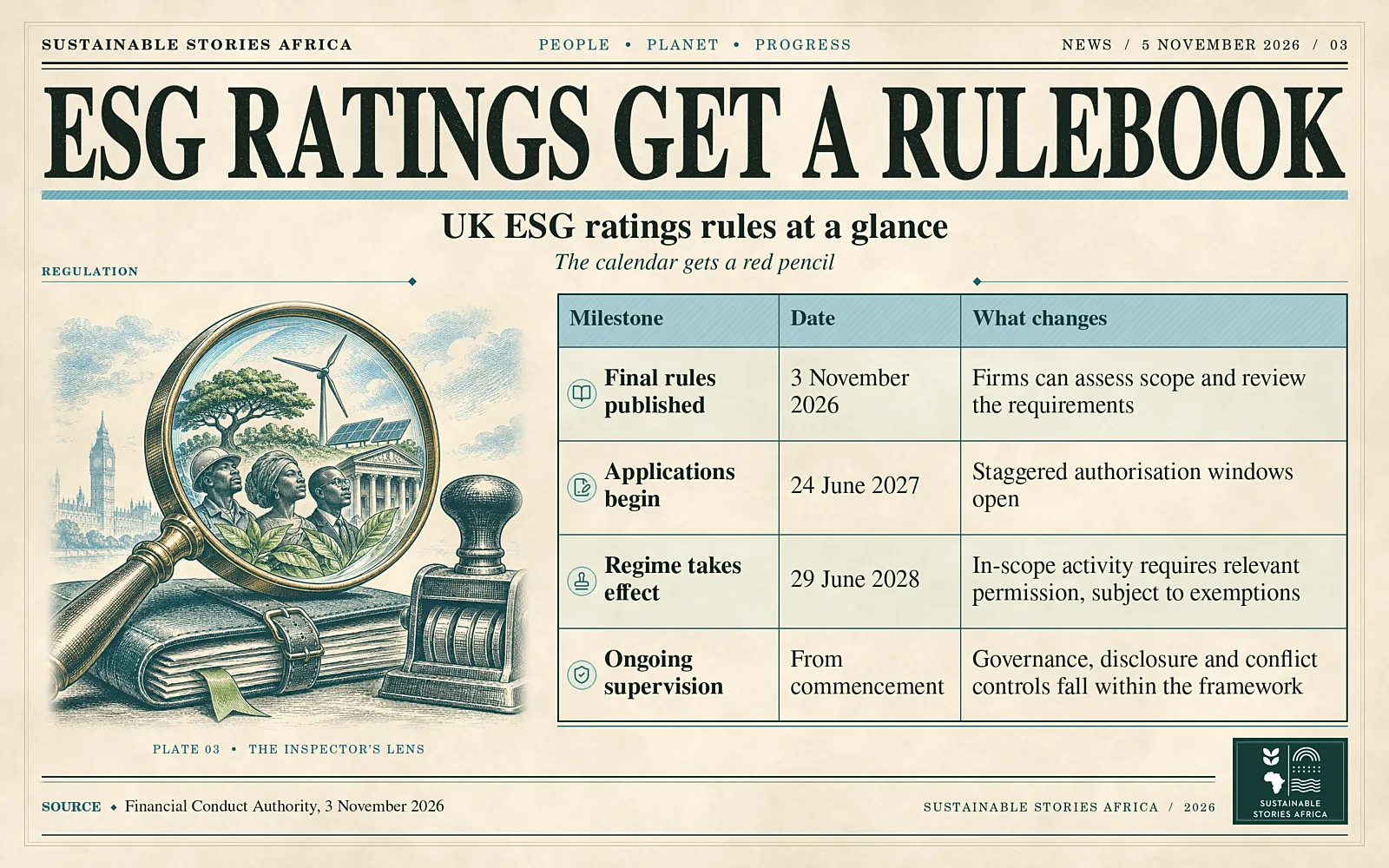
Applications open in stages from June 2027, ahead of the regime taking effect in June 2028.
The rules give investors a clearer basis for asking how scores are produced and how providers handle conflicts of interest.
Britain sets the timetable for ESG ratings oversight
The United Kingdom’s Financial Conduct Authority (FCA) published final rules on 3 November for providers of environmental, social and governance ratings.
- In-scope firms will need FCA authorisation and the relevant permission when the regime takes effect on 29 June 2028, unless an exemption applies.
- The watchdog’s application windows begin on 24 June 2027.
The framework sets requirements for transparency, governance, systems and controls, and managing conflicts of interest and engagement for user and rated entities.
The FCA says it has tailored the rules to the size and activities of firms.
Its focus is how ratings are produced and communicated, with providers retaining discretion over their sustainability views and methodologies.
Why two ESG ratings can tell different stories
- An asset manager can use ESG ratings to screen investments or assess exposure to risks.
- A lender can use them as one input when deciding where to direct capital.
However, ratings can answer different questions about the same business.
- One model might give greater weight to the financial risks a company faces from climate change.
- Another might emphasise the effects of that company’s activities on people or the environment.
Greater transparency would help the users of those scores see what each one is measuring.
- Governance and conflict management address a separate question: who oversees the process and what other commercial interests might influence it.
The regulator says its approach draws on international work, including recommendations from the International Organisation of Securities Commissions, and follows a consultation that closed in March 2026.
The announcement also cites demand for this kind of information.
- In the FCA’s 2024 Financial Lives Survey, 72% of adults who held investments or had a defined contribution pension wanted their investments to do some good as well as earn a return.
The finding describes the preferences of that group.
It gives context for why the quality of sustainability information used by intermediaries matters.
What a clearer score could change
A company raising capital may be assessed by several ESG rating providers.
- If its scores diverge, access to the underlying approach can help it understand whether the difference reflects the indicators used, the weights assigned to them or gaps in available information.
For African issuers covered by ratings used in the UK market, that clarity may make it easier to identify which public disclosures or corrections would address a provider’s questions.
Investors also have a clearer route to scrutinise how a score fits their own mandate.
- A pension fund interested in a company’s exposure to water shortages, for example, needs to know whether the rating uses site-specific information or a broader sector estimate.
The distinction can affect the usefulness of the rating for an investment decision even when both data sources serve legitimate purposes.
- A transparent method makes the judgement easier to examine.
The rating’s role also matters.
- A broad sustainability score might be useful for an initial screen, while a narrower measure is better suited to examining a particular exposure.
- Asset managers can make that distinction clearer by documenting which scores influence decisions and how much weight each receives.
This allows a client or oversight committee to see whether the information fits the question it was chosen to answer.
The work starts before applications open
Laura Dawes, the FCA’s director of authorisations and sustainable finance, urged firms to check whether their activities fall within the regime and start preparing for authorisation.
The regulator says it will offer webinars and access to its pre-application support service.
- Providers that identify the relevant products and controls early will have more time to document how they manage conflicts and explain their methods to customers.
Ratings users have a parallel task.
- They can identify where a rating feeds into a benchmark, screening rule or lending decision and check what would happen if the provider changed its method or withdrew the product.
Rated entities can track how providers obtain public information and where they direct enquiries.
- These steps give each participant a practical way to assess how the new requirements affect its work.
Firms serving the UK market from elsewhere can start by checking the regulator’s guidance on the scope of the regime.
- The release points providers to the final rules for that assessment.
The appropriate timetable depends on the activity, permissions and any exemption that applies.
Path Forward – Authorisation Will Test Providers’ Readiness Next
The first application windows open in June 2027.
Firms preparing for the June 2028 start will need to understand which activities require permission and how to demonstrate compliance.
Investors will be able to judge whether clearer information about methods, oversight and conflicts helps them use ratings more effectively.