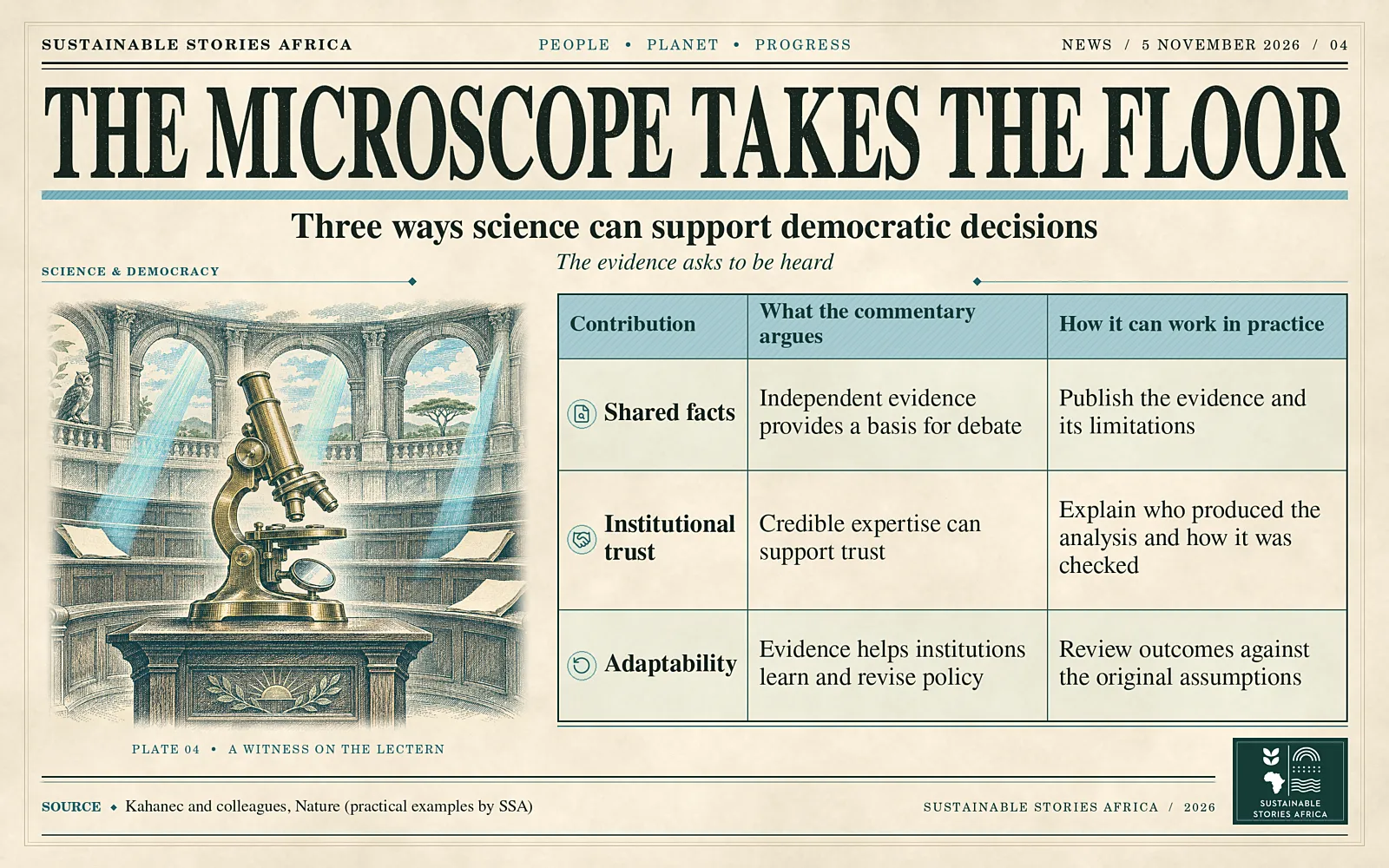
Seven members of the European Commission’s Group of Chief Scientific Advisors argue in Nature that democratic institutions depend on independent science.
Their commentary identifies three contributions: shared facts, institutional trust and adaptability.
The argument has practical implications for how governments explain choices on issues such as flood protection and public health.
A warning about interference in research
Writing in Nature on 3 November, Martin Kahanec and six fellow members of the European Commission’s Group of Chief Scientific Advisors argued that protecting independent research is part of protecting democracy.
- Their commentary points to restrictions on academic freedom, political interference in funding decisions and attacks on researchers.
- The authors say citizens and governments need access to independently produced, verifiable knowledge as policy choices grow more complex.
The piece is the authors' argument.
- It sits alongside a separate advisory process that they describe in the commentary.
In May, European Commissioner for Startups, Research and Innovation Ekaterina Zaharieva asked the group for advice on how science could strengthen the European Union’s democratic functioning and resilience.
- The authors present their three-part argument independently of that request.
Shared facts, public trust and room to adapt
The first contribution is a common basis for debate.
- People can disagree about what to do while examining the same evidence about the problem.
The second concerns trust.
- When the public can see where information came from and how it was tested, there is a basis for scrutinising the institutions that use it.
The third is adaptability.
- Evidence gathered after a decision can show whether the policy is working or should change.
Consider a city choosing which flood-prone streets to protect first.
- Maps can show where water collects, while residents can identify routes that become impassable and services people struggle to reach.
- A budget decision still involves competing priorities.
- Evidence makes it easier to examine the assumptions behind that choice and to see where the city may have overlooked a risk.
The three contributions reinforce one another.
- An evidence base gives people something to inspect, while an institution’s willingness to explain its reasoning can support confidence in how it uses that evidence.
- Reviewing the results later tests whether both the original facts and the decisions built on them still hold up.
This is especially relevant when decisions must be made under time pressure.
Decisions that people can examine and challenge
The public value of independent advice becomes visible when challenging decisions are on their merits.
- For example, a government preparing for drought can explain the rainfall and demand assumptions behind a water allocation plan.
- Farmers, utilities and households can then raise distinct concerns about how those assumptions affect them.
This makes disagreement more specific and gives officials a basis for revisiting the plan as conditions change.
For African governments and research institutions, the commentary offers a way to think about the relationship between public agencies and locally produced knowledge.
- A study gains policy value when data collection can disclose uncertainty, analysts can publish inconvenient results, and communities can see whether their experience is represented.
These practices can help maintain a record of what changed and why, especially when a policy outlasts its original sponsors.
Scientific advice can also show where the evidence leaves a genuine choice.
- Two flood measures may protect different areas, for example, even if engineers agree about their likely performance.
- Publishing that trade-off allows residents to debate priorities and gives elected officials a clearer basis for explaining why they chose one course.
It also lets future reviews distinguish a mistaken forecast from a deliberate choice about whom to protect first.
Make independence visible in public decisions
Research funders, universities and public agencies can make their decision processes easier to examine by disclosing funding arrangements, publishing methods and explaining how they weigh competing evidence.
- When an issue carries significant uncertainty, a public record of the competing interpretations can give decision-makers room to revise policy as new information emerges.
Newsrooms and civil society organisations can help the public see the difference between an expert’s assessment and the decision that elected officials make with it.
- Reporting who commissioned a study, what it measures and what it leaves open gives readers a way to evaluate both the evidence and its use.
- It also preserves the record for a later review if conditions change.
Protection for independent research has a practical bearing on that process.
- If researchers cannot publish findings that challenge a decision, the public loses information needed to assess the decision, and the government loses a way to detect problems early.
Safeguards matter at the point where funding, publication and access to data are decided.
Path Forward – Keep Scientific Advice Open To Scrutiny
The Nature commentary puts research independence and public access to evidence at the centre of its case. The EU advisory request gives the issue a separate institutional forum.
Elsewhere, publishing evidence, uncertainty and the reasons for decisions offers a practical way for institutions to make their use of science accountable.