A climate modelling study found that allowing oceans to respond increased the warming detected far from large-scale reforestation.
The effect was stronger at high latitudes and continued to build after local temperature effects had stabilised.
The work examines physical climate responses separately from carbon removal and calls attention to how long those responses can take to emerge.
The ocean changes the temperature response
Ocean dynamics can amplify warming far from reforested land in a multi-century simulation, according to a study published on 24 September in Earth System Dynamics.
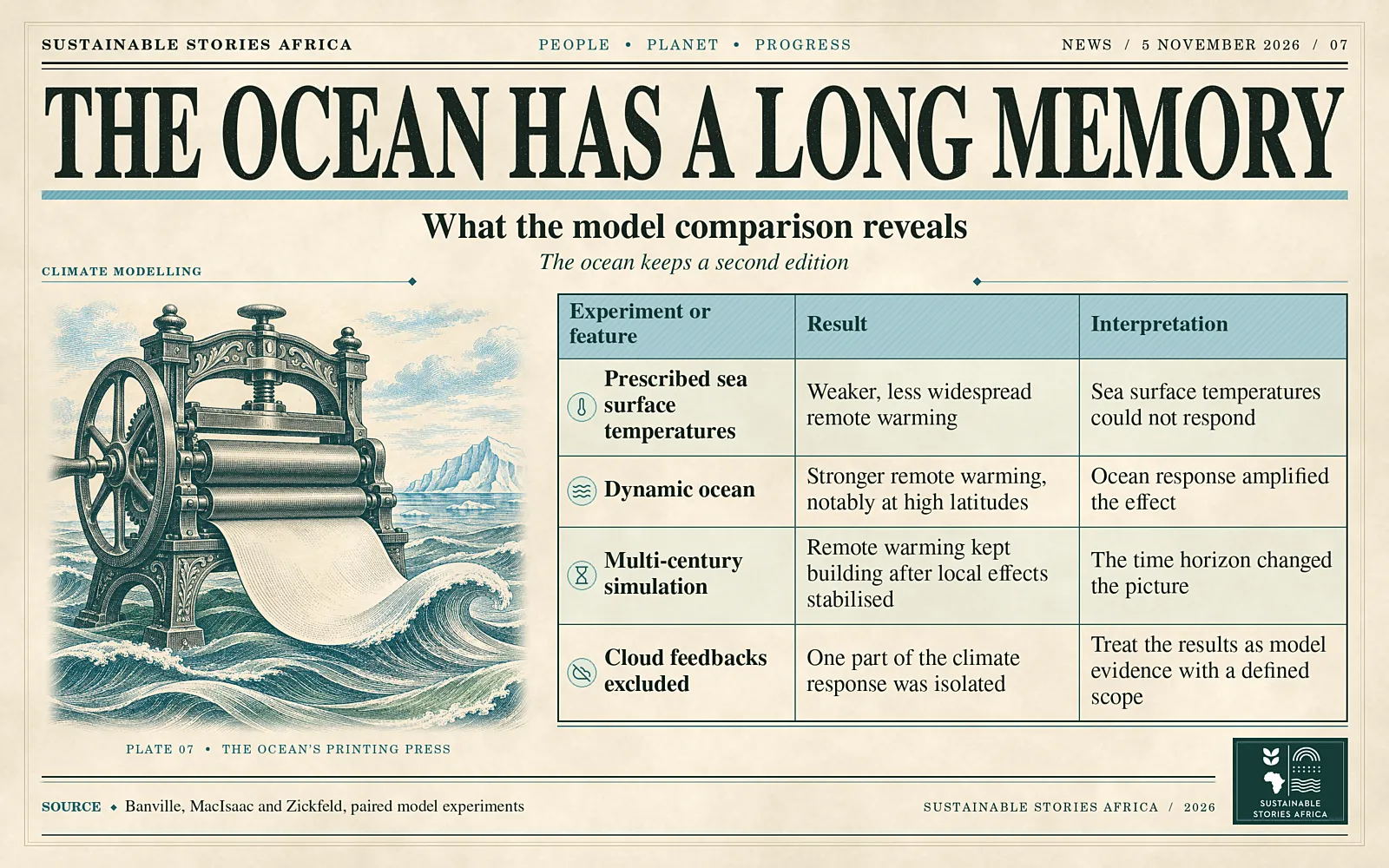
- Pierre Etienne Banville, Alexander MacIsaac and Kirsten Zickfeld used the University of Victoria Earth System Climate Model to compare reforestation experiments with a responsive ocean and with prescribed sea surface temperatures.
- The responsive ocean produced stronger and more widespread remote warming, especially at high latitudes.
The researchers examined the physical effects of changing land cover, excluding cloud feedbacks.
- Their results describe an idealised experiment and address one part of the climate consequences of restoring forests.
Carbon uptake, biodiversity and other ecosystem benefits need to be assessed alongside the physical temperature response when judging a real project.
What changed in the paired simulations
Forests can change how much sunlight a surface reflects, how rough it is and how water and heat move between the land and the atmosphere.
- These processes alter temperatures where trees grow.
- They can also influence distant places through changes in the atmosphere and ocean.
The researchers used a checkerboard design, in which selected model grid cells were reforested, to distinguish local responses from effects in places without the land-cover change.
In the experiments with a dynamic ocean, seawater warmed gradually and climate feedbacks amplified the response.
- Water stores heat and adjusts slowly.
- The lag allowed the remote temperature effect to grow even after local effects became relatively stable.
With prescribed sea surface temperatures, the ocean could not respond in the same way, and distant warming was weaker and less widespread.
One feedback the researchers identify involves sea ice.
- When less ice covers the ocean, a darker surface absorbs more incoming sunlight, which can reinforce warming at high latitudes.
- The model also points to a reinforcing role for water vapour.
These processes help explain why a land-use change can produce a different temperature pattern in the experiment that allows the ocean to adjust.
What a carbon figure leaves out of a land decision
Carbon storage remains a reason to restore forests.
- The study asks planners to consider what else changes when trees alter land cover.
- A hectare of restoration can affect water, shade and the surface energy balance as well as storing carbon.
- These benefits and effects vary by location.
The paper’s global experiment gives climate modellers a reason to track how these processes interact across time and space.
For African land managers, a practical implication is to keep project objectives visible.
- Restoring a degraded forest for biodiversity or watershed protection raises different questions from planting trees primarily to generate carbon credits.
- If a project claims a temperature benefit, reviewers can ask whether that claim comes from a carbon estimate, a local temperature model or a wider climate assessment.
Each answers a different question about the same intervention.
The scale of the experiment matters.
- Its global pattern of reforested grid cells is a way to identify mechanisms in the model. A single restoration project has a different scale, climate and land-use history.
Local plans may benefit from assessing the vegetation that existed before the project, how much water different species use and what the land will support through dry periods.
Test temperature claims across time horizons
Longer simulations can help researchers assess effects that take decades or centuries to emerge.
- Comparisons across several models would help show how sensitive the finding is to choices about circulation, clouds and the distribution of trees.
- Regional studies can separately assess risks and benefits tied to land use, water and local ecological conditions.
Policymakers can make those differences clearer by stating what evidence supports each restoration objective.
- A near-term carbon estimate can inform one part of a decision, while long-term model comparisons test another.
- Keeping the measures separate helps investors and public agencies avoid assigning a single climate meaning to outcomes measured on very different timescales.
The comparison also gives researchers a reason to report how they set up a model before readers compare results across studies.
- An experiment with fixed sea surface temperatures can help isolate some effects.
- An experiment with an interactive ocean captures processes that unfold more slowly.
Clear reporting of these choices makes apparently different findings easier to interpret and compare.
Path Forward – Follow Forest Effects Beyond Project Boundaries
The study makes the slow ocean response a priority for testing in land-based climate strategies. Further work can compare models and include feedbacks omitted in this experiment.
Restoration plans can state their carbon, biodiversity and local climate objectives separately and disclose the evidence behind each claim.