Researchers compare six measures of heat
A study of 22 exceptional heatwaves finds future events could exceed several recent records.
In higher-warming scenarios, some modelled events cover larger areas and last much longer.
Health, electricity and labour planners may need to prepare for conditions beyond recent experience.
Recent records provide a starting point
Heatwaves later this century could exceed several of the most extreme events people have already experienced, according to research published on 5 November in Nature Communications.
Philipp Aglas-Leitner and colleagues compared 22 heatwaves observed between 2010 and 2023 with simulations for 2020 – 2100.
- They found that some future events could exceed recent benchmarks even under lower-emissions scenarios, with the risk generally rising as the world warms.
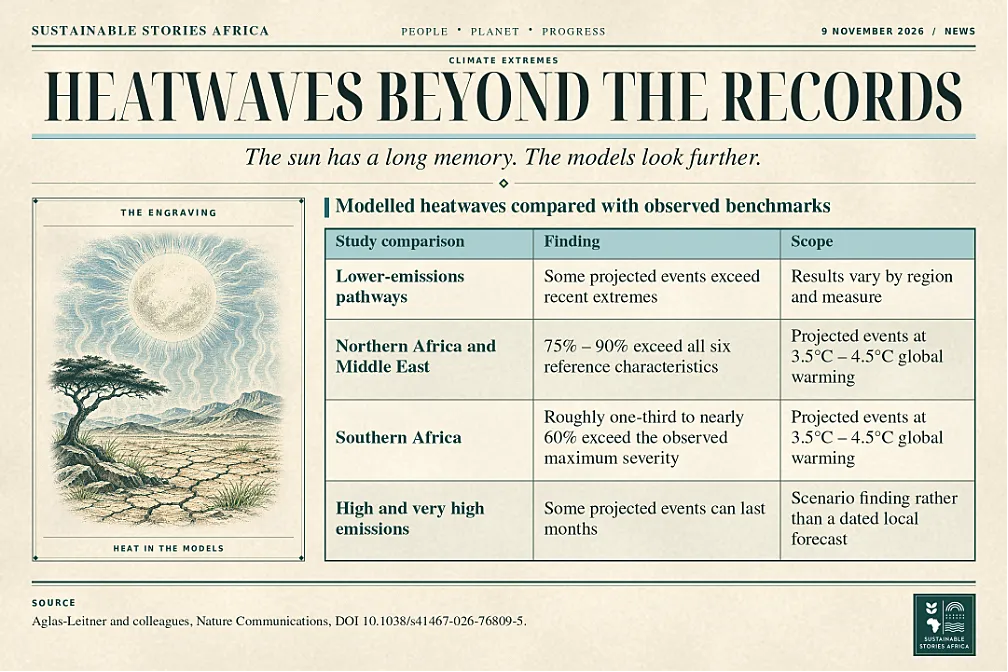
Under high and very high emissions, the simulations show that heatwaves in many regions could generate several times as much cumulative heat as the events used for comparison.
- Some projected events could last months.
- The study compares modelled heatwave characteristics with selected observed events in the same regions.
These comparisons help planners consider what may occur as warming increases.
How the researchers measure an event
The authors used four definitions of extreme heat based on local calendar-day temperature thresholds.
- Their main analysis generally focuses on events in which daily maximum temperatures exceed the 90th-percentile threshold for at least three consecutive days.
- The thresholds are relative to local conditions, which helps explain why a heatwave can be exceptional in a region without reaching the absolute temperatures recorded elsewhere.
The team assessed duration and cumulative heat, as well as typical and maximum severity and geographic extent.
- This captures the difference between a sharp peak and a prolonged emergency.
- Two events might reach similar peak severity; however, one that affects a wider area for longer can put several services under strain at once.
- It can limit neighbouring districts' ability to send staff and supplies.
Duration and cumulative heat answer different planning questions.
- Duration counts how long an event persists.
- Cumulative heat reflects the excess heat that builds up across the event.
- A response plan based on the hottest day alone could miss an extended period of moderate but persistent stress.
Comparing several measures allows officials to know whether thresholds designed for short incidents would still work under sustained pressure.
A longer heatwave changes the response
- A hospital can prepare for a hot afternoon by bringing in extra staff or checking its backup electricity.
- A prolonged event calls for a plan to rotate staff, replenish fuel and keep cooling equipment running, as patients continue to arrive.
Water systems, outdoor workplaces and electricity networks may be under pressure at the same time.
- Therefore, the events’ length and area matter, as well as their peak severity.
The study groups Northern Africa with the Middle East in one analysis region and examines Southern Africa separately.
- It compares those regions with different historical reference events.
- The percentages describe simulated heatwaves under stated warming conditions, and the authors did not estimate future deaths, local electricity shortages or economic losses.
These outcomes would depend on exposure, infrastructure and adaptation, which local assessments can examine.
Plan for duration and simultaneous demand
Authorities can use the study to test response plans against longer episodes and events that affect several districts together.
- A useful exercise would ask how long clinics can maintain cooling, what happens if electricity demand stays high for weeks and whether employers can keep workers safe without shifting risk to those who depend on daily wages.
- Historical thresholds can be checked against more demanding scenarios.
Emissions cuts remain part of the response.
- The authors find that ensuring climate commitments and limiting warming reduce the risk that future heatwaves exceed recent extremes across multiple measures.
- Their lower-emissions results also point to the need for adaptation.
- Both findings matter to planners deciding which facilities need upgrades and how soon they should be funded.
The study draws on observed and reconstructed temperature records, including Berkeley Earth and ERA5, to compare recent events with simulations.
Depending on the dataset, reference estimates can differ, making the choice of benchmark important.
- Officials using the findings locally would also need finer-scale observations to assess the risks for individual settlements, workplaces and infrastructure.
A regional average can obscure a neighbourhood that heats up faster or has less access to cooling.
Path Forward – Prepare essential services for longer heatwaves
Health agencies, utilities and employers can use local heat thresholds to test whether staffing, cooling and water supplies hold up during prolonged events.
Extended scenarios can simultaneously reveal where neighbouring areas may need help.
Regular updates to these plans can reflect local observations and changing emissions pathways as the evidence improves.