COP31 brings delivery gaps into focus
UN Climate Change says national climate plans increasingly cover entire economies.
Its assessment puts projected 2035 emissions cuts well below what science requires.
For developing countries, delays in accessing adaptation finance remain a barrier to delivery.
Broader plans face a test in Antalya
Three UN Climate Change reports show that governments are involving more sectors and institutions in climate policy while collective progress remains too slow to meet the Paris Agreement’s goals.
- Released on 27 October ahead of COP31 in Antalya, Türkiye, the reports track national pledges, governments' progress reports and efforts to prepare for the impacts of warming.
The UN assessment projects global greenhouse gas emissions in 2035 at around 6% below 2019 levels under current pledges, with the reduction reaching around 9% if all current pledges are fully implemented.
- These projections still fall short of the cuts science requires, UN said.
The difference between the two figures also shows how much the projections depend on whether countries receive the support they need and deliver the policies they have put on paper.
Three reports answer different questions
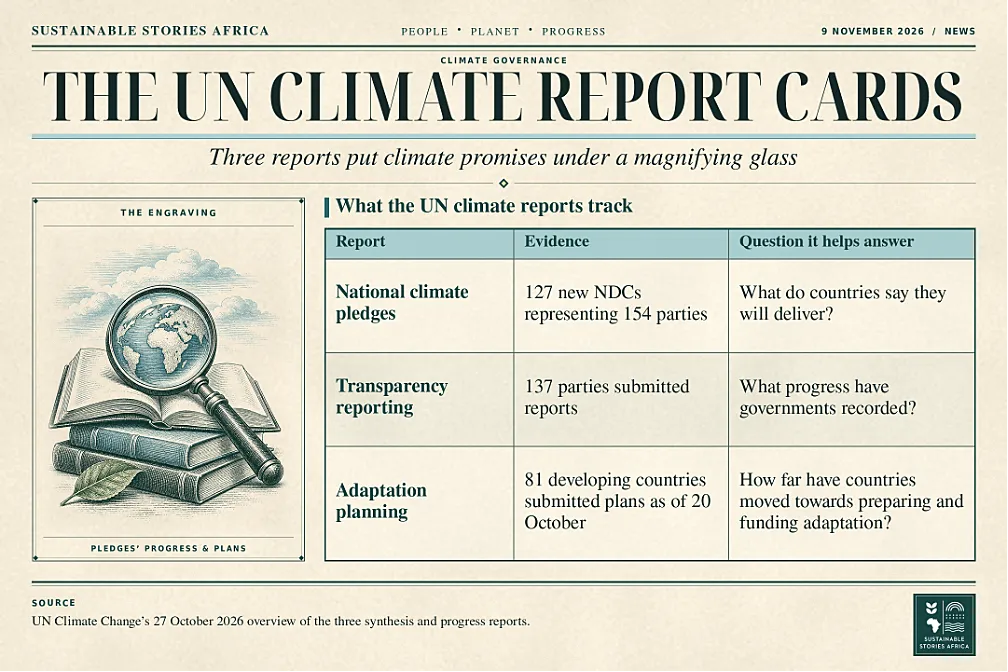
The report on nationally determined contributions, or NDCs, covers 127 new submissions representing 154 parties and around 70% of global greenhouse gas emissions.
- Nearly all parties in the report said they engage stakeholders such as local authorities, civil society and business in implementing their plans.
- The equivalent share in earlier plans was 70%.
The shift matters because decisions on electricity, transport, land and industry are often made outside environment ministries.
Biennial transparency reports provide another perspective.
- The latest synthesis covers submissions by 137 parties, representing about 85% of global emissions.
- Its implementation assessment draws on the first reporting period, 2020 – 2022.
A third report examines national adaptation plans and the obstacles governments face as they begin seeking approval and finance.
- The three sets of figures describe different populations and periods, so each answers a different accountability question.
The transparency report also says 61 parties made progress against their NDC targets in the 2020 – 2022 reporting period.
- These parties represented about 66% of global emissions in 2020.
The result describes progress against individual national targets.
- Its coverage figure is distinct from the share of emissions represented by all parties submitting reports.
Reading both together helps explain how evidence of progress in some economies can coexist with an insufficient global trajectory.
Why approval still leaves a gap
The adaptation report identifies obstacles at several stages.
- Countries need to turn priorities into project proposals, find institutions accredited to work with funding bodies, secure approval and then receive funding.
- Long processing and disbursement times can leave projects on hold after approval.
The report says 146 countries had started the national adaptation planning process by 20 October, a broader group than the developing countries that had filed completed plans.
- A flood-prone district illustrates what is at stake.
- A national plan can identify the need for drainage, early warnings and safe routes.
- Delivery requires local engineering, procurement and money to operate and maintain the infrastructure.
If a funding delay pushes construction into the rainy season, the next budget cycle may be too late for the people exposed now.
Follow climate finance through to delivery
UN Climate Change Executive Secretary Simon Stiell identified mitigation, adaptation, finance and just transitions as areas where negotiations can support implementation.
- Work alongside the talks includes electrification, methane reduction and waste.
- The practical question for each initiative is which institution will deliver it, what resources it can draw on and how to report progress.
Finance figures also need context.
- A separate UN assessment put total global climate finance at an annual average of $1.9 trillion in 2023 – 2024.
- That figure covers global public and private flows, including domestic investment
- It measures a greater pool of finance reaching developing countries
For African governments and communities, the relevant measures include affordability, the time between approval and disbursement, and whether projects meet national priorities.
- Publishing these stages would make it easier to see where approved climate action is being held.
A stronger delivery record would also show where national and local priorities line up.
- A ministry might budget for electricity upgrades that support an emissions pledge, while municipalities need reliable connections for public services.
Sectoral and by-project reporting can show which benefits reach those users and which depend on additional investment.
Path Forward – Measure progress where climate projects land
Delegations in Antalya can use the UN reports to identify which pledges depend on finance, technical support or institutional reform.
Governments and funding bodies can then publish progress from approval to disbursement and delivery.
The next reporting cycle can show whether broader climate plans are yielding lower emissions and funded adaptation in the places that need it.