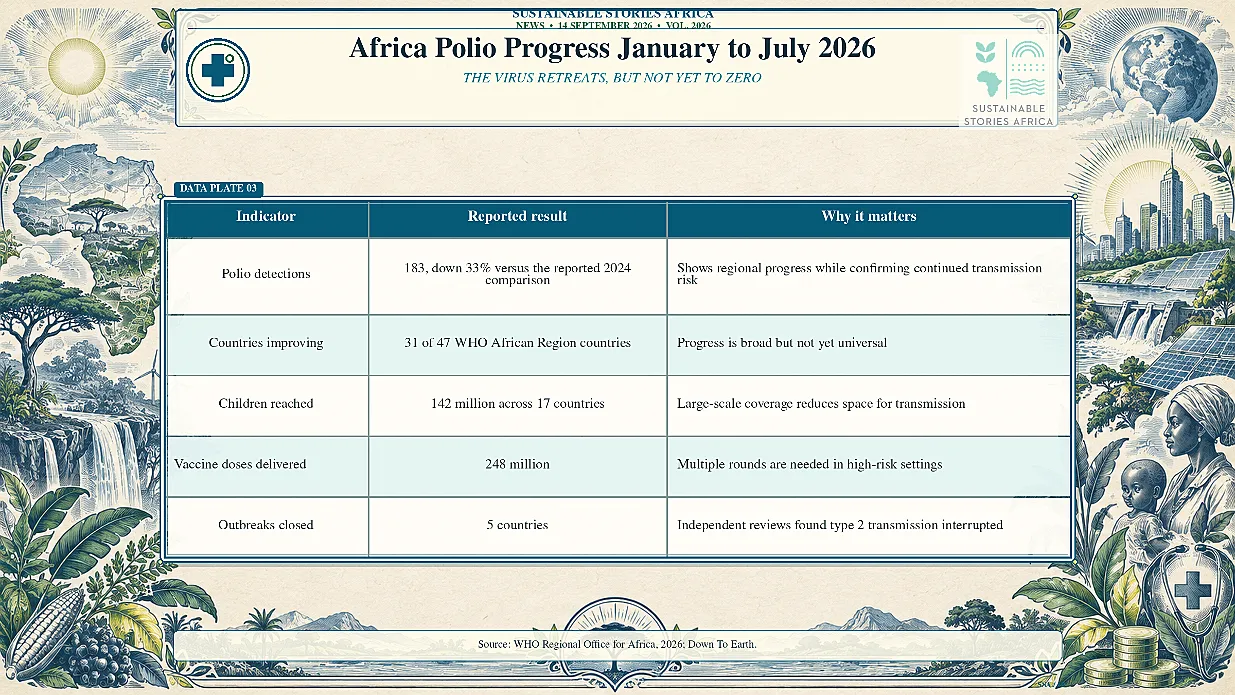
Africa recorded 183 polio detections from January to July 2026, a 33% decline compared with 2024, according to the World Health Organisation’s regional office.
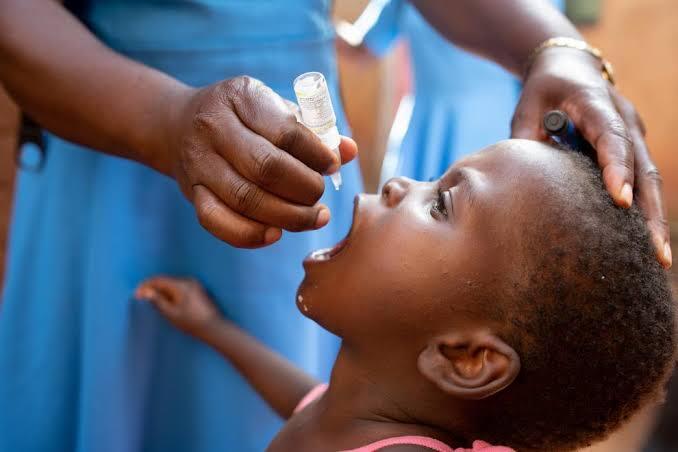
Five outbreaks were closed, and 142 million children received at least one vaccine dose across 17 countries.
The gains show the value of coordinated campaigns, but vaccine-derived poliovirus and missed children keep the continent’s final mile unfinished.
Fewer Detections Mark Measurable Continental Progress
Africa’s campaign against polio has recorded a significant gain, with 183 detections between January and July 2026, which is 33% fewer than the comparison level reported for 2024, as vaccination, surveillance and cross-border coordination reached more children and closed outbreaks in five countries.
Thirty-one of the World Health Organisation African Region’s 47 countries reported fewer detections
- Independent assessments concluded that type 2 poliovirus transmission had been interrupted in Burundi, Ghana, Guinea-Bissau, the Republic of Congo and Uganda, allowing those outbreaks to be closed.
Vaccines, Data, and Laboratories Drive Gains
The numbers reflect an operation built around scale.
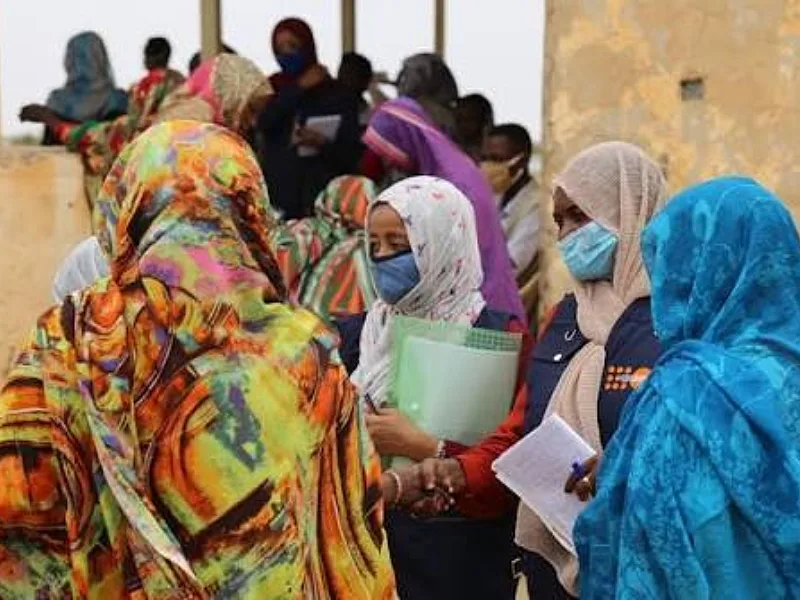
- Between January and July, 142 million children in 17 countries received at least one dose of polio vaccine, while campaigns delivered 248 million doses.
- Some campaigns also carried measles and diphtheria vaccines, vitamin A supplements, malaria services and support for neglected tropical diseases.
This integrated approach matters in communities where caregivers may face transport costs, insecurity or limited clinic access.
- Reaching a child once with several essential interventions can protect more lives while making each campaign visit more valuable to families and health systems.
Surveillance is becoming faster and more digital.
- The eSurv Companion application operates in 19 countries, while the DIGIT campaign-management system, initiated in Chad, helps convert field data into action.
- A new regional geodatabase is intended to identify missed settlements and improve targeting.
Laboratory capacity is also expanding.
- Ten laboratories have been upgraded, including the facility in Maiduguri, Nigeria, which became the African Region’s fifth Sanger-accredited laboratory.
- Faster sequencing helps public-health teams identify transmission chains and respond before a local signal becomes a wider outbreak.
Cross-border campaigns in the Lake Chad Basin further illustrate why national statistics cannot be read in isolation.
- Families, traders and pastoral communities move across borders, while viruses travel without passports.
- Shared microplans, synchronised vaccination rounds and rapid exchange of surveillance information help countries close gaps that would remain if each health ministry worked alone.
The Final Mile Remains Uneven
Africa was certified free of wild poliovirus in 2020, but that achievement did not end all polio risk.
- Most 2026 detections were circulating vaccine-derived poliovirus type 2: 133 of the 183 cases or environmental detections reported.
- In under-immunised populations, the weakened virus used in oral vaccines can circulate long enough to change and cause disease.
This is not an argument against vaccination.
- It is evidence that incomplete coverage leaves openings.
Polio has no cure and can cause irreversible paralysis, so high routine immunisation, rapid outbreak response and sensitive environmental and clinical surveillance remain essential.
WHO also flagged recent increases in types 1 and 3 as a concern.
Eradication Assets Can Strengthen Health Systems
The infrastructure built for polio can do more than stop one disease.
- Laboratories, community mobilisers, emergency teams, digital payment systems and cross-border surveillance can support broader outbreak preparedness.
- More than 650,000 health workers were paid digitally in 2026, demonstrating how campaign systems can improve speed and accountability at scale.
WHO’s Polio Transition and Sustainability Framework for 2026 - 2035 seeks to retain those assets through domestic leadership, sustainable financing, routine immunisation and integration into national health systems.
If handled well, the final push against polio can leave countries better prepared for measles, cholera and future health emergencies.
Every Child Must Remain Visible
Governments and partners should protect vaccine budgets, close coverage gaps in mobile and conflict-affected communities and keep laboratories and community networks functioning after outbreaks are declared over.
Cross-border coordination must follow the movement of people rather than stop at administrative boundaries.
Path Forward – The Final Mile Needs Sustained Vigilance
Falling detections prove that coordinated vaccination and surveillance work, but success remains reversible wherever children are repeatedly missed.
Africa’s polio-free future now depends on sustained domestic financing, trusted community engagement, rapid laboratory confirmation and health systems strong enough to reach every child before the virus does.
Culled from: https://www.downtoearth.org.in/africa/africa-moves-closer-to-polio-free-future-as-detections-fall-33-who-says