Her Horizon Fund has launched with $15.5 million committed to frontline efforts seeking to end female genital mutilation and cutting.
The initiative aims to pool $100 million as donor support for women’s rights and survivor-led work contracts.
Its design places activists and survivors closer to funding decisions, a shift that could determine whether local movements can protect hard-won gains and reach girls still at risk.
New Capital Backs Frontline Movement Leadership
A new global fund has launched with $15.5 million in disclosed commitments to support organisations working to end female genital mutilation and cutting, directing urgently needed capital toward survivor-led and community-based movements as international aid budgets shrink.
Her Horizon Fund was announced during the Justice for Girls convening in Kenya, which brought together 150 movement leaders from 36 countries.
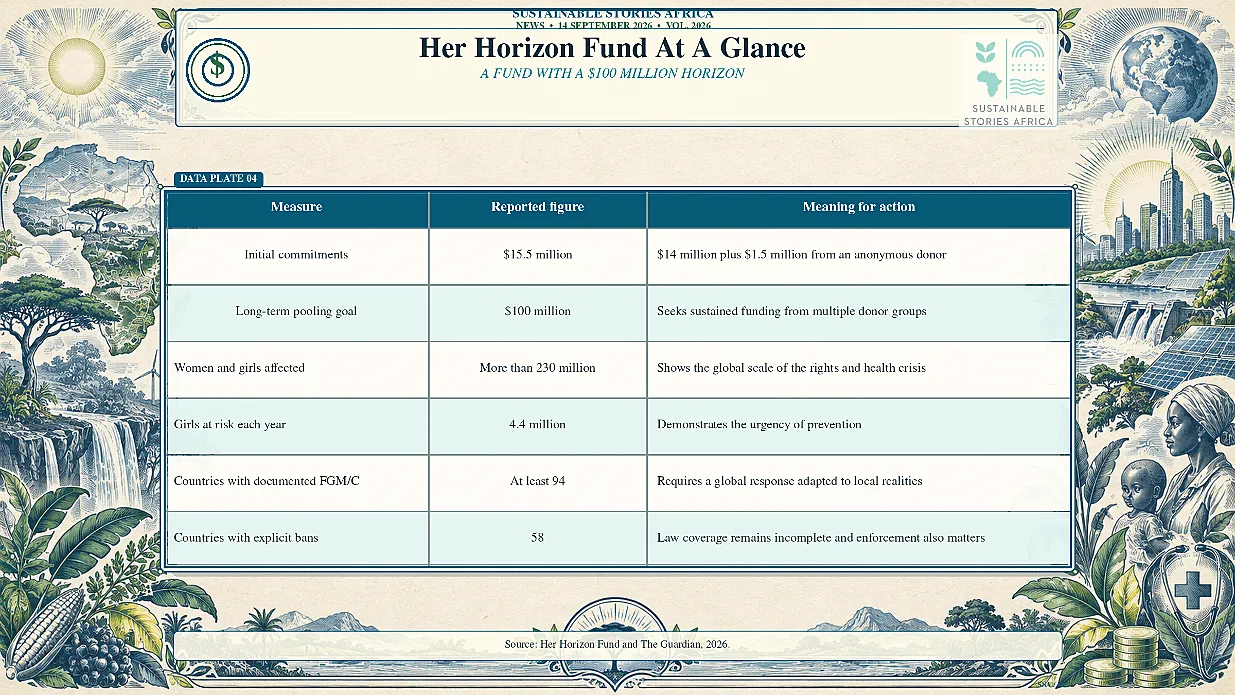
- The Wallace Global Fund committed $14 million, and an anonymous donor added $1.5 million.
The initiative, widely described as a new $15 million fund, ultimately aims to pool $100 million from philanthropic, bilateral and corporate donors.
The Funding Gap Threatens Hard-Won Gains
More than 230 million women and girls alive today have undergone FGM/C, including more than 144 million in Africa, 80 million in Asia and six million in the Middle East.
- The practice, usually carried out between infancy and age 15, can cause severe pain, bleeding, infection, childbirth complications, chronic pain and lasting psychological trauma.
However, funding is moving in the wrong direction.
- Support for the largest UN programme focused on ending FGM/C reportedly fell 45% in one year, from $29.6 million to $16.3 million.
- Frontline groups can lose trained staff, safe referral networks and community access when grants end abruptly, even where decades of organising have begun to shift attitudes and law.
The global picture is uneven.
- The practice is documented in at least 94 countries, while only 58 have laws explicitly prohibiting it, according to Her Horizon Fund.
- Legal protection is essential but cannot work alone where enforcement is weak, services are scarce, or families fear social exclusion for abandoning the practice.
Survivors Will Shape Funding Decisions
The fund’s distinguishing promise is that survivors, activists and frontline leaders will help determine its strategy, governance and grantmaking.
- Flexible and sustained support can allow local organisations to plan beyond short project cycles, strengthen survivor care, engage faith and traditional leaders, use media effectively and respond when laws face political challenge.
That model reflects a practical truth: lasting change cannot be imported as a campaign slogan.
- Community organisers understand the language, relationships and risks surrounding the practice.
- Their proximity helps them pair rights-based advocacy with protection, healthcare, education and locally credible alternatives.
Longer funding cycles also allow organisations to measure social change that rarely follows a quarterly timetable.
- They can build trust, train local advocates, accompany survivors and return to difficult conversations after public attention has moved elsewhere.
- That continuity is often the difference between a temporary campaign and an institution communities can rely on.
Evidence of progress already exists.
- Her Horizon Fund cites falling prevalence in Burkina Faso, Liberia and Kenya, and notes that coordinated advocacy helped defeat a 2024 attempt to repeal The Gambia’s 2015 anti-FGM/C law.
Those gains show what persistent movements can achieve, but they also show why progress must be defended.
Investment Can Protect Girls And Institutions
Well-directed funding can keep survivor services open, support better enforcement, build evidence and help organisations challenge backlash without abandoning long-term community dialogue.
- It can also strengthen institutions that work across health, education, justice and child protection rather than isolating FGM/C as a single-sector problem.
Grantmaking is expected to begin in 2027, with the fund housed at Women Win in the Netherlands.
Donors will need to make the governance promise visible in practice by publishing where funds go, how frontline groups influence decisions and whether multi-year support reaches underfunded geographies.
Donors Must Fund Trust And Time
Governments should enforce protective laws and finance survivor-centred services, while donors should commit flexible, multi-year resources directly to credible local organisations.
Businesses and philanthropies can join the pooled fund, but money should complement public responsibility rather than replace it.
Path Forward – Frontline Leadership Must Shape Lasting Change
Her Horizon Fund can protect momentum by giving survivor-led organisations the time, flexibility and influence required to work safely within communities.
Reaching the $100 million ambition should now be matched by transparent grantmaking, stronger national services and measurable progress toward the global promise to end FGM/C.
Culled from: https://www.downtoearth.org.in/africa/new-15-million-fund-to-support-ending-female-genital-mutilation-launched