Standard Chartered has launched a free platform that helps suppliers measure emissions, build decarbonisation plans and report progress.
The voluntary tool targets a persistent weak point in corporate climate strategies: smaller businesses that lack specialist staff, reliable data or affordable systems.
For suppliers across Africa and other emerging markets, access is useful, but finance and locally relevant implementation support will determine whether measurement becomes real emissions reduction.
Bank Brings Smaller Suppliers Into Transition
Standard Chartered has opened a free supplier decarbonisation platform designed to help businesses in its supply chain measure greenhouse-gas emissions, set practical action plans and communicate progress, widening access to tools that many smaller firms cannot easily build or buy.
Supply Net Zero by Standard Chartered is voluntary and open to the bank’s suppliers.
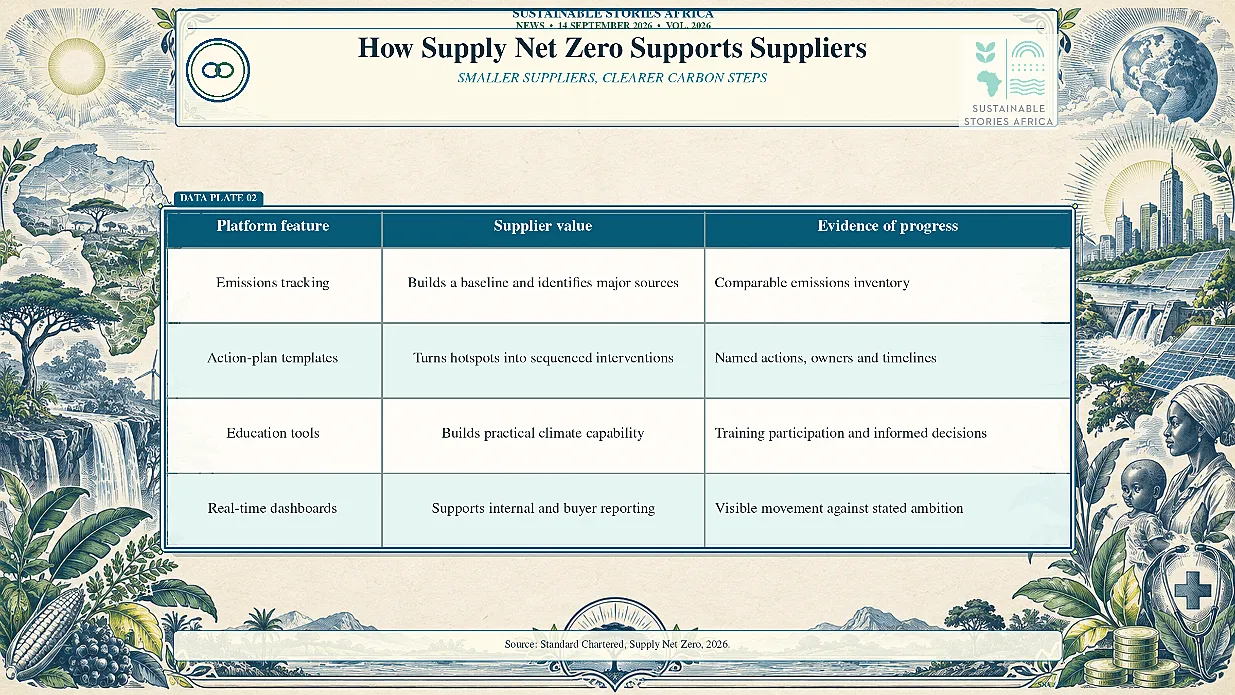
- It brings emissions tracking, templated decarbonisation strategies, education sessions and real-time dashboards into one platform.
- Suppliers may withdraw, and participation does not affect contracts or negotiations, according to the bank.
Scope Three Pressure Reaches Smaller Businesses
The launch addresses a difficult part of corporate climate accounting.
- A large company can reduce energy use in its offices, yet much of its footprint may sit outside its walls: in purchased goods, transport, technology, professional services and other value-chain activities.
- Those indirect emissions are commonly reported under Scope 3.
Standard Chartered says supply and value-chain emissions in Scope 3 categories 1 to 14 represent 0.86% of its disclosed emissions profile, compared with 99.13% from clients and 0.01% from its own operations.
- The smaller share is still operationally important because procurement choices connect the bank to thousands of businesses and can spread climate capability across markets.
The platform lets a supplier to collect and analyse emissions data, choose a plan suited to its ambition, learn through webinars and show progress to internal or external stakeholders.
- That sequence matters for a small logistics company, facilities provider or technology vendor that receives a carbon questionnaire but has no sustainability team to answer it.
Free Access Lowers One Important Barrier
Cost and complexity often keep small and medium-sized enterprises outside net-zero programmes.
- A shared platform can lower the first barrier by giving them a common starting point and a reporting trail.
- Better data may also help suppliers find energy savings, anticipate buyer requirements and demonstrate readiness for sustainability-linked opportunities.
The bank has paired the tool with a wider supply-chain ambition.
- It plans to direct at least half of total supplier spend toward suppliers with science-based emissions-reduction targets.
- Standard Chartered reported that 54% of supplier spend met that description in 2025 and that upstream Scope 3 emissions had fallen 20% during the year.
Those procurement signals can create a commercial reason for suppliers to act, not simply a reporting obligation.
- Clear expectations, consistent measurement rules and sufficient lead time can help businesses invest with confidence, and fragmented questionnaires from different buyers can drain the same limited capacity the platform is meant to build.
However, software alone cannot replace capital.
- A supplier may identify inefficient cooling, diesel dependence or costly transport routes and still lack affordable finance to change equipment.
In African markets, unreliable grids, limited renewable-energy instruments and uneven data systems can make a technically sound action plan harder to execute.
Local Support Can Convert Data Into Cuts
The platform will have greater impact if measurement is paired with procurement incentives, credible technical support and financing that reflects local operating conditions.
- Buyers should also avoid shifting the entire reporting burden onto small vendors whose emissions are partly shaped by infrastructure they do not control.
African suppliers can use the tool to establish baselines, identify the largest sources, assign responsibility and build phased plans.
Banks and large buyers can strengthen the model by recognising verified progress, offering longer contracting visibility and linking viable upgrades to green lending or blended finance.
Supply Chains Need Capability And Capital
Standard Chartered and other large purchasers should publish participation and outcomes, distinguish measured reductions from estimates, and make support accessible across languages and markets.
Suppliers should start with material emissions sources and resist turning the exercise into a paperwork-only response.
Path Forward – Measurement Must Unlock Practical Supplier Action
The platform creates a useful entry point, especially for smaller suppliers facing new climate-data requests without specialist resources.
Its lasting value will depend on whether training, procurement decisions and affordable finance help those businesses move from dashboards to cleaner equipment, lower energy costs and measurable emissions cuts.
Culled from: Standard Chartered Launches Supply Net Zero Platform for Smaller Suppliers