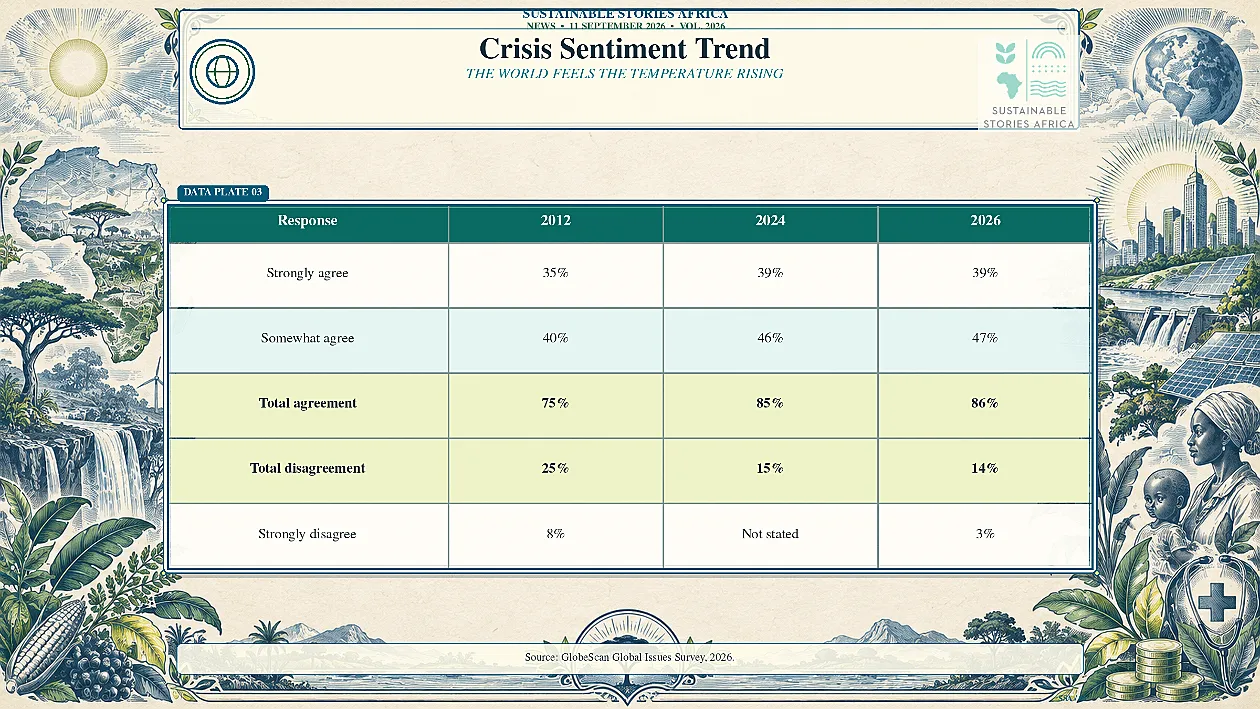
86% of people across 15 consistently tracked markets now believe today's challenges amount to humanity's biggest crisis.
GlobeScan says agreement has risen 11 percentage points since 2012 while disagreement fell from 25% to 14%.
The high level has barely changed since 2024, suggesting that public anxiety is becoming a durable test of institutional credibility rather than a passing reaction.
Crisis Becomes the Public Baseline
A large majority of people across 15 global markets now see the world's social, environmental and economic challenges as a bigger crisis than humanity has faced before, according to GlobeScan research published on September 10.
- Total agreement reached 86% in 2026, up from 75% in 2012.
The change reflects doubt as much as rising alarm.
- 39% strongly agreed in 2026, compared with 35% in 2012.
- Total disagreement level dropped from 25% to 14%.
- Strong disagreement dropped from 8% to 3% over the same period.
Concern Stabilises at Historic Levels
The survey suggests the mood has plateaued at a high level.
- Agreement moved from 85% in 2024 to 86% in 2026, a small change that GlobeScan interprets as evidence of a settled outlook rather than a response to one event.
- People are absorbing overlapping pressures, including conflict, extreme weather, economic insecurity and social division, into a single judgement about the period they inhabit.
GlobeScan surveyed 32,102 respondents online across 33 markets in July and August 2026.
- Its long-term comparison uses the 15 markets tracked consistently since 2012, including Kenya and Nigeria alongside Brazil, China, India, Indonesia, major European economies, Türkiye, Canada, Australia and the United States.
High Anxiety Changes Trust Standards
For governments and companies, a durable sense of crisis raises the standard for credibility.
- Long-dated commitments can sound detached when households experience immediate pressure from food prices, jobs, insecurity or environmental damage.
- Near-term progress, transparent trade-offs and evidence of delivery may therefore carry more weight than distant targets.
The finding does not mean every audience supports the same policy.
- A shared sense of urgency can produce competing demands and can be exploited by alarmist messaging.
- Institutions need to explain what they can change, what will take time and how costs and benefits will be distributed. Communication without delivery risks deepening distrust.
Africa Needs Visible Local Results
Including Kenya and Nigeria in the tracked group matters for African decision-makers.
- Climate shocks, debt pressures and gaps in public services can make global crises intensely local.
- Responses should connect national or corporate sustainability goals to outcomes people can recognise, such as reliable electricity, safer water, resilient food systems and decent work.
Leaders should publish measurable milestones, report setbacks and invite independent scrutiny.
Civil society and the media can help translate broad commitments into questions about budgets, timelines and affected communities.
The purpose is not to amplify fear, but to match the public's understanding of the stakes with credible evidence and practical agency.
The plateau since 2024 is important.
- It suggests that leaders cannot wait for anxiety to fade before acting, and that communications campaigns alone will not reset public sentiment.
- Institutions should track whether specific interventions improve security, affordability or environmental conditions, then show the results in language people use.
- Repeated surveys can test whether credible delivery reduces helplessness even if concern about the wider world remains high.
Path Forward – Turns Anxiety Into Agency
Institutions should replace vague reassurance with near-term targets, public progress data and honest explanations of difficult choices.
Policies will earn trust when people can connect ambitious promises to safer communities, fairer opportunities and services that work.
Culled from: The Global Sense of Crisis Has Deepened Significantly Since 2012