UNEP has published an air-pollution glossary showing how technical language shapes what governments measure, regulate and leave unaddressed.
About 43% of countries lack a legal definition of air pollution, while many definitions cover outdoor air alone.
Clearer standards could help African cities connect household fuels, traffic, industry, waste burning and dust to enforceable public-health action.
Pollution language determines who gets protected
The United Nations Environment Programme has released a glossary of essential air-pollution terms that highlights a basic governance problem:
- Countries cannot regulate consistently when laws define the same hazard differently or fail to define it at all.
UNEP says around 43% of countries have no legal definition of air pollution.
Around half of national definitions address only ambient, or outdoor, pollution.
- That can leave indoor exposure outside the main policy frame, even though charcoal, wood, kerosene and other solid fuels used in poorly ventilated spaces can generate dangerous household pollution.
The gap is especially relevant across African communities where clean cooking access remains uneven.
Small particles create very large dangers
The glossary distinguishes the pollutants people hear about during smog episodes from the sources and chemical processes that create them.
- Primary pollutants enter the air directly from factories, vehicles, stoves or fires.
- Secondary pollutants form through reactions involving precursor chemicals, sunlight, water vapour and other gases.
Particulate matter is among the most harmful.
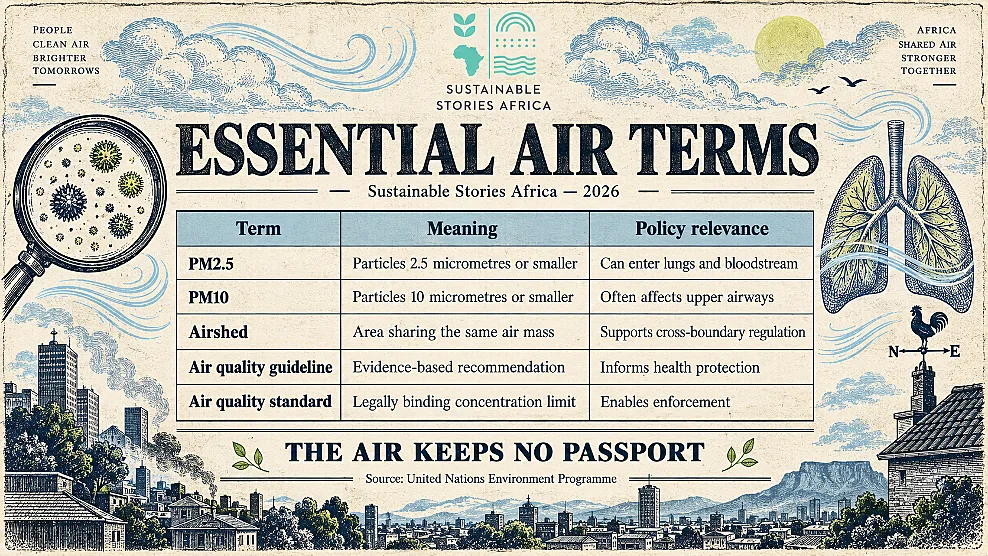
- PM2.5 measures 2.5 micrometres or less, about 30 times smaller than the width of a human hair, and can travel deep into the lungs and bloodstream.
- PM10 often lodges in the nose, throat and upper airways.
- Ground-level ozone, nitrogen dioxide, sulphur dioxide and carbon monoxide create additional respiratory and cardiovascular risks.
Shared definitions support smarter public policy
A common vocabulary would improve source attribution and enforcement.
- Airsheds, the geographic areas affected by the same air mass, often cross municipal or national borders.
- Monitoring by administrative boundary alone can therefore miss pollution that moves with wind, including smoke and dust from distant sources.
The distinction between a guideline and a standard also matters.
- A guideline is an evidence-based recommendation, such as those issued by the World Health Organisation.
- A standard is a legally binding concentration limit.
Governments need both credible health benchmarks and laws assigning responsibility to major sources.
Cities need measurement people can trust
UNEP estimates that human-caused outdoor fine-particle pollution and ground-level ozone caused 6.4 million premature deaths in 2025.
- However, only 12% of cities have air-quality measures that meet WHO standards.
The scale of harm calls for wider monitoring networks, public reporting and enforcement tied to transport, energy, waste and industrial policy.
African cities can also reduce exposure through clean cooking, safer public transport, controls on open waste burning and dust management.
- Air-quality indices should explain local health risks clearly because countries may interpret identical pollutant readings differently.
Action on short-lived climate pollutants can produce additional benefits.
- Methane, black carbon, hydrofluorocarbons and tropospheric ozone can warm the planet far more strongly per unit emitted than carbon dioxide in the near term.
- UNEP says these pollutants drive about 45% of global warming.
Cutting them can therefore improve health and slow warming while longer-term carbon dioxide reductions continue.
Health agencies should pair citywide readings with neighbourhood and household evidence.
- A single average can hide exposure around busy roads, industrial sites, dumps, generators and cooking spaces.
- Schools, clinics and outdoor workers need alerts they can use.
- Regulators need data precise enough to direct inspections and investment.
Path Forward – Clear rules can make breathing safer
Governments should define indoor and outdoor pollution in law, adopt health-based standards and publish comparable, timely measurements.
Regulators should then trace pollution to its sources and enforce emission limits.
Clear language is the starting point; cleaner fuels, transport, industry and waste systems must deliver the health benefit.
Culled from: Air pollution glossary: Key terms for understanding the air we breathe